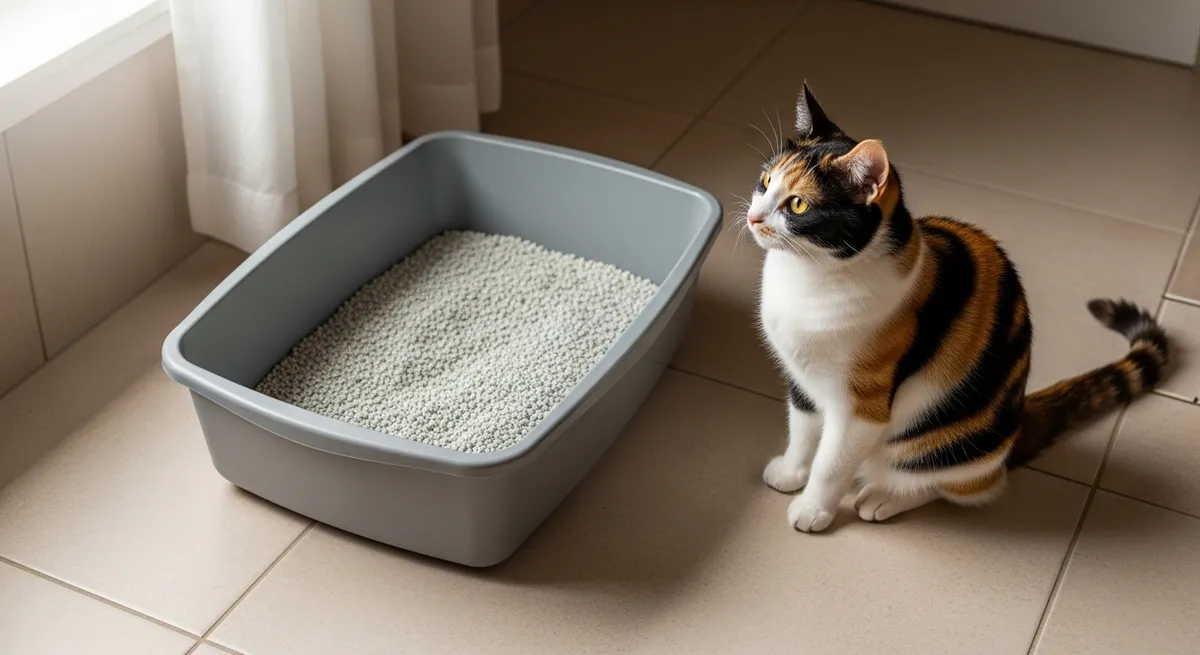
A cat who is suddenly peeing outside the litter box is sending a very specific signal. They are not "being spiteful," they are not "punishing you," and they did not "forget how to use the box." Cats are creatures of habit who use the box reliably for years, and a sudden change in that pattern is almost always one of two things: a medical problem or an environmental problem. Both are addressable, and both deserve immediate attention.
Step 1: Rule out medical first — this is not optional
A cat who has been box-trained their whole life and suddenly starts urinating outside the box should see a vet within days, not weeks. The most common medical causes are:
- Urinary tract infection (UTI). Painful urination causes the cat to associate the box with the pain, and they start eliminating in cooler, smoother locations (tile floors, sinks, bathtubs).
- Feline lower urinary tract disease (FLUTD) / idiopathic cystitis. Inflammation of the bladder, often stress-triggered. Common and treatable.
- Urinary crystals or stones. Can cause partial obstruction in either sex; complete obstruction in male cats is a life-threatening emergency.
- Kidney disease. Increased urine volume overwhelms the box capacity; urine often appears more dilute.
- Diabetes. Polyuria (excessive urination) leads to box overflow and accidents.
- Arthritis. Senior cats stop using boxes that require a high step-in. Common and underdiagnosed.
Emergency warning sign: A male cat repeatedly squatting and straining without producing urine, vocalizing, or showing distress is a medical emergency. Urinary blockages can be fatal within 24 hours. Get to an emergency vet immediately.
The vet visit will typically include a urinalysis, possibly a urine culture, and blood work for senior cats. The VetPetz medical-record integration helps the vet spot trends if your cat has had similar issues before — and preserves the workup for any future vet who sees the cat.
Step 2: If medical is ruled out, audit the environment
Cats are remarkably consistent about what they need from a litter box. The behavior community has converged on the "litter box rules" — and a cat who is missing the box is almost always telling you that one of these is being violated.
- One box per cat plus one extra. One cat means two boxes. Two cats means three. Below this threshold, ambush behavior, queuing, and avoidance start.
- Box size: 1.5 times the cat's body length (nose to base of tail). Most retail boxes are too small. A clear plastic storage tote with a low entry cut into one side is the standard upgrade.
- Litter type: unscented, fine-grained clumping clay is the consensus preference in cat litter studies. Pine pellets, crystal litter, and scented litters are tolerated by some cats and rejected by many.
- Litter depth: 2 to 3 inches.
- Location: low-traffic, away from food and water, away from loud appliances or ambush points. Cats will not eliminate near where they eat, and they avoid boxes where they can be cornered by another pet.
- No covered boxes if you can help it. Hooded boxes trap odor (the cat notices long before you do) and create ambush points in multi-cat homes.
- Cleaning: scoop at least daily; scoop twice a day for sensitive cats. Full litter change weekly. Wash with mild dish soap monthly (no bleach, no scented cleaners).
The full litter-box setup guide is in how do I train my cat to use the litter box?.
Step 3: Identify the specific trigger
Beyond the litter-box rules themselves, ask:
- Has anything changed? New cat, new dog, new baby, new partner, new furniture, recent move, new schedule, a contractor in the house, a window-visible outdoor cat, a renovation. Cats notice changes you don't.
- Has the litter brand or box model changed? Switch back if you can identify the change.
- Has the box location changed? Cats prefer the box where they originally accepted it.
- Is another pet ambushing the box? Common in multi-cat homes; the bullied cat starts eliminating elsewhere.
- Is the cat marking, not eliminating? Vertical urine spray on walls, doors, or vertical surfaces is marking, not litter-box failure. Marking is most common in unaltered males and in cats stressed by another cat (indoor or visible outside the window). Spaying and neutering reduce marking dramatically.
Step 4: Clean accidents properly
A spot that smells like cat urine to the cat — even if it does not to you — re-cues the cat to use the same spot. Standard cleaners do not break down the proteins in cat urine. You need an enzymatic cleaner specifically formulated for pet urine (Anti-Icky-Poo, Nature's Miracle, Rocco & Roxie). Saturate the area, let it sit per the bottle's instructions, and air-dry. Do not use ammonia-based cleaners — ammonia is a component of urine and the smell actively re-cues the cat to that spot.
Step 5: What NOT to do
- Do not rub the cat's nose in it. This is a myth from a much earlier era of pet care. It teaches the cat that you are unsafe and increases stress, which makes inappropriate elimination worse.
- Do not yell or chase. Same outcome.
- Do not shock collars or "deterrent sprays." There is no aversive intervention with positive evidence for litter-box issues in cats.
- Do not assume "the cat is mad at me." Cats do not pee outside the box for revenge. They pee outside the box because something is wrong — medically, environmentally, or socially.
When to see a behavior consultant
If medical is ruled out, the litter setup is correct, the obvious environmental triggers have been addressed, and the problem persists for more than 4 to 6 weeks: see a feline-specific behavior consultant (IAABC-CCBC) or a veterinary behaviorist (DACVB). Persistent inappropriate elimination is one of the most common reasons cats are surrendered to shelters, and most cases are resolvable with the right structured plan and (where indicated) medication.
Where PawMates Pro fits in
Cats arriving through PawMates Pro shelters carry their litter-box history on the pet profile — what litter they were using, whether they had any prior accidents, and any medical workup that has been done. That information travels into your adopter dashboard so the first 30 days at home can start with the cat's preferred setup rather than a guess. Medical history — prior cystitis, urinary issues, current medications — flows through the VetPetz integration.
For the foundational litter-box setup guide, see how do I train my cat to use the litter box?. For other cat behavior content, see why do cats knead?, why do cats sleep so much?, and why cats hide after adoption. More adopter resources on the PawMates blog.