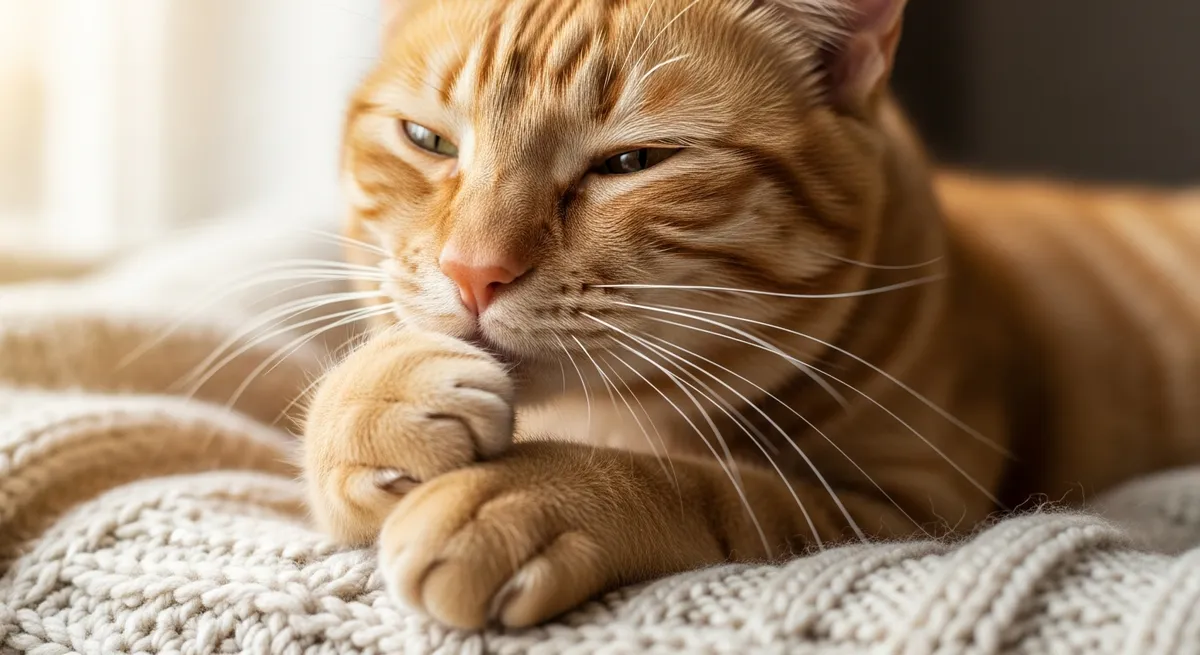
If you have ever sat down with a cat and watched them push their front paws rhythmically into a blanket, your lap, or another cat — that is kneading, sometimes called "making biscuits" or "happy paws." It is one of the most universally recognized cat behaviors, and one of the most affectionate signals cats send. Here is what is actually happening, why cats do it, and when it is worth paying attention to.
The leading explanation: kitten holdover behavior
The most widely accepted explanation is that kneading is a behavior carried over from kittenhood. Nursing kittens push rhythmically against the mother cat's mammary area to stimulate milk flow — a coordinated paw motion that is hardwired from birth. The motion becomes associated with the calm, fed, safe state of nursing, and many cats continue performing it into adulthood whenever they feel similarly content.
This is why kneading is almost always paired with other contentment signals: purring, slow blinks, half-closed eyes, drooling, and a fully relaxed body. The cat is in their happiest emotional state.
Why some cats knead more than others
Kneading frequency varies widely. Generally:
- Cats weaned early (before 8 to 10 weeks) often knead more as adults, possibly because the nursing-state association was interrupted.
- Cats raised by attentive mothers with full nursing periods sometimes knead less; they completed the nursing experience and don't need to recreate it.
- Highly affectionate or "people-oriented" cats tend to knead more on humans.
- Older cats sometimes knead more as they slow down and spend more time in pure-comfort states.
There is wide individual variation. A cat who never kneads is not unhappy; a cat who kneads constantly is not insecure.
Other plausible reasons cats knead
Researchers have proposed several non-exclusive explanations that probably all contribute:
- Scent marking. Cats have scent glands in their paw pads. Kneading deposits their scent onto whatever they are kneading — your sweater, the couch, another cat. They are claiming the spot.
- Nest preparation. Wild cats knead grass and leaves to flatten a comfortable resting area. The motion may be vestigial nest-building.
- Stretching. Kneading involves extending and retracting the toes and paws, which stretches the small muscles of the front legs. Cats often stretch as part of waking up or settling in.
- Pleasure / self-soothing. The motion releases endorphins and is calming for the cat — similar to how some people fidget or stim.
When kneading involves claws (and what to do)
Many cats knead with claws extended, which is the universal cat-owner complaint. A few practical responses:
- Keep your cat's nails trimmed. A monthly nail trim makes kneading much more comfortable for everyone. Most cats tolerate trims well with practice; treats during and after help.
- Put a soft layer between the cat and you. A thick blanket or a folded throw on your lap prevents the claws from snagging.
- Don't punish or push them off. Kneading is one of the most affectionate signals your cat sends. Pushing them away — especially if it becomes consistent — can damage the relationship.
- Provide an alternative kneading surface. A folded fleece blanket on the couch or a cat bed often becomes a preferred kneading spot.
When to pay attention
Kneading is almost always a positive, healthy behavior. A few rare situations to watch for:
- Sudden stop in a previously frequent kneader. If a cat who used to knead daily stops for more than a week, paired with other changes (decreased appetite, hiding, lethargy), it is worth a vet visit. Loss of comfort behaviors can be an early sign of pain or illness.
- Compulsive, frantic kneading paired with vocalization. This can be a sign of stress, hyperthyroidism, or in unspayed females, going into heat. A vet check is warranted.
- Kneading paired with painful expression. Senior cats with arthritis sometimes knead less and look uncomfortable when they do. Pain management changes this dramatically.
Where PawMates Pro fits in
Cats arriving through PawMates Pro shelters carry their behavioral observations on the pet profile — including positive social behaviors like kneading, lap-sitting, and purring — so adopters know going in whether the cat is a confident "people cat" or a more reserved companion. For cats who came through foster care, the foster's notes on social style are part of the same record.
For more cat behavior content, see why do cats sleep so much?, why do cats hate water?, why do cats love catnip so much?, and why cats hide after adoption. For more adopter resources, browse the PawMates blog.