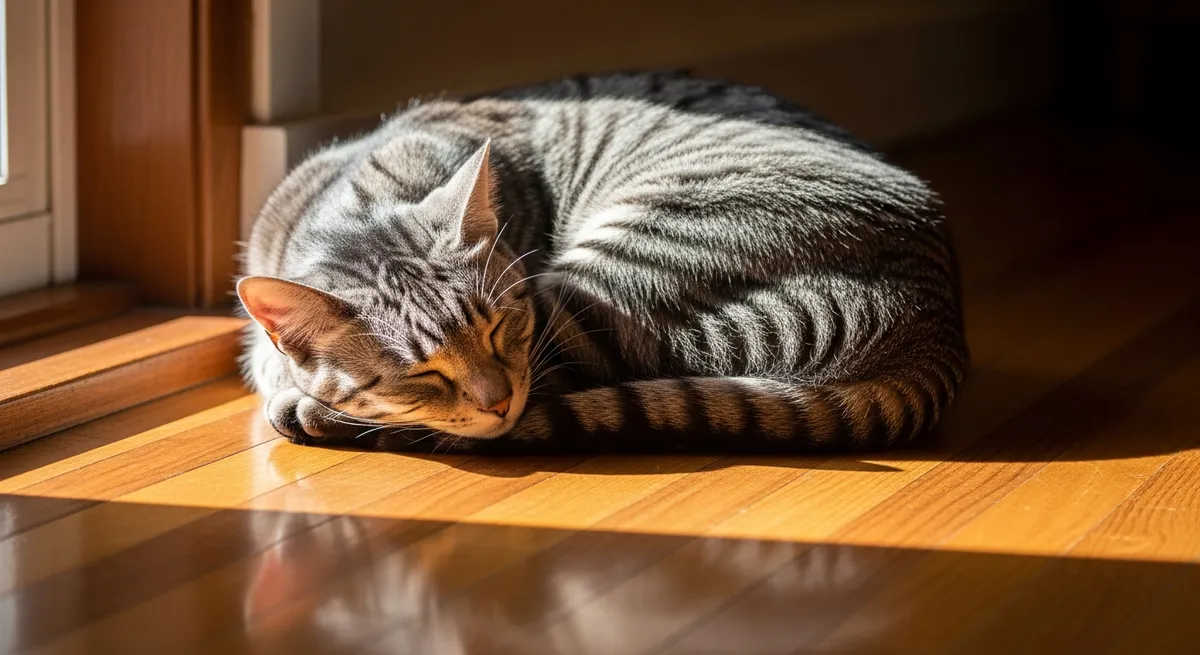
Adult cats sleep an average of 12 to 16 hours a day. Kittens and senior cats often sleep 18 to 20 hours. If your cat looks like they are sleeping their entire life away, that is normal — and there are good evolutionary, physiological, and behavioral reasons for it.
The short biology answer
Cats are obligate carnivores who evolved as solo hunters of small, fast prey — birds, rodents, lizards. Hunting is metabolically expensive and unsuccessful most of the time. The wild ancestors of the domestic cat (and most modern wild small cats) cycle between brief, intense bursts of hunting effort and long stretches of rest to conserve energy for the next hunt. Domestic cats inherited this physiology fully intact, and the pattern persists even in housecats whose food appears in a bowl twice a day.
This is why a cat will sleep 14 hours, then suddenly tear through the house at 2 a.m. chasing a phantom mouse: the prey-burst circuitry is the original use case for the resting hours.
Polyphasic sleep, not a single long night
Cats are polyphasic sleepers — they take many short sleep periods rather than one long one. A typical day looks like:
- Several long deep-sleep stretches (1 to 2 hours each).
- Many short cat naps (15 to 30 minutes).
- Brief wakeful periods of grooming, eating, or "staring at nothing" between naps.
About 70 to 75 percent of a cat's sleep is light sleep — the cat is dozing but easily roused. The remaining 25 to 30 percent is deep REM sleep, where the cat is fully unconscious, often twitching or moving paws as they dream.
This is why a sleeping cat can be napping one second and across the room chasing a ribbon the next. The light-sleep majority is a feature, not a bug.
Crepuscular, not nocturnal
A common misconception is that cats are nocturnal. They are actually crepuscular — most active at dawn and dusk. This matches the activity windows of their natural prey (small rodents and birds) and is why your cat is often most playful around 5 a.m. and 8 p.m. The hours in between, including most of midday and most of the night, are sleep hours.
If your cat's "zoomies" wake you up consistently, the evidence-based fix is more interactive play in the evening — 10 to 15 minutes of wand-toy hunting before your bedtime — followed by a meal. A hunted-fed-groomed cat sleeps. A bored cat zoomies at 4 a.m.
How sleep changes across the lifespan
- Newborn kittens (0 to 4 weeks): Sleep 90 percent of the day. Sleep is essential for growth.
- Kittens (1 to 6 months): Sleep 18 to 20 hours, in alternating bouts of intense play and hard collapse.
- Young adults (1 to 7 years): 12 to 16 hours, with the polyphasic pattern fully established.
- Mature adults (7 to 12 years): 14 to 18 hours, with longer naps and shorter active periods.
- Seniors (12+): 18 to 20 hours, often with stiffer joints and reduced play stamina.
Increases in sleep that come gradually with age are normal. Sudden changes are worth a vet visit.
When cat sleep is worth paying attention to
Most cat sleep is healthy. A few situations where you should be alert:
- Sudden increase in sleep paired with reduced appetite or hiding. This is one of the earliest signs of illness in cats. Cats hide pain and discomfort well; behavior changes are often the first symptom.
- Sudden decrease in sleep, restlessness, vocalizing at night. In senior cats, this can be a sign of cognitive dysfunction (feline dementia) or hyperthyroidism — both are treatable.
- Difficulty getting comfortable, repositioning often, painful posture. Senior cats with arthritis often sleep poorly. Vet-prescribed pain management transforms quality of life.
- Sleeping in unusual locations. A cat hiding to sleep in a closet or under furniture for the first time may be unwell. Stress, pain, and illness often drive cats to seek isolated rest spots.
- Excessive grooming or under-grooming during waking hours. Both are stress signals.
If you are seeing any of these patterns, a vet check is the right next step. The lifetime pet medical record makes it easier for the vet to spot trends across visits.
Where PawMates Pro fits in
Cats arriving through PawMates Pro shelters often have sleep and energy patterns documented as part of the behavioral evaluation — "dozes most of the day in office," "active at feeding times," "shy, sleeps in covered bed." That gives adopters a real baseline for what to expect at home. For senior cats especially, the VetPetz medical-record integration preserves the full health history so age-related sleep changes can be evaluated against the long-term picture rather than guessed at.
For more cat content, see why do cats knead?, why do cats hate water?, and why cats hide after adoption. More adopter resources on the PawMates blog.