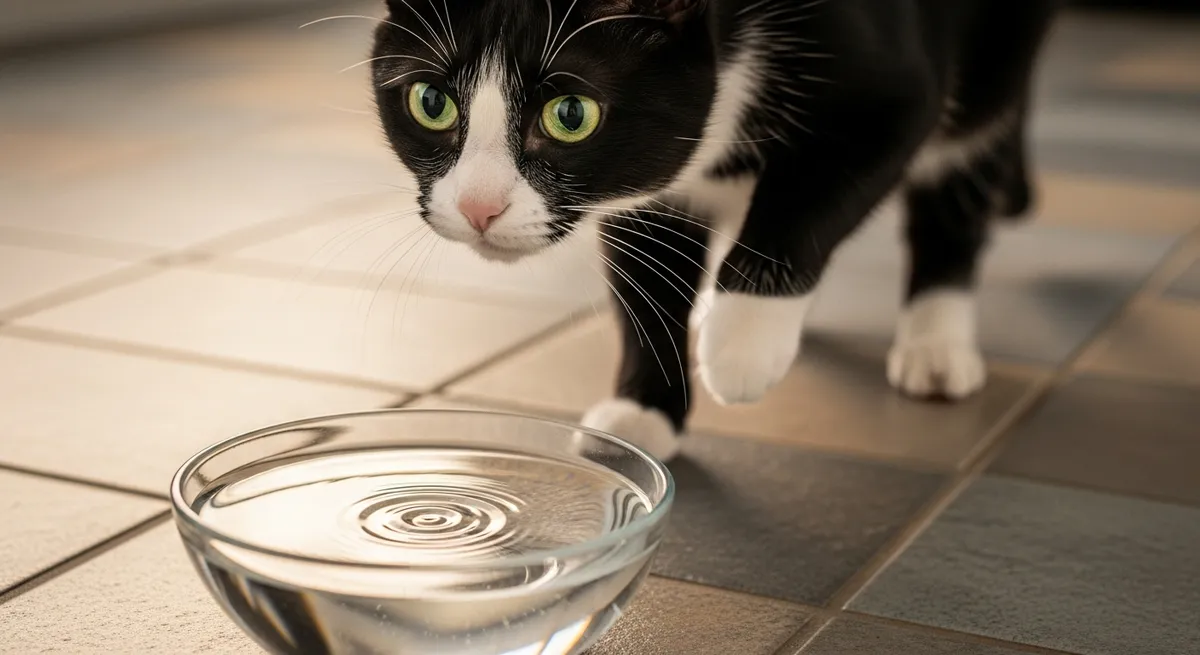
"Cats hate water" is one of the most repeated facts in pet ownership, and like many widely-repeated facts, it is partially true and significantly oversimplified. Most domestic cats do strongly prefer to stay dry, but the reasons are more interesting than the stereotype suggests, and a meaningful number of cats actually enjoy water under the right conditions.
The leading explanation: evolutionary heritage
The domestic cat's ancestor, the African wildcat (Felis lybica), evolved in the deserts and dry savannahs of the Near East and North Africa. The natural environment was hot, arid, and almost entirely water-free. Wildcats had no evolutionary reason to swim, fish, or interact with bodies of water — and several reasons to avoid them.
A few specific consequences of this evolutionary background:
- No habituation to water as a normal environment. Many mammals (dogs, otters, raccoons) evolved alongside water and developed neutral or positive associations. Cats did not.
- No selection pressure to swim well. Cats can swim — they are surprisingly capable when they have to be — but they did not evolve specialized swimming adaptations.
- No fishing as a primary food source. Domestic cats hunt small terrestrial prey: rodents, birds, lizards. Their hunting circuitry has nothing to do with water.
When a creature whose entire evolutionary history was dry encounters a bath, the natural response is "this is unfamiliar and possibly dangerous." That instinct is pre-loaded.
Coat physics matters more than people realize
A cat's coat is dense, layered, and engineered to retain body heat — not to repel water. When wet, cat fur:
- Becomes extremely heavy. A wet cat carries a meaningful percentage of their body weight in absorbed water. They feel encumbered and slow.
- Loses insulation. Wet fur conducts heat away from the body rapidly. Cats are easily chilled when wet.
- Takes a long time to dry. Hours, depending on the cat's coat density.
Compare this to a Labrador, whose double coat is partly water-resistant and partly designed to shed water quickly. The Lab gets out of the lake, shakes once, and is mostly dry in 20 minutes. The cat is uncomfortable for hours.
This physical discomfort is the bigger reason adult cats avoid water. It is not a phobia; it is a sensible response to a body that doesn't handle wetness well.
The cats that DO like water
Several breeds have a documented affinity for water:
- Turkish Van — sometimes called the "swimming cat," historically swims in lakes near Lake Van in Turkey.
- Maine Coon — water-tolerant coat, often plays with water bowls and faucets.
- Bengal — high-energy hybrid breed, frequently enthusiastic about water play.
- Abyssinian — curious explorers, often interested in water.
- Norwegian Forest Cat — water-resistant double coat.
- Savannah — also water-tolerant.
Even within these breeds, individual variation is huge. Plenty of Maine Coons hate baths.
Why your cat is fascinated by the dripping faucet
A common observation: the same cat who runs from the bathtub will sit and stare at a dripping faucet for an hour. This is not contradictory. Moving water at a small scale triggers prey-detection circuitry — the motion, sound, and unpredictability mimic a small live target. The cat is not interested in the water as water; they are interested in the movement.
This is also why many cats prefer drinking from running fountains or faucets over still water bowls. Moving water reads as fresher (because in the wild, moving water is fresher) and activates the natural drinking response. If your cat is a poor water drinker, a pet drinking fountain often dramatically improves intake — which matters for kidney health in aging cats.
When a cat needs a bath (and how to do it without trauma)
Most cats never need a bath in their entire life. Self-grooming handles 99 percent of cat hygiene. The exceptions:
- A long-haired cat with a soiled or matted coat that grooming cannot fix.
- A cat exposed to a toxic substance (paint, oil, motor fluid, certain cleaners).
- A cat with severe flea infestation or skin condition where the vet has prescribed a medicated bath.
- Senior cats who have lost the flexibility to groom themselves.
For cats who do need bathing, a few practical guidelines:
- Use a sink or small basin, not a full bathtub. Less space feels safer.
- Place a non-slip mat on the bottom — cats panic on slippery surfaces.
- Use lukewarm water — about body temperature.
- Use a cat-formulated shampoo (never human shampoo or dog shampoo).
- Pour water gently from a cup; avoid spray nozzles, which startle.
- Wash and rinse efficiently, then towel-dry as much as possible.
- Skip the hair dryer for most cats — the noise is more stressful than the wet.
- A high-value treat afterward helps the next bath go smoother.
Where PawMates Pro fits in
Cats arriving through PawMates Pro shelters often have grooming and handling notes on the pet profile — "tolerates nail trims," "needs muzzle for vet visits," "hates being picked up." That information travels into your adopter dashboard so your first vet visit and your first home grooming session can start with the right expectations. The medical history flows through the VetPetz integration, so any prescribed medicated baths or skin treatments stay in the record.
For more cat content, see why do cats knead?, why do cats sleep so much?, why is my cat peeing outside the litter box?, and why do cats love catnip so much?. More adopter resources on the PawMates blog.