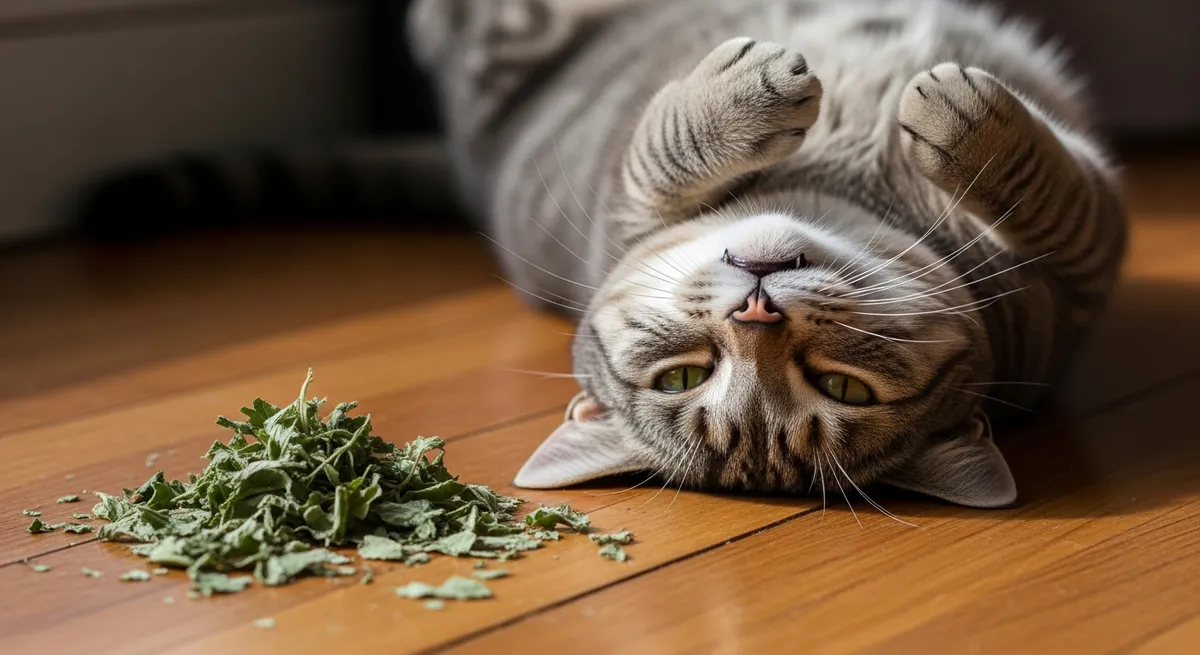
If you have ever sprinkled dried catnip on the floor and watched a normally dignified cat collapse onto their back, kick the air, drool, and roll around like they have lost their mind, you have witnessed one of the most reliable behavioral responses in the animal kingdom. Catnip works on roughly two-thirds of domestic cats, the response is hardwired, and the reason behind it is finally well understood.
The active ingredient: nepetalactone
Catnip is a member of the mint family (Nepeta cataria). Its leaves and stems contain a compound called nepetalactone, which is released when the plant is bruised, crushed, or chewed. When a cat sniffs nepetalactone, it binds to receptors in the cat's olfactory epithelium and triggers a cascade of responses in the brain.
The response cycle typically lasts 5 to 15 minutes, after which the cat enters a refractory period of about 30 minutes to 2 hours during which they will not respond to catnip again. After the refractory period, the response can be triggered again.
What the response actually looks like
Cats respond to catnip in different but recognizable ways:
- Rolling and rubbing. Many cats throw themselves onto the catnip and roll, rub their cheeks and chin into it, and twist around enthusiastically.
- Drooling. Some cats drool noticeably while in the catnip response.
- Vocalizing. Mews, chirps, occasional growls or yowls.
- Hyperactivity. Sudden bursts of running, jumping, batting at imaginary things.
- Aggression. A small percentage of cats become reactive or swatty during a catnip response. This is normal but worth noting in multi-cat homes.
- Mellow euphoria. Some cats, instead of getting excited, become extremely relaxed and dreamy.
- Eating it. Cats will sometimes eat catnip, which produces a different (more calming) effect than smelling it. Eating it is safe in normal quantities.
The response style is genetic; the same cat will respond the same way every time.
Why some cats don't respond
About 30 to 40 percent of cats do not respond to catnip at all. Sensitivity is determined by an autosomal dominant gene — a cat either has the response gene or doesn't. Things to know:
- Kittens under about 6 months don't respond. The receptor sensitivity develops with age.
- Senior cats may respond less intensely as receptor sensitivity declines.
- No response is not a defect. A cat with no catnip response is perfectly normal and may respond to alternatives (see below).
Catnip alternatives for non-responders
Several other plants produce catnip-like responses, often via different active compounds:
- Silver vine (matatabi). Particularly common in Asia. Studies suggest silver vine triggers a response in many cats who do not respond to catnip — often a stronger response, in fact. Two active compounds: actinidine and dihydroactinidiolide. Worth trying for any cat who is unresponsive to catnip.
- Tatarian honeysuckle. Wood and sawdust from this plant trigger catnip-like responses in many cats.
- Valerian root. Triggers a similar response in many cats; smells genuinely terrible to humans.
A 2017 study in BMC Veterinary Research found that combining catnip, silver vine, valerian, and Tatarian honeysuckle elicited a response in roughly 95 percent of cats — far more than catnip alone.
Is catnip safe?
Yes. Catnip is non-toxic, non-addictive, and has no known long-term health effects on cats. The euphoric response is brief and self-limiting. Cats cannot overdose in any practical sense; they self-regulate, and the receptor desensitization during the refractory period prevents continuous use even when the catnip is freely available.
A few practical notes:
- Cats can occasionally vomit if they eat large quantities. This is benign and self-resolving.
- A small percentage of cats become aggressive during the response. In multi-cat homes, supervise the first few catnip experiences.
- Catnip stays potent for about 6 to 12 months in storage. After that the nepetalactone degrades and the response weakens.
- Fresh catnip is generally more potent than dried.
Why nepetalactone evolved this response
The leading evolutionary hypothesis: nepetalactone closely mimics certain feline pheromones, which is why it activates the cat brain's reward and play circuits. There is also a competing hypothesis that catnip's mosquito-repellent properties drove the rolling and rubbing behavior — cats coat themselves in nepetalactone, which then repels biting insects. Both could be true at the same time. The behavior is so reliable across the cat family (lions, tigers, leopards, and many small wild cats also respond) that the underlying mechanism almost certainly predates domestication by a long time.
Practical uses for catnip in pet ownership
- Toy enrichment. Stuffing toys with fresh catnip dramatically increases play interest.
- Scratching post acceptance. Sprinkling catnip on a new scratching post gets most catnip-responsive cats interested faster.
- Carrier acclimation. A pinch of catnip in the cat carrier before a vet visit helps some cats associate the carrier with positive experiences.
- New space introduction. A small catnip session in a newly accessible room or new piece of furniture helps cats claim the space as their own.
- Senior enrichment. For older cats whose play drive has declined, a catnip session a few times a week is a low-effort enrichment win.
Where PawMates Pro fits in
Cats arriving through PawMates Pro shelters often have play and enrichment notes captured during behavioral evaluation — including which enrichment items they responded to in the kennel. That information travels into your adopter dashboard, so you can stock up on the right toys, the right treats, and the right enrichment style for the specific cat you are bringing home. For cats who came through foster care, the foster's notes on what worked at home are part of the same record.
For more cat content, see why do cats knead?, why do cats sleep so much?, why do cats hate water?, and why is my cat peeing outside the litter box?. More adopter resources on the PawMates blog.