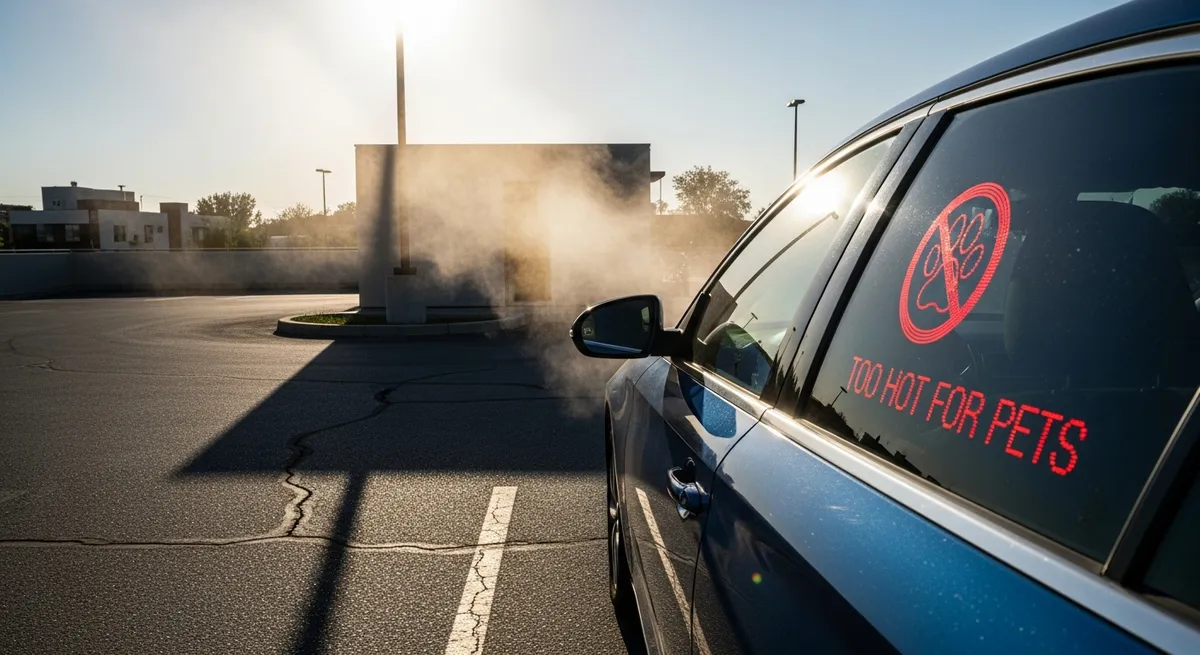
It is 72 degrees out — a beautiful, mild summer morning. You pull into the grocery store, glance at your dog dozing in the back seat, and tell yourself what every loving owner has told themselves: "I'll only be five minutes." You crack the windows two inches and walk inside. By the time you are back at your car, the inside of that "mild" vehicle has climbed past 90 degrees, and your dog is panting hard, drooling, and frightened. On a hotter day, those same minutes can be fatal.
This is the most dangerous misunderstanding in pet ownership, because it almost never comes from neglect. It comes from good people underestimating physics. Let's walk through exactly what happens inside a parked car, minute by minute, why the "cracked window" trick does almost nothing, and what to do if you ever see an animal trapped in a hot vehicle.
What actually happens in 10 minutes
A parked car acts like a greenhouse. Sunlight pours through the glass, heats every interior surface, and that heat has nowhere to go. The temperature does not climb gradually — it spikes fast and early. According to widely cited veterinary and safety research, here is the rough timeline on a 75-degree day:
1. After 10 minutes: the interior reaches roughly 94 degrees.
2. After 20 minutes: it climbs to about 99 degrees.
3. After 30 minutes: it passes 104 degrees.
4. After 60 minutes: it can exceed 120 degrees.
The most dangerous jump happens in those first 10 minutes — about 70 percent of the total temperature rise occurs early. So "I'll only be a minute" is exactly the window in which the cabin becomes deadly. And it does not need to be a scorching day: cars have reached lethal temperatures with outside readings in the low 70s.
Why cracking the windows is a myth
People genuinely believe an inch or two of open window keeps a car safe. It does not. Studies comparing closed cars to cars with windows cracked found only a few degrees of difference — nowhere near enough to matter. There is no meaningful cross-breeze in a parked car, and the air that does move is hot air. Parking in the shade helps a little, but shade shifts as the sun moves, and the greenhouse effect still wins. The only safe version of "leaving the dog in the car" is one where the climate control is actively running and monitored, which is the entire reason features like Tesla's Dog Mode exist.
Why dogs and cats overheat so much faster than we do
Humans sweat across our entire skin surface, which is an extraordinarily efficient cooling system. Dogs and cats cannot. They cool themselves almost entirely by panting and through a tiny amount of sweating in their paw pads. In a hot, humid, enclosed car, panting barely works — they are just recirculating hot air. Certain animals are at even higher risk:
- Flat-faced (brachycephalic) breeds like Bulldogs, Pugs, Boxers, Boston Terriers, and Persian cats, whose short airways make panting far less effective.
- Puppies, senior pets, and overweight animals, who regulate temperature poorly.
- Pets with heart or respiratory conditions or thick double coats.
For these animals, the timeline above is even more compressed. By the time a dog is in visible distress, internal organ damage may already be underway.
What to do if you see a pet trapped in a hot car
This is the moment that matters. If you spot an animal in distress in a parked car, act — but act smart:
1. Assess the animal. Heavy panting, drooling, glazed eyes, vomiting, staggering, or collapse are emergency signs. A calm, alert pet in a running car with climate on is a different situation.
2. Note the car — make, model, color, and license plate.
3. Find the owner. If you are near a store, ask staff to page the vehicle's owner immediately.
4. Call for help. Phone local animal control or the non-emergency police line, or 911 if the animal is in clear, acute distress. Stay until help arrives.
5. Know the law before you break a window. A number of states have "Good Samaritan" laws that protect people who rescue animals from hot cars — but the rules, and the steps you must take first (like calling authorities), vary widely. Breaking a window can carry legal risk where no such protection exists. This is not legal advice; learn the law where you live so you can act decisively and lawfully.
The simplest rule: just leave them home
For the overwhelming majority of summer errands, the safest choice is the easiest one — leave your pet at home with water and air conditioning. If your dog truly must come along, plan for a person to stay with them, or use a vehicle and technology designed to keep the cabin actively cooled and monitored. The convenience of bringing your dog into the parking lot is never worth the risk.
A hot car is only one of summer's hazards. The same heat that bakes a cabin also superheats sidewalks and can push a dog into heat stroke on an ordinary walk — learn the asphalt paw test and the warning signs of heat stroke so you can spot trouble early. For the bigger picture, our guide to protecting your pet during heat waves ties it all together.
Where connected pet care fits in
If a heat emergency ever does happen, the vet who treats your pet works far better with their full history in front of them — current medications, known heart or airway conditions, vaccination status, and more. When you adopt from a shelter running PawMates Pro, your pet comes with a real profile instead of a thin paper folder, and that information lives in a lifetime medical record that travels with the animal and can be shared, with your consent, to whatever clinic is treating them. The microchip is just the doorbell a stranger or shelter rings to look your pet up; the record itself is tied to a durable PawMates Pet ID, so the history stays attached even if your contact details change.
Frequently asked questions
How hot does a car get if it's only 70 degrees outside?
Surprisingly hot. On a 70-degree day a parked car can reach the mid-90s within 10 minutes and exceed 110 degrees within an hour. The greenhouse effect does not need a heat wave to become dangerous.
Does cracking the windows make it safe to leave my dog?
No. Research shows cracked windows lower the interior temperature by only a few degrees — nowhere near enough to keep a pet safe. There is no real airflow in a parked car.
Is it illegal to leave a dog in a hot car?
In many places, yes, and a growing number of states also have laws protecting people who rescue animals from hot vehicles. The specifics vary, so check the laws where you live and travel — this article is not legal advice.
What should I do if I see a dog in a hot car?
Note the vehicle, try to locate the owner (have a store page them), and call animal control or police right away. Stay with the animal until help arrives, and understand your local "Good Samaritan" rules before considering breaking a window.
Related reading
- How hot is too hot for dog walks? The asphalt test — protect your dog's paws and prevent overheating on walks.
- Heat stroke in dogs and cats: warning signs — recognize the early and emergency signs fast.
- Protecting your pet during heat waves — a complete plan for the hottest stretches of summer.
For more adoption and pet-care guides, browse the PawMates adopter blog.