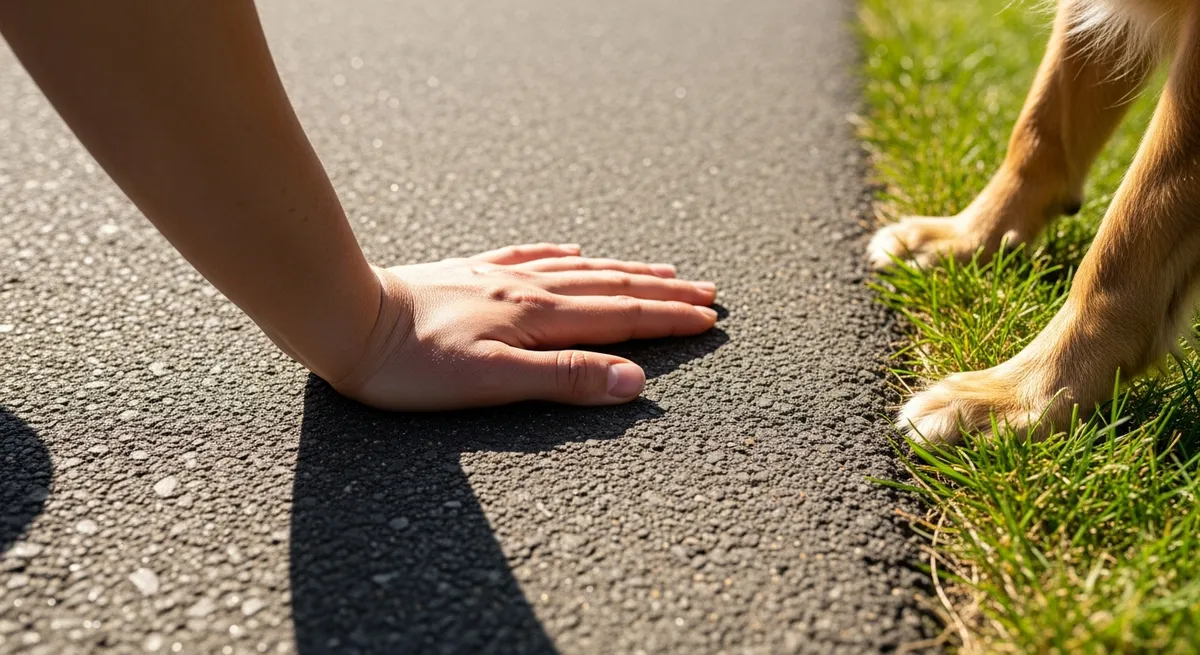
Your dog is bouncing by the door, leash in mouth, ready for a walk on a gorgeous summer afternoon. The air feels pleasant. But the sidewalk and street your dog is about to trot across may be 40 to 60 degrees hotter than the air — hot enough to blister their paw pads within seconds. There is a simple, five-second test that can prevent a painful, avoidable injury, and every dog owner should make it a reflex before any warm-weather walk.
The 7-second test that protects your dog's paws
Here is the rule, and it could not be easier: press the back of your hand flat against the pavement and hold it there for seven seconds. If you cannot keep it there comfortably for the full seven seconds, it is too hot for your dog's paws. Full stop. If it is too hot for your skin, it is too hot for theirs.
This works because air temperature lies. On an 87-degree day, asphalt in direct sun can reach 140 degrees — hot enough to cause burns. Dark surfaces absorb and hold heat long after the sun's peak, which is why a sidewalk at 6 p.m. can still be dangerous even as the air cools. Your hand is a far better gauge than the thermometer or the weather app.
What hot pavement actually does to paws
Paw pads are tough, but they are still skin, and they burn. Pavement burns range from mild redness to serious, blistering wounds that can become infected and take weeks to heal. Watch for these signs that your dog's pads have been hurt:
- Limping or refusing to walk.
- Licking or chewing at the feet.
- Pads that look darker than usual, red, or are visibly blistered.
- Missing patches of pad surface.
- Whimpering or pulling a foot away when you touch it.
If you see blistering, raw skin, or your dog is in obvious pain, call your veterinarian. In the meantime, get them off the hot surface, gently cool the paws with cool (not ice-cold) water, and keep them from licking the area.
Best times to walk in summer
The fix for hot-pavement risk is mostly about timing. The ground is coolest before the sun has had hours to bake it and after it has had time to release heat:
1. Early morning — ideally before 8 or 9 a.m., is the safest window of the day.
2. Late evening — after the sun is fully down and surfaces have cooled. Remember that asphalt holds heat, so right at sunset may still be too warm; use the hand test.
3. Avoid the danger zone — roughly 10 a.m. to 5 p.m. on hot days, when both air and pavement peak.
Beyond timing, change your route. Grass, dirt trails, and shaded paths stay dramatically cooler than asphalt and concrete. If your only option is a sidewalk at a warm hour, keep the outing short and stick to shade.
Booties, hydration, and other smart protections
If your dog tolerates them, dog booties are excellent paw protection for hot surfaces (and they double for winter ice and rough trails). Introduce them slowly indoors with treats, since most dogs need time to get used to the feeling. Paw waxes offer a lighter layer of protection but far less than boots on truly hot pavement.
A few more warm-weather walk habits:
- Bring water for any walk longer than a few minutes, and offer it frequently.
- Watch for overheating, not just paws. Heavy panting, lagging behind, seeking shade, or wanting to lie down are signs to stop, cool down, and head home. These can be early signals of something more serious — know the warning signs of heat stroke.
- Be extra cautious with at-risk dogs — flat-faced breeds, seniors, puppies, overweight dogs, and those with thick coats overheat faster and should do shorter, cooler walks.
- Never leave the walk and then leave your dog in the car to run "one quick errand" — see what happens to a pet in a hot car.
Make the hand test a habit
The beauty of the asphalt test is that it takes seven seconds and requires nothing but your own hand. Build it into your routine the way you grab the leash and poop bags. On a borderline day, that quick check is the difference between a happy walk and a trip to the vet. When in doubt, walk on grass, walk early, or skip the walk and play indoors instead.
For a season-long game plan, see our protecting your pet during heat waves guide and the printable summer pet safety checklist.
Where connected pet care fits in
Recurring paw injuries, breed-specific heat sensitivity, and chronic conditions are exactly the kind of details a vet wants on record. When you adopt from a shelter running PawMates Pro, your dog arrives with a real profile, and ongoing notes live in a lifetime medical record that travels with them and can be shared, with your consent, with any clinic. The microchip number is only the lookup key a shelter or stranger uses to find your pet; the medical history itself is tied to a durable PawMates Pet ID, so it stays attached for life.
Frequently asked questions
How hot is too hot to walk a dog?
Use the 7-second hand test: if you cannot hold the back of your hand on the pavement for seven seconds, it is too hot for your dog's paws. As a rough guide, be very cautious once air temperatures reach the mid-80s and above, especially in direct sun.
How hot can asphalt really get?
On an 87-degree day, asphalt in full sun can reach about 140 degrees — well into the range that causes paw burns. Air temperature consistently underestimates surface temperature.
What time of day is safest to walk a dog in summer?
Early morning is best, followed by late evening after surfaces have cooled. Avoid roughly 10 a.m. to 5 p.m. on hot days.
Do dog booties actually work?
Yes. Properly fitted booties protect pads from hot pavement (and cold and rough terrain). Introduce them gradually indoors with treats so your dog gets comfortable wearing them.
Related reading
- Never leave your pet in a hot car — how fast a parked car becomes deadly.
- Heat stroke in dogs and cats: warning signs — what to watch for and when to rush to the ER.
- Summer pet safety checklist — a quick, scannable list to keep your pet safe all season.
For more adoption and pet-care guides, browse the PawMates adopter blog.