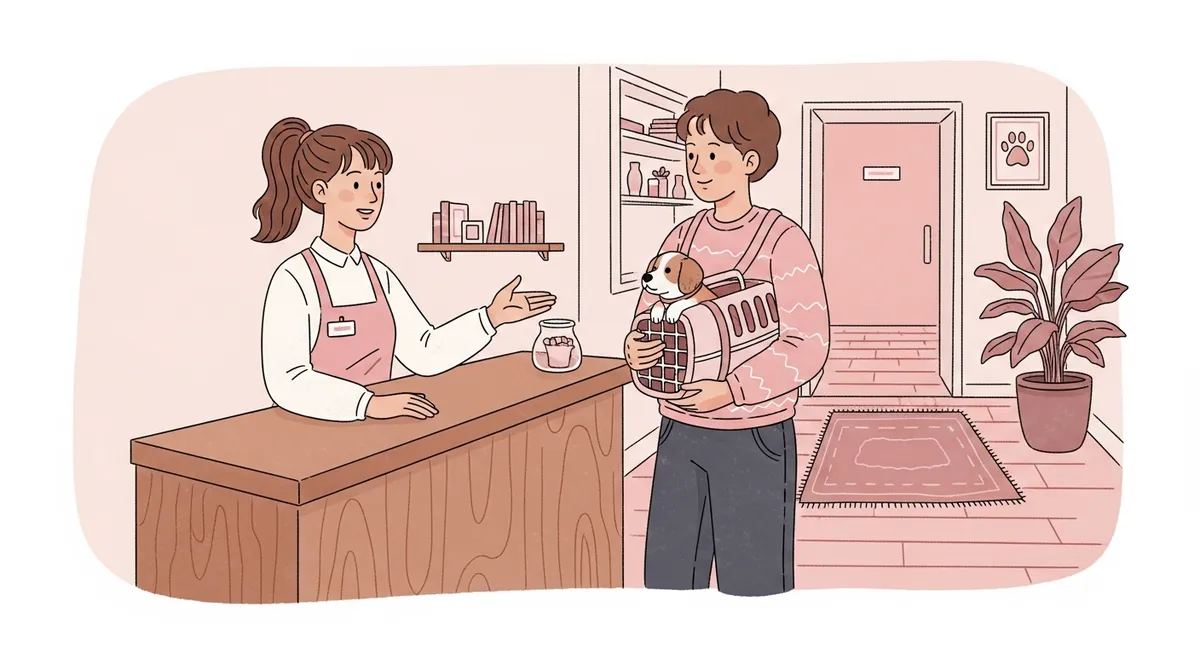
It's 4:55 on a Friday. Your front desk staffer is wrapping up the day. The door swings open and someone walks in carrying a small dog in a hastily packed carrier, or a cardboard box of kittens, or a leash with a very confused senior dog on the end of it. They have no appointment. They look exhausted, embarrassed, or angry — sometimes all three. They want to leave the animal with you and go.
This is one of the most consequential conversations in a shelter, and it's the one staff are least likely to be trained for. Done well, it preserves the relationship, opens the door to surrender prevention, and keeps the animal out of a worse outcome. Done poorly — usually with a flat "we don't take walk-ins" — it ends with the pet tied to the parking-lot fence after closing, or dumped at a gas station two miles away.
The framework: Acknowledge → Reframe → Action
Almost every difficult shelter conversation follows the same emotional shape: someone is in distress, embarrassed, frustrated, or scared, and they're presenting that as a demand or a complaint. The most reliable response pattern is three steps:
1. Acknowledge the emotion before the content. ("I can hear how stressful this is.") This buys you 30 seconds of reduced reactivity.
2. Reframe the situation so you and they are on the same side. ("Let's see what we can do together.")
3. Action — give them a concrete next step, even a small one. ("Here's what I can do today.")
The script below is just this pattern applied to one specific scenario. Once your team internalizes the pattern, they can handle the conversations you never wrote a script for.
The script
> *"I can see you're trying to do the right thing for this pet, and I appreciate that. We're not able to take a walk-in surrender today, but I don't want you to leave without a plan. Can we sit down for ten minutes and look at your options together? There are usually more than people realize."*
If the surrenderer agrees to sit down, walk them through your full menu of alternatives: temporary boarding partners, pet food banks, behavior helplines, low-cost vet referrals, rehoming through your shelter's network, and the soonest available intake slot. If a true emergency surrender is the only path forward (medical crisis, eviction, domestic violence, owner death), schedule the same-day or next-day intake and document why.
Why each piece works
- *"I can see you're trying to do the right thing"* — this disarms the embarrassment that 90% of surrenderers walk in with. Embarrassed people make bad decisions; acknowledged people make better ones.
- *"We're not able to take a walk-in surrender today"* — direct, no waffling. Clarity is kindness.
- *"I don't want you to leave without a plan"* — this is the reframe. You go from gatekeeper to ally in one sentence.
- *"There are usually more options than people realize"* — invites curiosity. People who think they have one option will leave; people who think they have five will stay and talk.
Common variations
- The "I'm leaving him here either way" surrenderer. Skip straight to the intake slot conversation, document the abandonment risk, and prioritize getting the animal safely into your care over winning the policy debate. The relationship matters less than the outcome.
- The third-party surrenderer ("my mom died, this is her dog"). Same script, but explicitly add: *"I'm sorry for your loss. We'll take it from here as soon as we can — let's figure out the gentlest path."* Grief plus shelter logistics is its own beast; lead with the grief.
- The repeat surrenderer. Same script. Do not let staff rant about "this is the third dog they've brought in." The conversation in front of you is the only conversation you control.
What not to say
- "We're full." (Even if true. It sounds like a brush-off, and it doesn't give them anywhere to go.)
- "Why didn't you call ahead?" (Punitive. Solves nothing.)
- "Did you try the other shelter?" (Without a name and number. Useless.)
- Any sentence starting with "Well, you should have…"
Training drill
At your next team huddle, role-play this scenario for 15 minutes. One person plays the surrenderer (give them a backstory: "My landlord just told me dogs aren't allowed and I have to be out by Sunday"). One person plays the staffer. Run the script once cold, then debrief: where did the conversation get stuck? Which line of the script did the most work? Rotate roles. Five minutes of awkwardness in training prevents an animal in the parking lot.
Related reading
- Surrender Prevention Programs: Alternatives Your Shelter Should Offer — the full menu of alternatives this script points to
- How Shelters Should Handle Bite History Disclosures at Surrender — the conversation that follows when a surrenderer mentions a bite
More scripts in this series
- Script: How to Handle a Walk-In Owner Surrender
- Script: How to Handle an Adoption Return Call
- Script: How to Deliver an Adoption Denial
- Script: How to Disclose a Dog's Bite History to an Adopter
- Script: How to Tell an Applicant They're the Runner-Up
- Script: How to Handle a "Found Litter" Phone Call
- Script: How to Talk to Someone Who Found a Stray
- Script: How to Answer the Euthanasia Question in Public
- Script: How to Handle a Restricted Donation Request