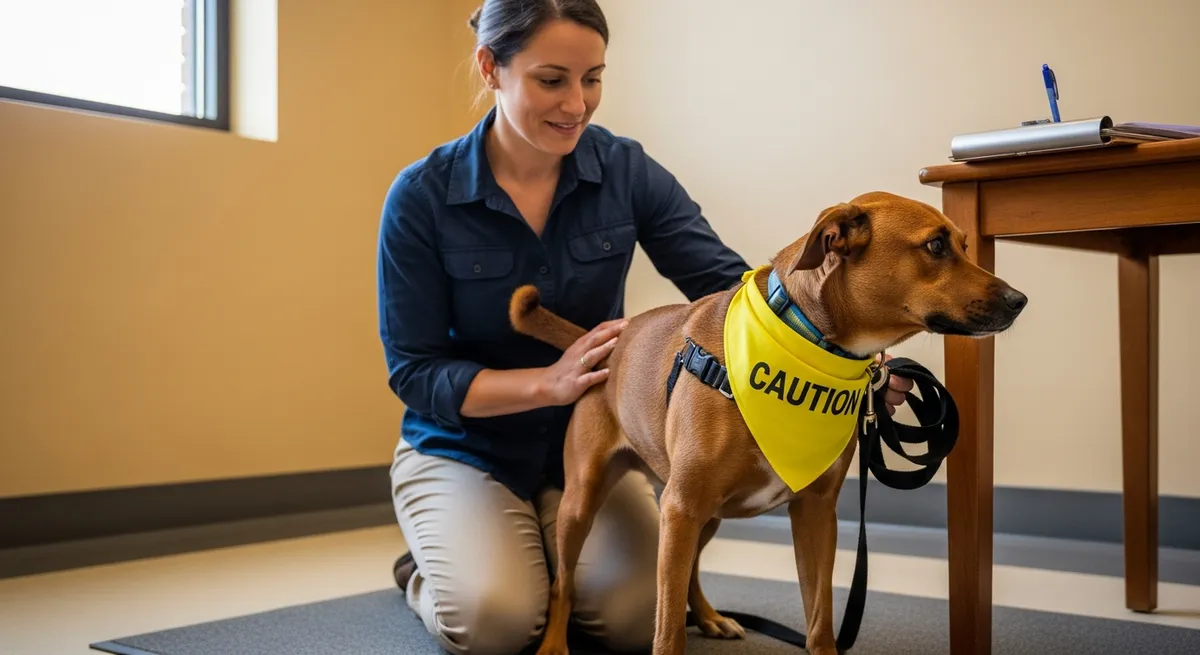
Bite history is one of the most underreported pieces of information in animal sheltering — and one of the most consequential. When an owner walks into your facility to surrender a dog, the way your team handles the bite history conversation determines whether that dog gets evaluated and placed safely, or whether the next family unknowingly takes home a serious safety risk.
Shelters across the country are seeing the same pattern: owners hide bite incidents at surrender because they're afraid of judgment, afraid the dog will be euthanized, or afraid of personal legal exposure. The result is mismatched placements, preventable bites in adoptive homes, returns that damage the dog's chances even further, and lawsuits that can devastate small rescues.
This guide walks shelter staff through the protocols, conversations, and documentation practices that make bite history disclosure work — for the dog, the next adopter, and your organization.
Why Owners Hide Bite History — And How to Get the Truth
Owners almost never volunteer bite information. They minimize, reframe, or omit. Common phrases your intake team will hear:
- "He's never really bitten anyone, just a nip."
- "She only growls, she'd never actually do anything."
- "He just doesn't like men with hats."
- "It was the kid's fault, the dog was provoked."
- "He's perfect, no issues at all."
The job of intake isn't to interrogate — it's to create a conversation safe enough that the truth comes out. That means leading with reassurance, not consequences.
Train your intake team to open the conversation like this:
> "We don't judge owners for bringing us pets with bite histories. In fact, knowing about it is the single most important thing you can tell us, because it lets us place this dog with the right family — adults only, no other pets, experienced handler, whatever fits. Has [name] ever bitten or nipped anyone, even once, even if it seemed minor?"
Then ask follow-ups in plain, non-clinical language:
- Has anyone in the home ever needed first aid or medical attention because of the dog?
- Has the dog ever broken skin? Left a bruise? Caused bleeding?
- Has the dog ever growled, snapped, or lunged at people, kids, or other animals?
- Has the dog ever guarded food, toys, beds, or a person?
- Has there ever been a bite report filed with animal control or your vet?
- Has the dog been muzzled at the vet, groomer, or anywhere else?
Document the answers verbatim. The exact wording matters legally and clinically.
Reassure Owners About the Outcome
Owners frequently lie because they assume disclosure equals euthanasia. In most cases, it doesn't. Tell them what's actually true at your shelter:
- Most dogs with bite histories can be safely placed with the right adopter and the right disclosures.
- Some dogs need behavioral support, longer evaluation, or specialized rescue partners — and your team has those connections.
- Hiding the information doesn't help the dog; it almost guarantees a return and a damaged record. (See The Importance of Following Up: How to Prevent Adoption Returns.)
- The decision about placement is made by your behavior team based on a full evaluation — not by a single sentence on an intake form.
When owners understand that honesty creates options rather than ending them, they talk.
A Standardized Bite History Protocol Every Shelter Should Have
If your shelter doesn't have a written bite history protocol, build one. The framework below is a starting point — adapt it to your jurisdiction, capacity, and risk tolerance.
Step 1: Capture the History at Intake
Use a dedicated bite history section on every intake form. Don't bury it inside a generic behavior question. Capture: number of incidents, victim type (adult/child/dog/cat/livestock), severity (Dunbar bite scale 1–6), context, whether medical care was sought, and whether animal control was involved.
Step 2: Flag the File
Tag the animal record with a clear, system-wide flag (color-coded kennel card, system status, handler-only notation) so every staff member, volunteer, and adopter coordinator sees the disclosure. (This is one of the use cases QR code kennel cards handle especially well.)
Step 3: Hold the Animal for Behavioral Evaluation
No bite-history dog goes to the adoption floor until your behavior team has completed a structured evaluation. Use a standardized assessment (SAFER, Match-Up II, or your own validated protocol) and document results in writing.
Step 4: Tier the Animal for Placement
Most shelters use some version of three tiers:
- General adoption with disclosure — Low-severity history, clear context, no pattern. Adopter receives full written disclosure and signs an acknowledgment.
- Restricted adoption — Adults-only home, no other pets, experienced owner, fenced yard, behavior support plan. Often paired with a foster-to-adopt trial.
- Rescue partner / sanctuary placement — High-severity history, repeat incidents, or unmanageable triggers. Placed only with a partner organization equipped to handle the case.
Step 5: Disclose in Writing — Always
Every adopter of a bite-history dog must receive a written disclosure of the known history, sign an acknowledgment, and receive a copy. No exceptions. Your adoption contract should explicitly reference the disclosure document. (See Building Post-Adoption Support Systems That Keep Pets in Homes for how to support adopters of bite-history dogs after placement.)
Step 6: Provide Post-Adoption Support
Bite-history adoptions need follow-up. Schedule check-ins at 1 week, 1 month, and 3 months. Connect adopters with vetted trainers. Make returns easy and judgment-free — early returns prevent escalation.
The Legal Side: Owner and Shelter Liability
Bite history disclosure isn't just an ethics issue. It's a legal one — and your team should understand both sides.
For surrendering owners:
In many states, owners who knowingly transfer a dog with a bite history without disclosure can be held civilly liable if that dog bites again. Some jurisdictions have explicit "duty to disclose" statutes for animal transfers. Hiding a known bite history doesn't shield owners from liability — it can actually expand it. Communicate this calmly during the conversation: disclosure protects them, not just the shelter.
For shelters:
Once a shelter knows about a bite history, it has a duty to act on that knowledge. Adopting a bite-history dog into the wrong home without disclosure can expose your organization to significant liability. The good news: a documented intake conversation, a written behavioral evaluation, a tier-appropriate placement, and a signed adopter disclosure together form the strongest defense your shelter can have.
Your local animal control agency, county counsel, or a sheltering attorney can help you tailor protocols to your jurisdiction. This is worth investing in before an incident, not after.
What "Bite History" Actually Means: The Dunbar Scale
A bite is not a bite is not a bite. Train your team and adopters to think in terms of the Dunbar bite scale:
- Level 1 — Aggressive behavior with no skin contact (snap, lunge).
- Level 2 — Skin contact with no puncture (tooth scrape, bruising).
- Level 3 — One to four shallow punctures from a single bite.
- Level 4 — One to four deep punctures, possibly with bruising or tearing, indicating the dog held on.
- Level 5 — Multiple Level 4 bites in a single incident.
- Level 6 — Fatal bite.
Levels 1 and 2 are common, often manageable, and rarely indicate a dangerous dog with appropriate placement. Levels 4+ require specialized placement or a serious conversation about whether adoption is appropriate. Document the level — not just the word "bite."
What to Tell Adopters of Bite-History Dogs
When you do place a bite-history dog, the disclosure conversation matters as much as the document. Walk the adopter through:
- The specific incident(s), including context and severity
- Known triggers (kids, food, beds, certain handling)
- Management protocols you recommend (gates, muzzle conditioning, no-fly zones)
- Trainers and behaviorists you trust
- The shelter's return policy — and your encouragement to use it without shame if needed
Adopters who understand the dog walk in eyes-open. Adopters who are surprised walk out.
Training Your Team to Handle These Conversations
The single biggest factor in bite history disclosure is the comfort level of the staff member taking intake. New staff freeze. Volunteers minimize. Burned-out coordinators rush. Build training into onboarding:
- Role-play surrender intake with realistic owner deflections
- Practice the "we don't judge — we place safely" framing until it's automatic
- Review past intake forms together and identify what good documentation looks like
- Debrief incidents (without blame) to keep the protocol sharp
Bite history disclosure is a skill. Treat it like one.
How PawMates Pro Helps
PawMates Pro gives shelters a structured place to capture bite history at intake, flag those records system-wide, attach behavioral evaluation documents, and surface that information automatically to adoption coordinators and adopters. Our platform supports tier-based placement workflows, signed adopter disclosures, and post-adoption follow-up scheduling — all in one system. Combined with our audit log and role-based permissions, your team can prove exactly what was known, when, and who acted on it. Honest intake plus reliable documentation is the safest combination your shelter can have.
The Bottom Line
Bite history disclosure protects the dog from a return spiral, the next family from a preventable injury, and your organization from a preventable lawsuit. The owner won't volunteer it — your team has to ask, reassure, document, and act. Build the protocol once, train it relentlessly, and trust it.
The shelters that get this right place more dogs successfully and protect more families. That's the standard.
Frequently Asked Questions About Bite History Disclosures
Should every shelter ask about bite history at intake?
Yes. Bite history should be a required, dedicated section on every intake form — not an optional checkbox or a vague behavior question. Owners rarely volunteer the information, but most will disclose when asked directly in a non-judgmental way. Capture severity, context, victim type, and whether medical care or animal control were involved.
Can a shelter be sued for adopting out a dog with a bite history?
A shelter can face liability if it knew about a bite history, failed to disclose it, and the dog bit again. Liability is significantly reduced when the shelter documents the intake conversation, completes a written behavioral evaluation, places the dog in an appropriate tier, provides written disclosure to the adopter, and obtains a signed acknowledgment. Consult a sheltering attorney or county counsel for jurisdiction-specific guidance.
What is the Dunbar bite scale and why should shelters use it?
The Dunbar bite scale (Levels 1–6) standardizes how bites are described, from aggressive display with no contact (Level 1) to fatal bite (Level 6). Using the scale prevents the word "bite" from carrying unclear meaning across staff, volunteers, behavior teams, and adopters. It also supports accurate placement decisions and consistent documentation.
Should bite-history dogs be euthanized?
Most should not. Many bite-history dogs are safely placeable in appropriate homes (adults-only, no other pets, experienced handlers) with full disclosure and post-adoption support. Decisions about euthanasia should be made on a case-by-case basis by qualified behavior staff, considering severity, frequency, triggers, manageability, and the resources available for placement.
How should staff handle owners who minimize a bite incident?
Stay calm and curious, not confrontational. Ask follow-up questions in plain language: "Did anyone need first aid?" "Did the dog break skin?" "Was there bleeding or bruising?" Reassure the owner that disclosure creates more placement options, not fewer. Document the owner's exact words alongside the staff member's clinical interpretation.
Do owners face legal risk for hiding a bite history at surrender?
In many jurisdictions, yes. Owners who knowingly transfer a dog with a bite history without disclosure can be held civilly liable if the dog bites again. Communicating this clearly during intake — without using it as a threat — often increases honest disclosure.
What documentation should a shelter keep on bite-history dogs?
At minimum: a completed intake form with verbatim owner statements, a written behavioral evaluation, kennel-card and system-wide flagging, the placement tier decision and rationale, the signed adopter disclosure, the adoption contract referencing the disclosure, and post-adoption follow-up notes. This documentation protects the dog, the adopter, and the organization.
Related Articles
- Surrender Prevention Programs: Alternatives Your Shelter Should Offer
- The Importance of Following Up: How to Prevent Adoption Returns
- Building Post-Adoption Support Systems That Keep Pets in Homes
- 10 Ways QR Code Kennel Cards Increase Shelter Adoptions
- Why AI-Powered Shelter Software Is Better Than Traditional Systems