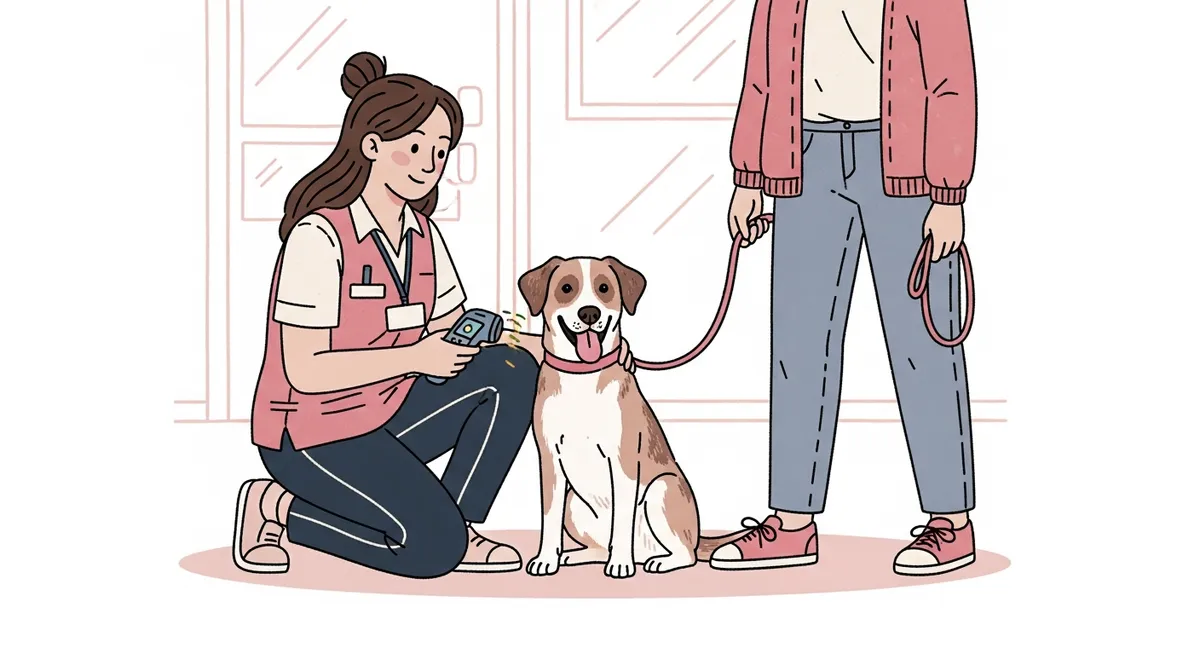
Someone calls (or shows up) with a stray adult dog or cat they've picked up off the street. They want you to take it. Often there are jurisdictional rules at play — your shelter may only have intake authority for certain cities or counties, and the stray may be from outside your service area.
The wrong response is "we don't take strays from your area." Even when that's literally the policy, the caller hears "you're on your own with this animal," and the most likely outcome is that the animal ends up back outside.
The framework: Acknowledge → Reframe → Action
Almost every difficult shelter conversation follows the same emotional shape: someone is in distress, embarrassed, frustrated, or scared, and they're presenting that as a demand or a complaint. The most reliable response pattern is three steps:
1. Acknowledge the emotion before the content. ("I can hear how stressful this is.") This buys you 30 seconds of reduced reactivity.
2. Reframe the situation so you and they are on the same side. ("Let's see what we can do together.")
3. Action — give them a concrete next step, even a small one. ("Here's what I can do today.")
The script below is just this pattern applied to one specific scenario. Once your team internalizes the pattern, they can handle the conversations you never wrote a script for.
The script
> *"Thank you for picking him up — that's the hardest part. Here's what I'd love to do: first, can you help me check him for a microchip? About a third of strays we encounter have one, and we can often have him home in an hour. If he doesn't have a chip, the next step depends on where you found him — we serve [list of jurisdictions], and for [other jurisdictions] I'll give you the right number to call. If he does belong with us, we'll absolutely take him in, and I'll walk you through what happens from there."*
If your shelter has a microchip scanner you can lend out, or a partnership with a local vet who'll scan for free, name it explicitly. The microchip-first approach reframes the entire call from "intake" to "reunification" and dramatically improves outcomes.
Why each piece works
- *"Thank you for picking him up — that's the hardest part"* — acknowledges the caller's effort and signals that you see them as a partner, not a problem.
- *"Can you help me check him for a microchip?"* — gives the caller a real, productive role in the next ten minutes. People who feel useful stay engaged.
- *"About a third of strays we encounter have one"* — gives them realistic hope. The microchip-reunification rate is high enough that this isn't a stalling tactic.
- *"The next step depends on where you found him"* — explains jurisdiction without sounding like a brush-off. The caller hears a decision tree, not a refusal.
- *"For [other jurisdictions] I'll give you the right number"* — names the alternative shelter and provides the number. Don't say "look it up online."
- *"We'll absolutely take him in"* — closes the loop on the part of the call that the caller is most worried about: are you going to leave them holding the leash?
Common variations
- The stray with visible injuries. Triage immediately. *"Okay, we need to act on that. Here's the closest emergency vet — call ahead, tell them you're bringing in a found animal, and we can usually arrange to cover initial stabilization through our [partnership / fund]."*
- The friendly stray that's clearly someone's pet. Walk the caller through the "neighborhood detective" steps before intake: post on local lost-pet groups, knock on a few doors, check for a chip at a vet. Many of these animals are home within 48 hours without ever entering a shelter.
- The fearful or aggressive stray the caller can't safely contain. Now you're talking about a field response, not a counter conversation. Connect the caller with your animal control partners or, in jurisdictions where you handle field response, dispatch.
- The stray from your jurisdiction with no apparent owner and no chip. Move directly into intake: *"Okay, this is one of ours. Can you bring him in within the next two hours, or would it be easier if I sent someone?"*
What not to say
- "We don't take strays." (Without context. Sounds like every animal in the parking lot is the caller's problem.)
- "You'll have to bring him to [other shelter]." (Without name, address, hours, and a phone number. Useless.)
- "Have you tried Facebook?" (As the entire response. Patronizing.)
- "We can't help you." (Almost always false. You can almost always help with *something* — a chip scan, a phone number, a step-by-step.)
Training drill
Build a one-page jurisdiction map for your front desk: every city and county your shelter does and does not serve, with the right phone number for each "does not serve" answer. Role-play five calls a month with stray scenarios from different jurisdictions. The script doesn't work without the map.
Related reading
- Surrender Prevention Programs: Alternatives Your Shelter Should Offer
- How Automation Reduces Shelter Burnout
More scripts in this series
- Script: How to Handle a Walk-In Owner Surrender
- Script: How to Handle an Adoption Return Call
- Script: How to Deliver an Adoption Denial
- Script: How to Disclose a Dog's Bite History to an Adopter
- Script: How to Tell an Applicant They're the Runner-Up
- Script: How to Handle a "Found Litter" Phone Call
- Script: How to Talk to Someone Who Found a Stray
- Script: How to Answer the Euthanasia Question in Public
- Script: How to Handle a Restricted Donation Request