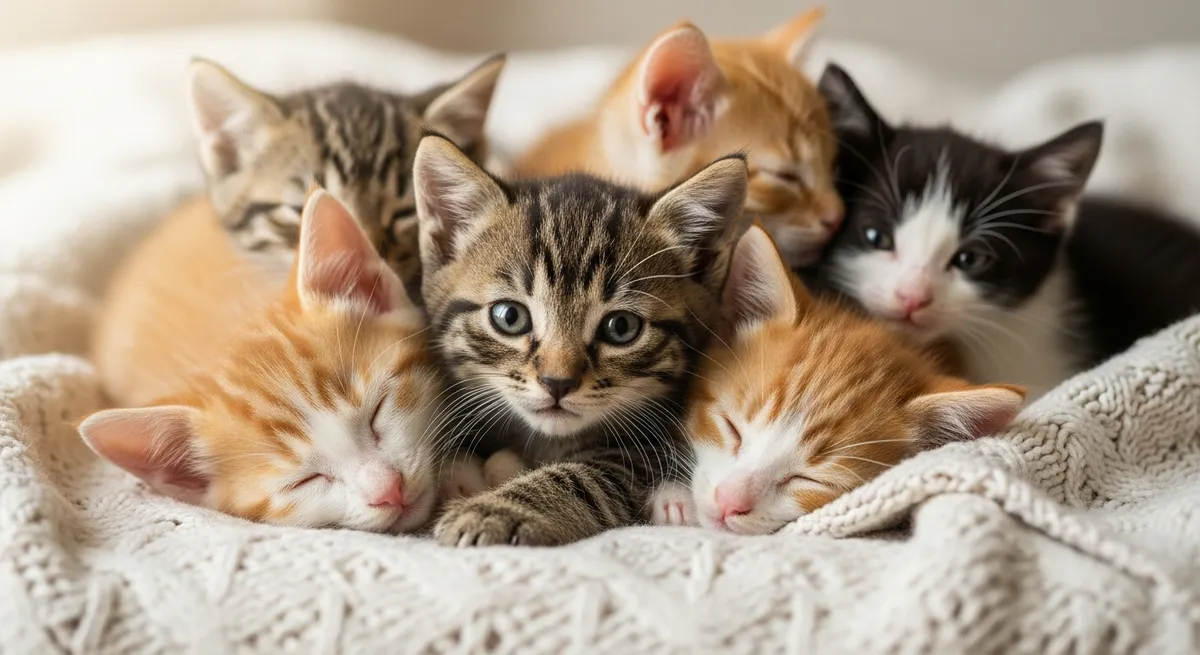
Ask anyone who works in animal rescue what time of year keeps them up at night, and you will hear two words over and over: kitten season. It sounds adorable — and the kittens absolutely are — but the phrase describes one of the most overwhelming, resource-draining, and life-or-death stretches of the entire shelter calendar. If you have ever wondered why your local shelter seems buried in tiny cats every summer, this is the explanation.
What "kitten season" actually means
Kitten season is the months-long stretch — roughly spring through fall, peaking in the warm months — when cats give birth in enormous numbers. Cats are what biologists call seasonal breeders: as days get longer and temperatures rise, their bodies are triggered into reproductive cycles. The practical result is wave after wave of litters arriving at shelters and rescues over a concentrated period.
In warmer climates the season can stretch nearly year-round; in colder ones it is more sharply confined to summer. But almost everywhere, the warm months bring the flood.
Why it overwhelms shelters
The numbers are the problem. Consider:
- A female cat can become pregnant as young as four to five months old.
- She can have multiple litters in a single season.
- Her kittens can begin reproducing before that same year is out.
Left unchecked, one unspayed female and her descendants can multiply into a startling number of cats within just a few years. Multiply that across every unaltered owned cat, stray, and community cat in a region, and you get the seasonal tidal wave shelters brace for every summer. It is a major reason shelters often fill up during summer.
Why kittens are uniquely hard to care for
It is not just the volume — it is the kind of animal. Neonatal kittens are among the most labor-intensive creatures a shelter can take in:
- Bottle babies (kittens too young to eat on their own) need feeding every two to three hours, around the clock, including overnight.
- They cannot regulate their own body temperature and must be kept carefully warm.
- They are extremely fragile and vulnerable to illness.
- A traditional shelter environment, with its noise, stress, and germs, is one of the worst places for them.
This is exactly why fostering is the lifeline of kitten season. A foster home provides the quiet, clean, attentive, around-the-clock care that keeps fragile kittens alive until they are old enough to be spayed or neutered and adopted. When shelters put out an urgent call for fosters in summer, this is why. You will find fostering in our full list of ways to help shelter pets this summer.
The real solution: spay and neuter
Fostering saves the kittens who are already here. Spay and neuter is how we stop next year's flood before it starts. Every fixed cat is litters that will never strain a shelter, never be born into uncertainty, never compete for a finite number of homes.
This is also where TNR (Trap-Neuter-Return) comes in. Community cats — unowned, free-roaming cats — are a huge source of kitten-season litters. TNR programs humanely trap these cats, spay or neuter them, and return them to their territory (typically with an ear-tip to mark them as altered). Over time, TNR shrinks community-cat populations and dramatically reduces the number of kittens born outside each year. Supporting your local TNR effort is one of the highest-leverage things you can do.
How you can help during kitten season
- Foster. Even one litter for a few weeks frees critical shelter space and saves lives.
- Spay and neuter your own cats — including indoor-only cats, who escape more often than owners expect.
- Support or volunteer with TNR.
- Donate kitten supplies: milk replacer, bottles, heating pads, soft bedding.
- Adopt an adult cat — they are frequently overlooked during the kitten rush, yet make wonderful, lower-maintenance companions.
- Spread accurate information, especially about found kittens (see below).
One critical caution: found kittens
If you discover a litter of kittens outdoors, your instinct may be to scoop them up and rush them to a shelter. That is often the wrong move — mom is usually nearby and is the best possible caregiver. Removing kittens prematurely can hurt their chances rather than help. Please read found kittens? here's what to do before bringing them to a shelter before you intervene.
Where connected records help
Kitten season generates a blizzard of medical events — deworming, first vaccines, spay/neuter, microchipping — across dozens of tiny patients moving between foster homes and the shelter. Shelters running PawMates Pro keep each kitten's record connected from intake onward, so nothing falls through the cracks as a litter moves around. When those kittens are adopted, the families leave with a real lifetime medical record tied to a durable PawMates Pet ID, shared with their vet on their consent through the VetPetz bridge — the start of a lifetime of organized care instead of a lost paper trail.
The bottom line
Kitten season is not a cute marketing phrase; it is the annual crush that defines summer for shelters. The kittens are blameless and the math is unforgiving, but the answers are clear: foster to save the ones who are here, and spay, neuter, and support TNR to shrink the wave that comes next year. Both are within reach of ordinary people who simply decide to help.
Frequently asked questions
When is kitten season?
Roughly spring through fall, peaking in the warm summer months. In warm climates it can run nearly year-round; in colder regions it is more tightly concentrated in summer.
Why is kitten season a problem for shelters?
Cats reproduce in huge numbers over a short span, and neonatal kittens need round-the-clock bottle care that shelters cannot provide in-house. The volume and fragility of the animals overwhelm staff, space, and resources.
How can I help during kitten season?
Foster a litter, spay and neuter your own cats, support TNR, donate kitten supplies, and adopt overlooked adult cats. Sharing accurate information about found kittens helps too.
Does spaying and neutering really make a difference?
Enormously. Each altered cat prevents future litters, and over time spay/neuter plus TNR shrink the community-cat population that drives kitten season in the first place.
Related reading
- Found kittens? here's what to do before bringing them to a shelter — the wait-and-watch rule.
- Why shelters often fill up during summer — kitten season in context.
- The best ways to help shelter pets this summer — fostering and beyond.
For more adoption and pet-care guides, browse the PawMates adopter blog.