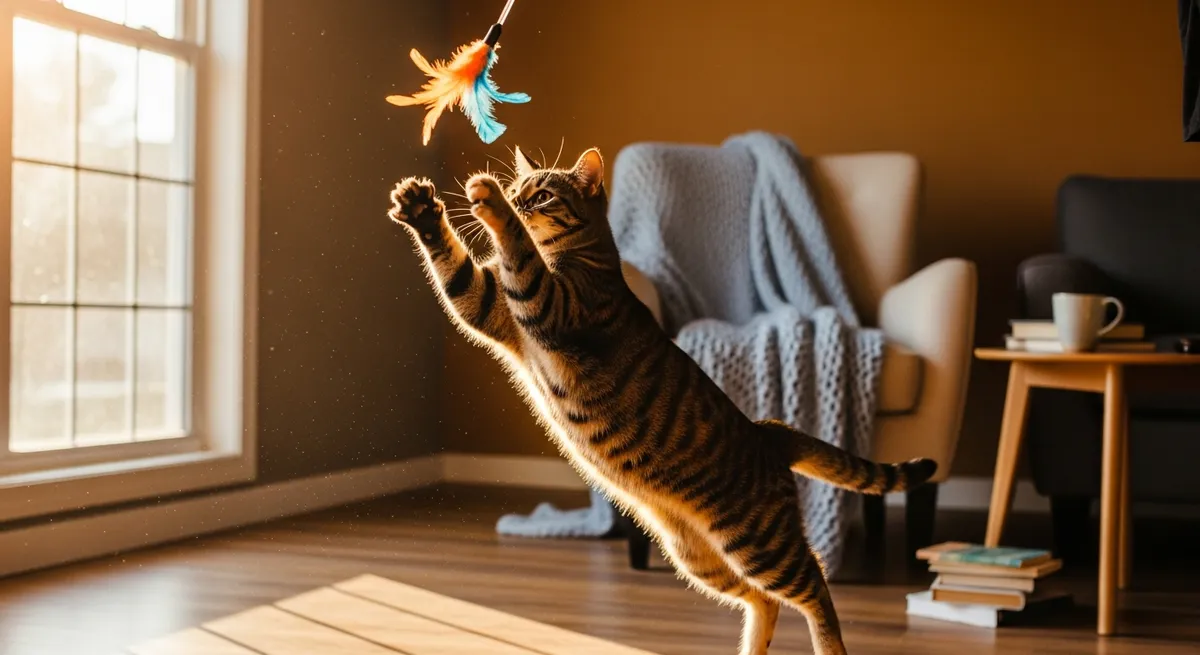
When the weather outside is brutal, your indoor cat is the one pet who is genuinely better off staying in — but "safe from the heat" and "mentally satisfied" are two different things. A bored indoor cat does not just nap more; it over-grooms, picks fights with the other pets, yowls at 3 a.m., and treats your ankles like prey. Hot weather, when everyone is cooped up and the household rhythm changes, is exactly when feline boredom peaks. The good news: cats are cheap and easy to enrich once you understand what their brains actually want.
What cats are really wired to do
A house cat is a small predator running ancient software. In the wild it would spend its waking hours in a loop of stalk, chase, pounce, kill, eat, groom, sleep. Indoor life removes the hunt, and that missing piece is the root of most "behavior problems." Your job in summer is to recreate that loop indoors — without the heat, the fleas, or the cars. Do that and the yowling, the over-grooming, and the ankle ambushes tend to fade on their own.
Make the vertical world bigger
Cats live in three dimensions. Floor space is nearly meaningless to them; height is everything.
- Window perches. A padded perch in a shaded, screened window gives your cat "cat TV" — birds, squirrels, leaves. Position it out of direct afternoon sun so it stays cool.
- Cat trees and shelves. Vertical territory lets cats survey their domain and escape other pets, which lowers stress in a crowded summer household.
- A safe screened window or catio. If you have a secure, escape-proof screened window or an enclosed "catio," your cat gets fresh air and stimulation while staying contained. Never leave a cat near an unsecured open window — screens push out.
Turn mealtime into a hunt
Free-feeding from a bowl is the enrichment equivalent of staring at a wall.
- Puzzle feeders. Make your cat bat, paw, and problem-solve for kibble. Start easy so they do not give up.
- Food balls and rolling dispensers. These add chase to the meal — perfect indoor exercise on a hot day.
- Scatter feeding. Toss dry food across a clean floor or hide small portions around a room so your cat has to forage.
- Frozen lick treats. A smear of a cat-safe wet food or a churu-style treat on a lick mat, lightly chilled, is a cooling novelty (skip anything with onion, garlic, or xylitol — always check with your vet on new foods).
Play like a predator (this is the big one)
Interactive play is the single most powerful tool for a bored cat, and it doubles as exercise when it is too hot to do anything else.
1. Use a wand toy with feathers or a fabric lure and move it like prey — skittering, hiding, freezing — not waving it in your cat's face.
2. Let your cat win. Always end with a real "catch" so the predatory sequence completes; a hunt with no kill is frustrating.
3. Finish with a snack. Hunt, catch, then a small treat or meal mimics the natural loop and often leads to a long, satisfied nap.
4. Two short sessions a day (about 10 minutes each, dawn and dusk) match a cat's natural activity peaks and burn energy during the coolest hours.
Rotate, do not accumulate
Ten toys left out all the time become invisible. Keep most toys in a bin and put out only two or three, swapping them every few days. To your cat, a toy that vanished last week and reappeared today is brand new.
Cheap, high-value extras
- Cardboard boxes and paper bags (handles removed) are world-class cat enrichment — hiding, ambushing, shredding.
- Cat grass grown indoors gives safe chewing and nibbling.
- A simple ping-pong ball in a dry bathtub becomes a self-play arcade.
- Catnip or silvervine, offered occasionally, can spark bursts of play — though not every cat responds, and that is normal.
Keeping cool while staying busy
Enrichment and heat safety go together in summer. Make sure your cat has shaded resting spots, more than one water source (some cats prefer a pet fountain), and a cool tile or a chilled mat to stretch out on. Schedule the active play for early morning and evening, and let the hot midday be for napping. If you ever see lethargy, open-mouth panting, drooling, or wobbliness, treat it as a heat emergency and call your vet — cats hide distress until it is serious, so review the signs in protecting your pet during heat waves.
Why your cat's profile makes enrichment smarter
What enriches one cat overwhelms another. A shy, recently adopted cat needs quiet hiding spots and gentle solo toys before wand play; a bold young cat needs vigorous daily hunts. When you adopt from a shelter running PawMates Pro, your cat arrives with real behavior and medical notes — not a blank slate — so you can match the enrichment to the individual from day one. Those notes live in a lifetime medical record that follows your cat and is shared with your vet, with your consent, through the PawMates and VetPetz connection. The microchip is only the lookup key a clinic or shelter uses to find your cat; the record itself is anchored to a durable PawMates Pet ID, so the history sticks even if your contact details change. (Curious how that all fits together? See the future of connected pet care.)
Frequently asked questions
How do I know if my indoor cat is bored?
Common signs include over-grooming, excessive sleeping paired with sudden hyperactivity, attention-seeking yowling, destructive scratching, picking on other pets, or ambushing your feet. Adding daily interactive play usually helps quickly.
How much should I play with my cat each day?
Aim for two short interactive sessions of about 10 minutes, ideally at dawn and dusk when cats are naturally most active. Always end with a catch and a small snack to complete the hunting sequence.
Are laser pointers good for cats?
They are fine for movement but frustrating if the cat never gets to catch anything. Periodically land the dot on a physical toy or follow up with a wand toy and a treat so the hunt has a satisfying finish.
What human foods are safe to freeze as cat treats?
Stick to cat-formulated wet food or treats; avoid onion, garlic, xylitol, chocolate, grapes, and excess dairy. Always confirm any new food with your veterinarian, especially for cats with medical conditions.
Related reading
- 20 fun summer activities for dogs — the canine companion to this guide.
- Protecting your pet during heat waves — keeping cats cool and safe when temperatures climb.
- The future of connected pet care — how your pet's record makes everyday care smarter.
For more adoption and pet-care guides, browse the PawMates adopter blog.