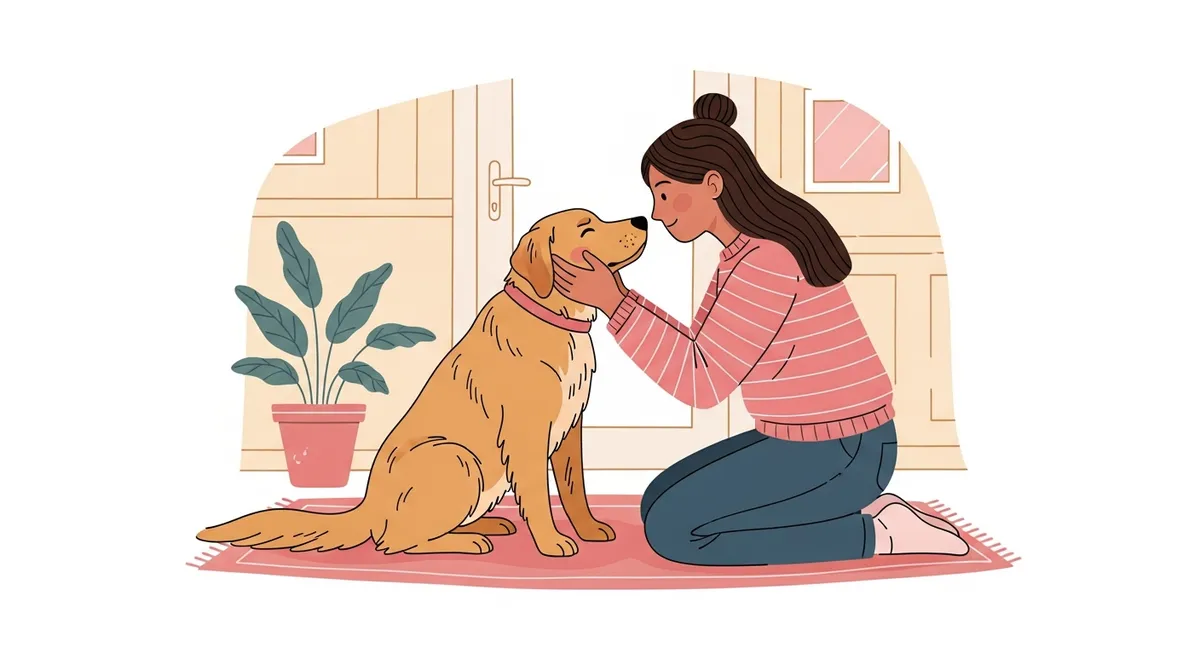
Dogs do not say "I love you" the way humans do. They don't have words. They don't make grand gestures. They don't post on Instagram. The way dogs communicate affection is mostly small, easy to miss, and largely *physical* — and the way you communicate love back to a dog needs to match.
The good news: once you know the vocabulary, dogs are extraordinarily clear and consistent communicators. Here's how to actually say "I love you" in a language your dog understands — and how to read whether your dog is saying it back.
1. The slow blink
The single most underrated dog (and cat) affection signal. When your dog is calm and looking at you, slowly close your eyes for a beat, then open them. Most relaxed dogs will return the slow blink. In dog body language, sustained direct eye contact can read as a challenge or threat; the slow blink says "I see you, I am not threatening you, I am at ease in your presence." It is, very precisely, dog for "I love you."
2. The calm pet, in the right place
Most people pet dogs the way they want to *show* affection — fast, overhead, on the head — rather than the way the dog actually enjoys. Dogs almost universally prefer:
- Slow, long strokes
- On the chest, shoulders, or under the chin (NOT on top of the head from above, which most dogs tolerate but few enjoy)
- With the dog leaning *into* the contact, not away from it
- For as long as the dog is choosing to stay there, and stopping when they shift away
If you want to know whether your dog is enjoying the petting, do the consent test: pet for three seconds, then stop. If your dog leans in, paws at you, or scoots closer, they want more. If they look away, get up, or shake themselves off — they were tolerating it, not enjoying it.
3. Match their breathing and pace
Lie or sit near your dog and slow your breathing down. Dogs are remarkable co-regulators — they sync to the people around them. A calm, breathing-down human in close physical proximity is, to a dog, a clear and complete love letter. This is also the foundation of using a dog for stress reduction, which we covered in What Animal Is Best for Lowering Cortisol?.
4. Be predictable
This sounds unromantic. It isn't. Dogs experience love largely through the absence of unpredictability. Same wake time, same walk route, same dinner, same bedtime, same place on the couch — these are not boring repetitions to a dog. They are the architecture of safety, and safety is how dogs experience being loved. The single biggest gift you can give a dog is a life they can predict.
5. Train with kindness, not corrections
Modern positive-reinforcement training isn't just more effective; it's also a love language. Every short positive training session — sit, hand-target, find-it games — is your dog learning that interacting with you is rewarding and safe. This is why training-based bonding is dramatically stronger than treats-without-context bonding. The case for structure-as-affection is in Pet Adoption: Why Structure Matters More Than Love in the Beginning.
6. Read their stress, not just their joy
A huge part of love, in dog terms, is the human who *notices when something is off*. Dogs whose people miss their early stress signals (lip-licking, yawning out of context, the whale-eye, the freeze-and-look-away) become dogs who escalate to bigger signals (growl, snap) because their early signals weren't being heard. Loving a dog well means watching for the small signals all the time. The full body-language vocabulary is in What Your Pet's Body Language Is Telling You (That You're Missing) and How to Spot a Confident Dog vs. an Anxious One.
7. Let them choose you
This one is harder than it sounds. The dogs who feel most loved are the ones who are *allowed to opt in* — to a snuggle, to a petting session, to coming over to say hello to a guest. When a dog is forced into interactions they didn't choose, even loving ones, the bond degrades. When a dog is given the choice and takes it, the bond compounds. Sit on the floor and let the dog come to you. Wait. They will.
How dogs say "I love you" back to you
Once you start watching for it, the vocabulary is everywhere:
- Following you from room to room. Your dog has decided you are the safest spot in the house.
- Sleeping touching you. Highest-vulnerability behavior. Massive trust signal.
- Bringing you a toy. "I want to share this thing with you." Often misread as a request to play; it's also a gift.
- Leaning against you. Physical contact without expectation. The dog equivalent of a hug.
- The "soft eyes" gaze. Relaxed face, soft eyes, slightly squinted, slow tail wag at a relaxed height. This is the look that science measured a 2015 study of, finding that human-dog mutual gazing releases oxytocin in *both* species — the same hormone underlying mother-infant bonding.
- Greeting you specifically when you walk in. Not the door — *you*.
- Yawning when you yawn. Dogs catch yawns from people they're bonded to, the same way humans catch yawns from people we're close to.
- The full-body wiggle when you come home. Yes, even after you only stepped out for the mail. This one is well understood.
The mistakes that get in the way
A few things humans do with the best intentions that don't read as love to dogs:
- Hugging. Most dogs tolerate hugs from their primary person but find them genuinely uncomfortable. Save hugs for humans; do the slow blink for dogs.
- Face-kissing. Same. Watch the dog's body language — if they're freezing, looking away, or licking their lips, they're enduring it.
- High-pitched baby talk in their face. Some dogs love this; many find it overwhelming. Match the dog you have.
- Forced interactions with kids or strangers. "Go say hi to Aunt Karen." If the dog doesn't want to, don't make them. The relationship between dog and primary person takes the hit, even though the discomfort happened with someone else.
For the broader piece on what really binds a dog to a person, see Do Dogs Have a Favorite Person?. For the science behind the dog-human bond at a deeper level, The Science of Human-Animal Bonding.
The honest takeaway
You don't say "I love you" to a dog with words. You say it with predictable routines, calm physical presence, attention to their small signals, training that respects their mind, and the patience to let them choose you. Do those things, and your dog will know it as clearly as if you'd said it out loud — and they'll say it back to you, dozens of times a day, in a vocabulary you'll start to see everywhere once you know what to look for.
Related reading
- Do Dogs Have a Favorite Person?
- What Your Pet's Body Language Is Telling You (That You're Missing)
- How to Spot a Confident Dog vs. an Anxious One
- The Science of Human-Animal Bonding
- Pet Adoption: Why Structure Matters More Than Love in the Beginning
- Understanding Shelter Dog Behavior: What It Really Means