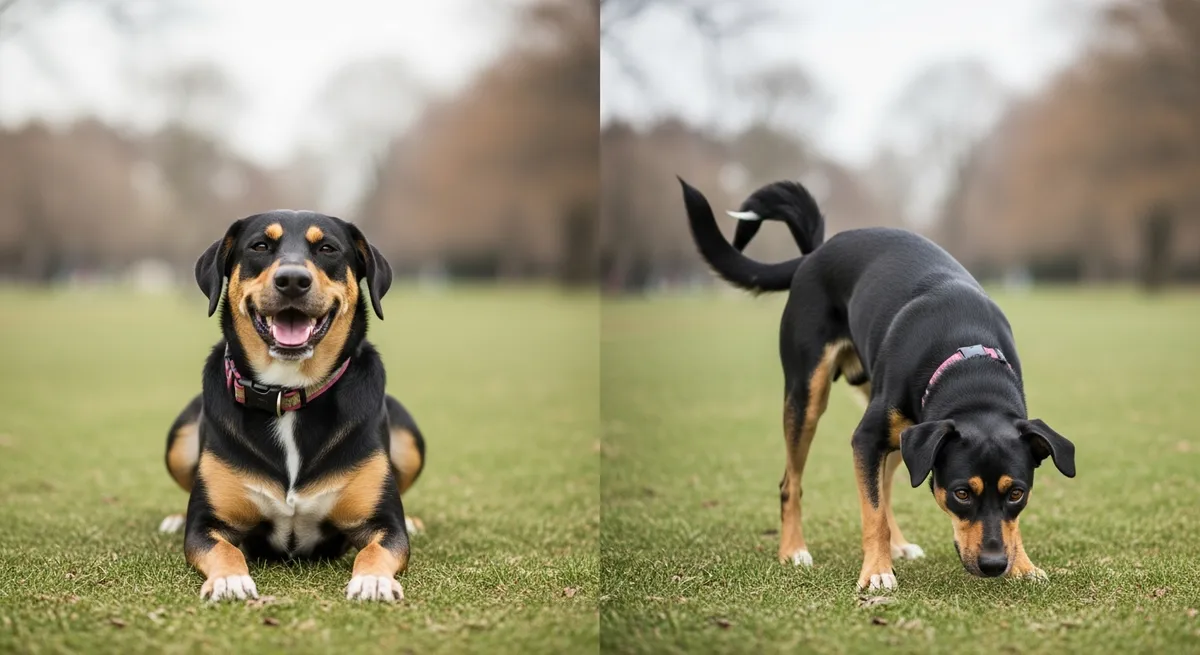
Two dogs walk into a room. One stands tall, ears forward, tail at mid-height, eyes scanning calmly, mouth slightly open. The other crouches slightly, tail tucked, ears flattened, eyes darting, lips pulled back in what might look like a smile but isn't. Same room. Same situation. Two completely different conversations going on inside their nervous systems.
Knowing which dog is in front of you matters. Whether you're meeting a potential adoption, deciding how to approach a stranger's dog at the park, or interpreting your own pet's behavior on a hard day, the difference between "confident" and "anxious" determines almost everything about how you should respond.
This guide breaks down exactly what to look for, why it matters, and what to do with what you see.
Why This Distinction Matters
A confident dog and an anxious dog can sit identically. They can both wag their tails. They can both make eye contact. The differences are in the details — and the details predict almost everything about safety, training approach, socialization plan, and long-term welfare.
Reading dogs accurately:
- Helps you choose the right dog for your household
- Prevents bites that "came out of nowhere"
- Builds appropriate training and socialization plans
- Protects children and other pets in the home
- Helps you advocate for your dog in vet, trainer, and public situations
(For the broader body-language framework, read What Your Pet's Body Language Is Telling You (That You're Missing).)
The Confident Dog: A Full-Body Description
A confident dog at baseline shows:
- Loose, easy posture. No stiffness anywhere — neck, shoulders, hips, tail.
- Soft, almond-shaped eyes. Direct but not hard. Comfortable looking at you and looking away.
- Slightly open mouth. Often with the tongue partially out. The face looks "soft."
- Mid-height tail. Wagging in slow, sweeping arcs or simply held in a relaxed neutral.
- Forward, mobile ears. Listening to the environment but not pinned alert.
- Even weight distribution. Standing four-square or sitting comfortably, not leaning forward or back.
- Curiosity rather than vigilance. Investigates new things by approaching, sniffing, then moving on.
- Normal social greetings. A confident dog meets another dog with curved-body approaches, sniffing, and either a relaxed disengagement or a play bow.
- Recovers quickly. A loud noise, a strange object, or a brief startle gets a one-second response, then back to normal.
A confident dog is not a fearless dog. It's a dog whose nervous system reads the world as fundamentally safe, even when something unusual happens.
The Anxious Dog: A Full-Body Description
An anxious dog shows some combination of:
- Stiff or low body posture. Crouching, hunching, or standing rigidly.
- Tucked tail. Pressed against the belly or wagging only at the tip.
- Whale eye. Whites of the eyes visible because the head is turned but the eyes are still tracking.
- Pinned-back ears or "airplane ears."
- Tight, closed mouth. Lips pulled back tight, not loose.
- Lip licking, yawning, or panting outside of food or heat contexts.
- Slow movement, freezing, or pacing.
- Avoidance of eye contact or, conversely, hard staring.
- Trembling.
- Hiding behind people, objects, or in corners.
- Slow recovery from minor events. A door slam stays bothering them for minutes instead of seconds.
- Hyper-vigilance. Constantly scanning, never fully relaxing.
An anxious dog can absolutely be a wonderful family member. It just requires different choices in environment, training, and pace of socialization.
The "Friendly Smile" That Isn't
One of the most commonly misread signals: a dog who pulls their lips back and shows their front teeth in what looks like a grin. This is almost always either:
- A submissive grin (some dogs, especially retrievers, show this when greeting people they like — paired with a loose body and soft eyes)
- An appeasement grimace (paired with stiff body, tucked tail, lowered head — this is fear, not friendliness)
The difference is the rest of the body. If anything else looks tense, the "smile" is stress, not joy.
How to Tell Confidence vs. Anxiety in Common Situations
Meeting a Stranger
- Confident: approaches calmly, sniffs the offered hand, accepts a chest scratch, stays present
- Anxious: hangs back, may approach in a half-circle, sniffs and retreats, may freeze if reached for
At the Vet
- Confident: alert but mobile, accepts handling, recovers quickly between procedures
- Anxious: trembles on the table, panting heavily, may flinch at touch, pulls toward the exit
Walking on Leash in a Busy Area
- Confident: notices things, briefly investigates, continues walking
- Anxious: scans constantly, ducks at sounds, may freeze, lunge, or attempt to bolt
Meeting Another Dog
- Confident: approaches in a curve, sniffs, exchanges signals, disengages or play bows
- Anxious: approaches stiffly, freezes at proximity, may snap pre-emptively or shut down completely
At Home in a Quiet Moment
- Confident: lies in an open space, sleeps deeply, accepts gentle handling without flinching
- Anxious: may sleep in tight spaces, startles awake easily, follows owner room to room compulsively
The Spectrum, Not the Binary
Most dogs are not purely confident or purely anxious — they sit on a spectrum, and the spectrum can shift by context. A dog who is confident at home may be anxious at the vet. A dog who is anxious in the city may be confident on hiking trails.
Useful categories to think in:
- Globally confident. Comfortable across most contexts. Rare and lovely.
- Situationally confident. Confident at home, less so in novel environments. Most common.
- Situationally anxious. Confident generally but specific triggers (men in hats, garbage trucks, vet office) cause acute anxiety.
- Globally anxious. Hyper-vigilant most of the time, slow to recover, often a result of under-socialization or genuine trauma.
The category matters because it determines the support plan. A globally anxious dog needs a calm environment, slow socialization, and often professional help. A situationally anxious dog needs targeted desensitization in the trigger context.
What to Do With What You See
If the Dog Is Confident
- Build on it with continued positive socialization.
- Don't take it for granted — confidence can erode if a dog is repeatedly placed in situations they can't handle.
- Train with reward-based methods that maintain trust and reduce the small stresses that can compound over time.
If the Dog Is Situationally Anxious
- Identify the specific triggers and avoid them while you build a desensitization plan.
- Use distance as your tool — most dogs can handle a trigger from 30 feet that they cannot handle from 5.
- Pair the trigger appearance with high-value treats at a distance the dog tolerates.
- Don't push through. Forcing exposure usually makes anxiety worse.
If the Dog Is Globally Anxious
- Lean heavily on environment management: predictable routine, calm home, limited novel exposure at first.
- Use the 3-3-3 framework deliberately, allowing weeks for adjustment.
- Get professional help early — a certified positive-reinforcement trainer or veterinary behaviorist can dramatically change the trajectory.
- Discuss medication with your vet if anxiety is severely impacting welfare. Modern anti-anxiety medication for dogs is well-studied, often game-changing, and not a sign of failure.
- Be patient. Anxious dogs improve, but on their timeline.
Special Note for Adopters
When meeting a potential adoption, don't penalize a dog for showing anxiety in the shelter. Shelter is a high-stress environment, and many dogs read as anxious there who become confident at home within a few weeks.
Useful questions to ask the shelter:
- How does this dog behave in the office, the play yard, and on walks (different contexts)?
- Has anyone fostered this dog? What did they observe at home?
- What signals does this dog use most often when stressed?
- What does this dog look like when relaxed?
A shelter that can answer these questions clearly is documenting behavior carefully — that information is invaluable for setting up a successful adoption.
(For the bigger-picture adopter playbook, see Red Flags to Watch for When Adopting a Pet and The First 7 Days After Adopting a Pet: What to Expect.)
Special Note for Households With Kids or Other Pets
A confident dog is generally easier to integrate with children and other pets. An anxious dog can also work — but the integration plan needs to be slower, the management more careful, and the household members more aware of stress signals.
If you have young kids and you're considering an anxious dog:
- Choose a dog whose anxiety triggers do not include children (ask the shelter directly)
- Plan for permanent management — the dog has a safe space the kids cannot enter, ever
- Teach the kids the body language basics in this guide before the dog comes home
- Get a trainer involved from the start, not after the first incident
(See also The Right Way to Introduce Cats and Dogs and How to Introduce a New Pet to Your Existing Pets.)
When Anxiety Looks Like "Bad Behavior"
A great deal of what gets labeled bad behavior is actually anxiety:
- "Reactive on leash" is usually fear-based, not aggression
- "Destructive when alone" is often separation distress
- "Snappy with kids" is frequently stress that nobody recognized in time
- "Hates the vet" is anxiety with a specific context
- "Stubborn in training" is often a dog whose stress is interfering with their ability to focus
Reframing behavior as a stress signal — instead of a personality flaw — is the single most useful shift any new owner can make. Most "bad" behavior improves significantly once anxiety is addressed.
How PawMates Pro Helps
PawMates Pro powers shelters that document confidence and anxiety patterns carefully through structured behavioral evaluations, interactions with staff, foster reports, and play group observations. That information flows into adopter-facing profiles and disclosures, so you bring home a dog with a real understanding of where they fall on the confidence-to-anxiety spectrum and what their specific triggers are. Honest disclosure plus structured post-adoption support is what makes anxious dogs thrive in well-prepared homes — and confident dogs continue to grow into their best selves.
The Bottom Line
Confidence and anxiety in dogs are not personality flaws — they are nervous-system patterns that influence almost everything about how the dog experiences the world. Once you can read which one is in front of you, you can choose the right approach: build on confidence, support situational anxiety carefully, and bring in professional help for global anxiety.
Soft eyes, loose body, mid-height tail, recovers quickly = confident. Stiff body, tucked tail, lip licking, slow recovery = anxious. The rest is response.
Read the dog. Respond to the dog you're actually looking at. The relationship gets better immediately.
Frequently Asked Questions
How can I tell if a dog is confident or anxious?
Look at the whole body, not just the tail. A confident dog shows soft eyes, a slightly open mouth, a loose body, a mid-height tail with sweeping movement, and quick recovery from minor surprises. An anxious dog shows stiff or low posture, a tucked tail, whale eye (whites of the eyes showing), pinned ears, lip licking, yawning out of context, and slow recovery from small events.
Can an anxious dog become confident over time?
Yes — most situationally anxious dogs make significant progress with consistent positive reinforcement training, gradual desensitization, predictable routine, and a calm home environment. Globally anxious dogs may always need management strategies but can still live happy, full lives. Professional help and, in some cases, veterinary anti-anxiety medication can change the trajectory dramatically.
Is a tail wag always a sign of a friendly dog?
No. A tail wag is communication, not happiness. A high, stiff, fast wag often signals arousal that could go either way. A low or tucked-tail wag is appeasement, often fear-based. A loose, mid-height sweeping wag combined with a soft body is the friendly signal. Always read the whole body before assuming a wag means it's safe to approach.
What does it mean when a dog shows the whites of its eyes?
"Whale eye" — when you can see the whites because the head is turned away but the eyes still track something — is one of the most consistent precursors to a defensive snap. It signals that the dog is uncomfortable and asking for space. Disengage immediately when you see it.
Are some dog breeds naturally more anxious than others?
There are general tendencies — some working breeds, some toy breeds, and dogs from certain backyard breeding lines show higher rates of anxiety on average. But individual variation within any breed is significant. Early socialization, genetics, life history, and current environment all matter more than breed alone.
What should I do if my dog seems anxious in new situations?
Use distance as your tool — most dogs can handle a trigger from far away that they cannot handle close up. Pair the trigger with high-value treats at a distance the dog tolerates. Don't force exposure. Gradually work closer over weeks, not minutes. If progress stalls or the anxiety is severe, work with a certified positive-reinforcement trainer.
Can a shy dog at the shelter become confident at home?
Often, yes. Many dogs who appear anxious in a shelter environment — which is high-stress for almost any dog — become substantially more confident within a few weeks at home. Ask the shelter how the dog behaves in different contexts (office, play yard, foster home if applicable) to get a fuller picture.
Related Articles
- What Your Pet's Body Language Is Telling You (That You're Missing)
- Understanding Shelter Dog Behavior: What It Really Means
- Separation Anxiety in Rescue Pets: Signs and Solutions
- The First 7 Days After Adopting a Pet: What to Expect
- Red Flags to Watch for When Adopting a Pet
- The Emotional Rewards of Adopting a Rescue