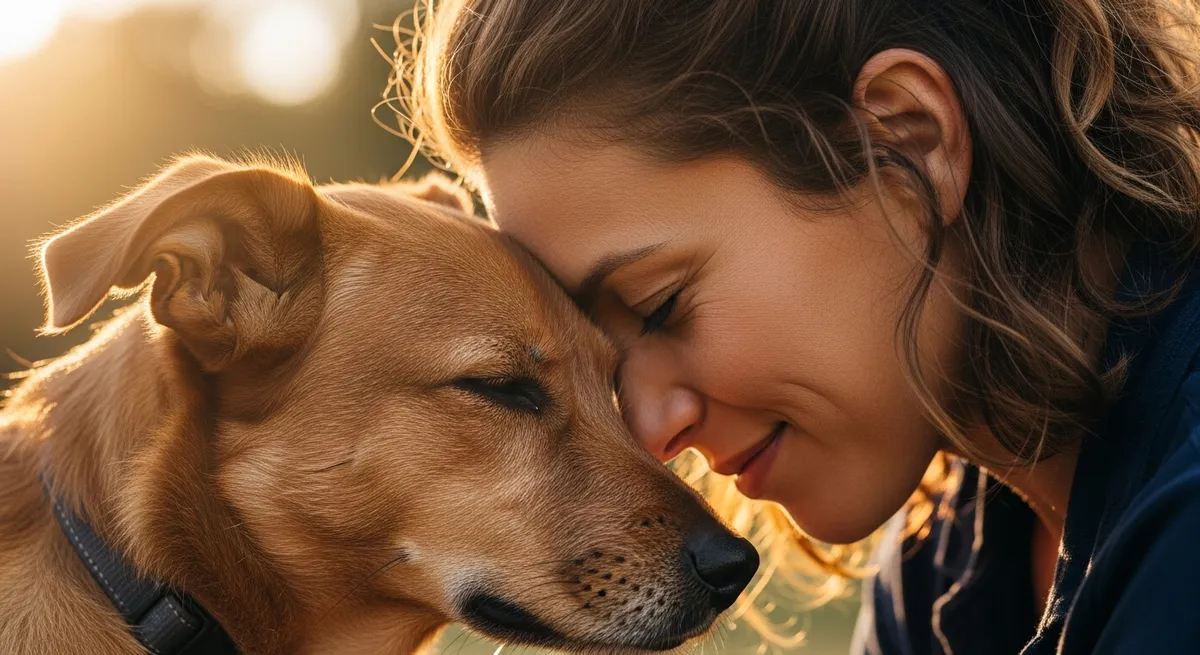
The bond between a person and an adopted pet is one of the most extensively studied relationships in modern behavioral science — and almost everything about it is more interesting than the casual reader expects. The bond is real, it is measurable in blood and brain chemistry, it benefits both species in ways that go well beyond companionship, and it follows a developmental arc that adopters can actively support. Understanding the science makes the first months at home easier and the long arc more rewarding.
The hormone story: oxytocin in both directions
The same hormonal system that bonds parents to infants — oxytocin, the so-called "love" or "trust" hormone — fires in both humans and dogs during sustained mutual gaze and gentle physical contact. A 2015 study in *Science* by Nagasawa and colleagues demonstrated that when dogs and their owners looked into each other's eyes, oxytocin levels rose in both species — a feedback loop nearly identical to the one between mothers and infants. Wolves, even hand-raised, do not produce this response. The capacity to bond chemically with humans appears to be one of the things domestication selected for.
What this means in practice: the slow, soft eye contact your dog offers across the room, the head-rest on your knee, the cat slow-blink — these are not metaphorical bonding moments. They are biochemical ones, and they change you both.
Cortisol: stress goes down for both species
Multiple studies have measured cortisol (the primary stress hormone) before and after positive human-pet interaction. The result is consistent: in calm, voluntary interactions — petting, talking softly, gentle play — cortisol drops measurably in both the human and the animal. Heart rate variability improves. Blood pressure declines, particularly in humans with hypertension. The effect is strongest in established bonds and weakest in first encounters with unfamiliar animals.
This is part of why adoption — even of an animal you've known for two weeks — quickly starts to feel different from the early days. The pet is no longer a stranger, and your nervous system is no longer running a "is this safe?" subroutine in the background.
Dogs read humans better than almost any other species
Domestic dogs are unusually skilled at reading human cues — pointing gestures, eye direction, even tone of voice — better than chimpanzees, our closest relatives, and dramatically better than wolves. This isn't training; it's selection. Over thousands of years, dogs who could read us were the ones who got fed, kept, and bred. The result is that the new pet sitting in your living room is, by genetic inheritance, paying close attention to your face, your hands, your shoulders, and your voice — looking for the signals that tell them what comes next.
The implication for new adopters: how you move and speak in the first month will be cataloged. Predictable, slow, gentle, low-volume — and the bond accelerates. Loud, sudden, unpredictable, even unintentionally — and you spend extra weeks rebuilding what could have started clean.
Cats bond too — differently, and on their own terms
Pop culture undersells cats. Research at Oregon State University in 2019 (Vitale and colleagues) found that cats display the same major attachment styles as human infants and dogs do, with the majority showing a secure attachment to their primary person. Cats who feel safely bonded explore more, recover from stress faster, and seek out their person actively. The catch is that the bond is built on the cat's terms, not the human's: with cats, you are auditioned, not chosen on day one. Patience here is not a weakness; it's the protocol.
The bonding arc: what to expect, week by week
For most adopted pets, the bond develops in a recognizable arc:
- Week 1: The pet acclimates. Sleep, food, basic predictability. Bond is barely visible. Many pets are still asking "is this place safe?"
- Weeks 2–3: The pet starts seeking you. Following you to rooms, settling near you (not on you), offering brief eye contact. This is the biochemical bond beginning to fire.
- Weeks 4–8: Active engagement. The pet greets you at the door, asks for play, leans in to be touched, brings toys. Cats may begin to slow-blink and "loaf" near you. The pet is making a thousand small choices to be near you.
- Months 3–6: Deep recognition. The pet reads your moods, anticipates your routine, and shows distinct distress when you leave and joy when you return. Their nervous system is now partly regulated by yours.
- After month 6: Steady-state companionship. The bond stabilizes. New stressors barely shake it. Many adopters describe this as the moment the pet "feels like ours."
This arc compresses for some pets and stretches for others. Highly socialized young animals can run through it in weeks. Older, more cautious, or trauma-affected pets may take a year. Both endings are normal, and both end at the same place.
What accelerates the bond (the evidence-based shortlist)
- Hand-feeding small portions during the first two weeks. Food and trust co-encode neurologically. Even one meal a day from your hand changes the trajectory.
- Daily training in micro-sessions. Five minutes of cooperative work — sit, name response, target a hand, "come" inside the house — builds shared attention faster than long unstructured time.
- Low-pressure parallel time. Sitting calmly in the same room, doing your own thing, builds bond more than active interaction does in the early weeks. The pet learns that being near you is the resting state.
- Predictable daily schedule. Same wake time, same meal times, same walk window. The nervous system bonds faster to predictable people.
- Soft eye contact and slow blinks. Especially with cats. Hold a soft gaze, blink slowly, look away. Repeat.
What decelerates the bond
- Frequent visitor flow in the first three weeks.
- Loud households, unpredictable schedules, frequent travel away from the pet.
- Forced interaction, especially with children at the pet's eye level. (See teaching kids how to respect animals.)
- Punishment-based training, which damages the human-animal trust signal at exactly the time it is being constructed.
- Energy mismatch — an under-stimulated pet has too much arousal in their system to settle into bonding behaviors. (See matching energy levels.)
The benefit runs both ways
The science on the human side is just as strong. Pet ownership is associated with lower resting blood pressure, lower triglycerides, faster recovery from cardiac events, lower rates of depression in older adults, and meaningfully lower loneliness scores across age groups. Children who grow up with pets show modest but consistent advantages in empathy and emotional regulation. None of these effects are large enough to be a medical prescription, but together they are the most robustly documented set of cross-species health benefits in the literature.
The pet is not just changed by living with you. You are changed by living with them.
The shelter's quiet role
This entire bonding arc is what shelters are betting on when they spend hours screening adopters, requiring meet-and-greets, and following up after placement. It's why many PawMates Pro shelters send structured post-adoption check-ins at 3 days, 3 weeks, and 3 months — those windows match the bonding arc almost exactly. A staffer reading those responses can tell whether the bond is forming on schedule, and can offer help before a stalled bond turns into a return.
The honest bottom line
The bond you're about to form is real, ancient, biochemical, and mutually beneficial. It mostly takes care of itself if you give it the conditions it needs: time, predictability, gentle handling, and respect for the pet's pace. The science doesn't tell you to do anything exotic. It tells you that the slow, patient, attentive presence you intuitively know is right is, in fact, exactly right.
For the practical first weeks, the 7 basic needs of animals is your checklist; for the longer arc, questions you should ask before adopting helps you walk in ready.