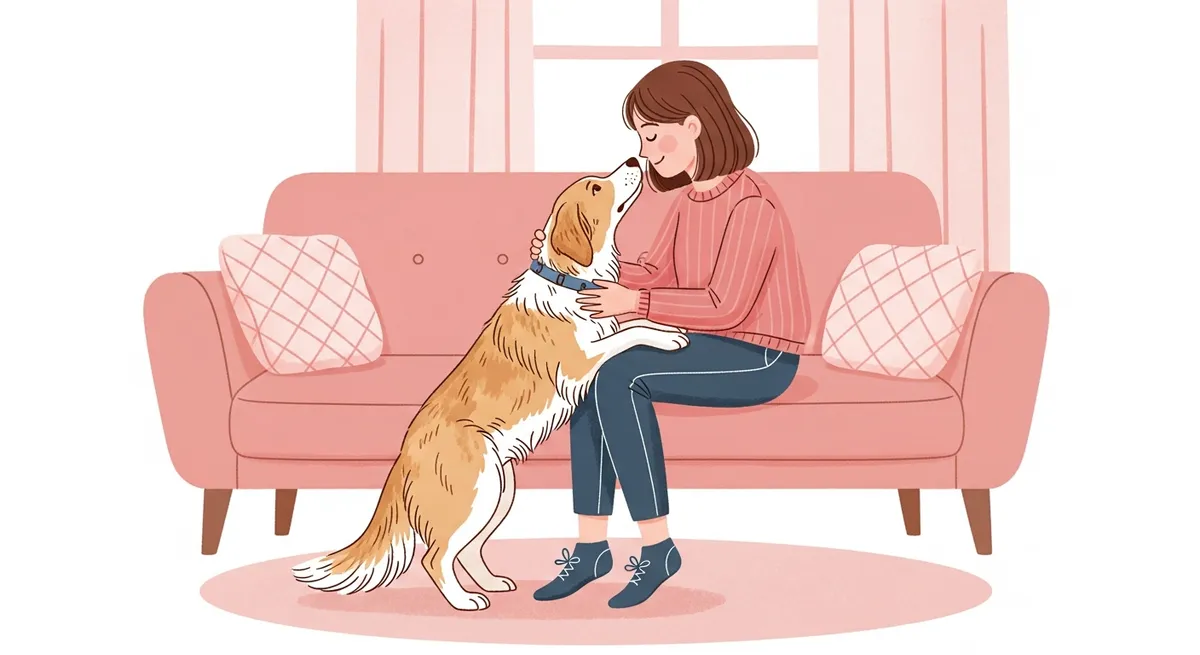
If you live in a multi-person household and you've ever wondered whether your dog *actually* prefers one of you over the others — the short, honest answer is: usually, yes. Most dogs do form a primary attachment. It's not a popularity contest, it's not about who loves the dog more, and it's almost always something you can shape over time. Here's what's really happening, and what to do if you wish your dog were a little more bonded to you specifically.
The science: dogs form attachments much like children do
Decades of behavior research (most famously a series of studies adapting Mary Ainsworth's "strange situation" attachment test from human infants) have shown that dogs form genuine attachment bonds with their people. They prefer the company of their primary person, they seek that person out for comfort when stressed, and they explore more confidently when that person is present. This is not anthropomorphism — it's a measurable, replicable behavioral pattern.
What's less well known is that dogs can absolutely form *secondary* attachments to other household members, and those bonds can become equally strong with the right kind of investment. The "favorite person" isn't fixed at adoption; it's earned daily.
What actually predicts who becomes the favorite
In rough order of importance:
1. Who feeds, walks, trains, and handles vet care. Caretaking is the single biggest driver. Your dog learns who solves their problems and who provides their reliable goods.
2. Who plays in the way the dog likes. A 10-minute high-quality tug session beats two hours of passive couch presence. Quality of interaction matters more than quantity.
3. Who is calm and predictable. Dogs deeply prefer people whose energy and tone they can predict. The household member who is consistently calm — even when the dog isn't — usually wins.
4. Who matches the dog's communication style. Some dogs love a high-energy, vocal greeter; others prefer the quiet person who waits for the dog to come to them. Read What Your Pet's Body Language Is Telling You (That You're Missing) — most "the dog doesn't like me" complaints are actually "the dog dislikes how I'm approaching them."
5. Who the dog associates with safety after the hard moments. The person who comforted them after the thunderstorm, the vet visit, the move — that person rises in the rankings fast.
What does NOT determine the favorite
- How much you love the dog. (Truly. The dog can't tell.)
- How much money you spent on them.
- Whether you talk to them constantly or barely at all.
- Whether you adopted them or someone else in the house did.
If you want to be your dog's favorite (or at least a strong second)
Start doing the boring, daily, repeatable things: feeding, the morning walk, the evening enrichment session, the calm sit-with-me time after a stressful event. Avoid the trap of trying to "win the dog over" with treats and excited high-pitched voices — for many dogs, especially shy ones or recently adopted ones, that style is actually off-putting. See How to Spot a Confident Dog vs. an Anxious One for how to read whether your approach is landing.
Two specific habits that disproportionately move the needle:
- Be the source of the predictable good thing. Same time, same walk, same evening chew toy, same calm "good night" routine. Predictability is a massive currency with dogs.
- Let the dog approach you, not the other way around. Sit on the floor, do something that isn't about them, and wait. Dogs strongly prefer humans who let them choose the interaction.
For recently adopted dogs
If your new dog seems to bond with one household member instantly and barely engage with you, don't take it personally — and don't push. Most newly adopted dogs latch onto whichever human is calmest and most predictable in the first 72 hours, and the bond often diversifies over the following months. The full settling-in arc is described in The First 7 Days After Adopting a Pet: What to Expect and the longer adjustment in What Is the 3-3-3 Rule for Shelter Pets?.
The real takeaway
Yes, dogs almost always have a favorite person — and the criteria for that role are entirely within your control. If you want it to be you, the path is unglamorous: be the calm, predictable, problem-solving presence in your dog's daily life. The dog will figure out who you are inside of three to six months, and the bond you build that way is much sturdier than the one built on excited greetings and high-value treats.
Related reading