Every shelter has the same fundamental job: move animals from intake to outcome, humanely and at pace. Some shelters are exceptionally good at that job. They run a tighter operation, present their animals better, match more accurately, and follow up more consistently. They are not luckier. They are running a system.
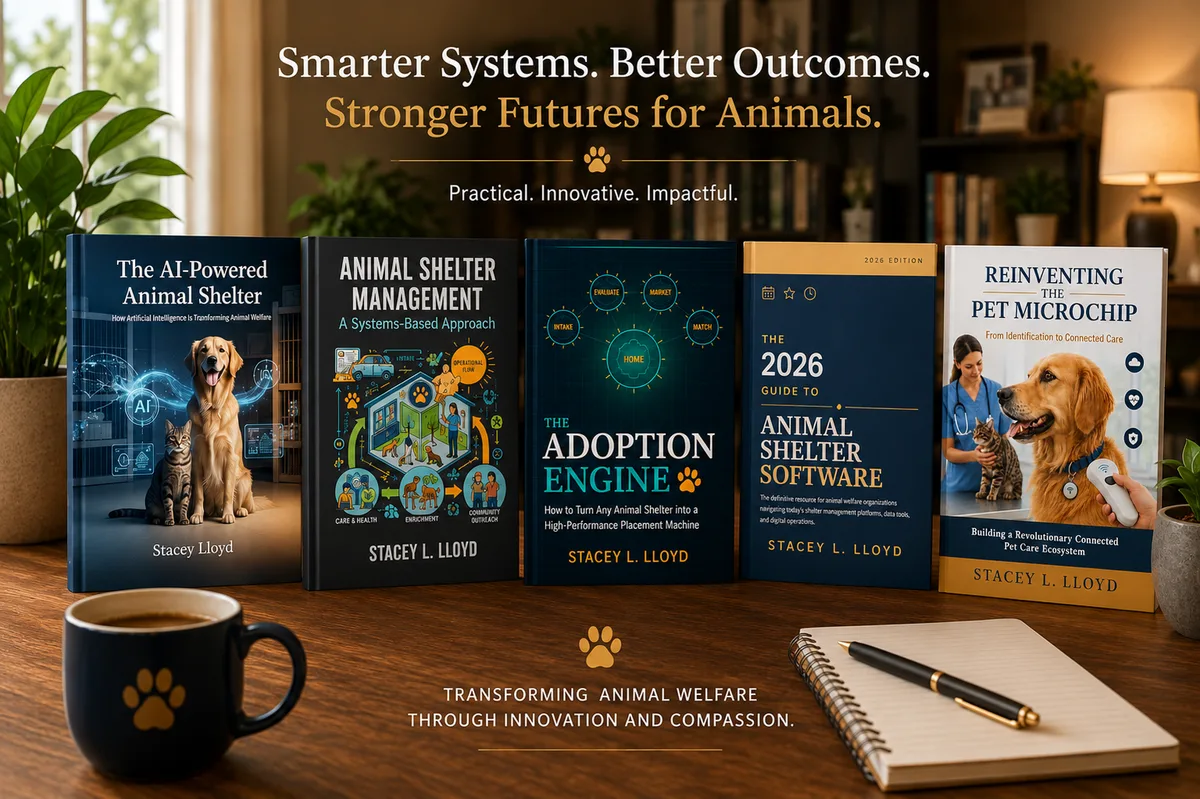
The Adoption Engine is the book that documents that system. This post summarizes what it covers, who it's for, and the operational changes it will let you make this quarter.
What the book is about
The book is a chapter-by-chapter playbook for turning a shelter or rescue into a high-performance placement organization. It is operational, not aspirational. Every chapter ends with a checklist your team can act on.
The core sections cover:
- Intake done right. The conditions under which a healthy intake stream feeds a healthy placement stream — and how the wrong intake habits create downstream bottlenecks.
- Workflow optimization. Where time is lost between intake and adoption, how to measure it, and the highest-leverage process redesigns.
- Marketing and listings. Photography standards, description writing, website import, PawMates adopter app publishing, and the social-media cadence that actually moves animals.
- Community engagement and outreach. How to build the foster network, volunteer base, and partner-shelter relationships that quietly do the heavy lifting.
- Technology-driven placement systems. Adoption matching, automated communication, follow-up sequences, and the data that makes them work.
- Measurement, KPIs, and board reporting. Length of stay, return rate, live-release rate, adoption-to-application conversion, and what each metric is actually telling you.
- The chapter on returns. A whole chapter on why returns happen and how to design the matching and onboarding flow to prevent them. (See Why Animals Get Returned After Adoption for the standalone treatment.)
Who it's for
- Shelter and rescue executive directors who want a comprehensive operational baseline.
- Operations managers and adoption coordinators who want a chapter-by-chapter playbook they can hand to their team.
- Boards who want a shared vocabulary for evaluating shelter performance.
- Municipal contract managers evaluating the shelters they fund.
Three takeaways shelter leaders will actually use
1. The biggest gains are in the boring parts. Photo standards, description quality, follow-up cadence, and application response time move more animals than any high-concept marketing campaign.
2. Return rate is a leading indicator, not a lagging one. The book reframes returns as a measurement of your matching process, not a measurement of bad adopters. That reframing changes how the matching workflow gets designed.
3. Length of stay is a system metric, not an animal metric. The book makes the case that any individual long-stay dog is a symptom of an upstream system failure — intake, matching, marketing, or follow-up — and gives you the diagnostic tree. (See How Data Can Predict Long-Stay Animals for the analytics implementation.)
How this maps to PawMates Pro
PawMates Pro is the operational substrate the book assumes. Intake, matching, photo handling, website import and PawMates adopter app publishing, follow-up sequences, return capture, and KPI dashboards all live in one platform. The book is product-agnostic; PawMates Pro implements the playbook.
FAQ
Is this only for large shelters?
No. The book is explicit about scaling each recommendation up and down. Small foster-based rescues get separate sidebar guidance in most chapters, and the operational principles are identical at any size.
How long does it take to implement the playbook?
The book's recommended pacing is a 90-day rollout. The first 30 days are measurement, the next 30 are workflow redesign, and the final 30 are training and stabilization. Most chapters can be partially adopted in a single week.
Does it cover fundraising?
Lightly. The book stays focused on placement operations. Fundraising is treated as the engine that funds the placement system, not as its own discipline.
Related reading
- The AI-Powered Animal Shelter
- Animal Shelter Management: A Systems-Based Approach
- Fixing Bottlenecks That Keep Pets Stuck in Shelters
Featured book — see full article for details.
To compare tier features and pricing for the platform the playbook runs on, see shelter pricing. More on the PawMates shelter blog.