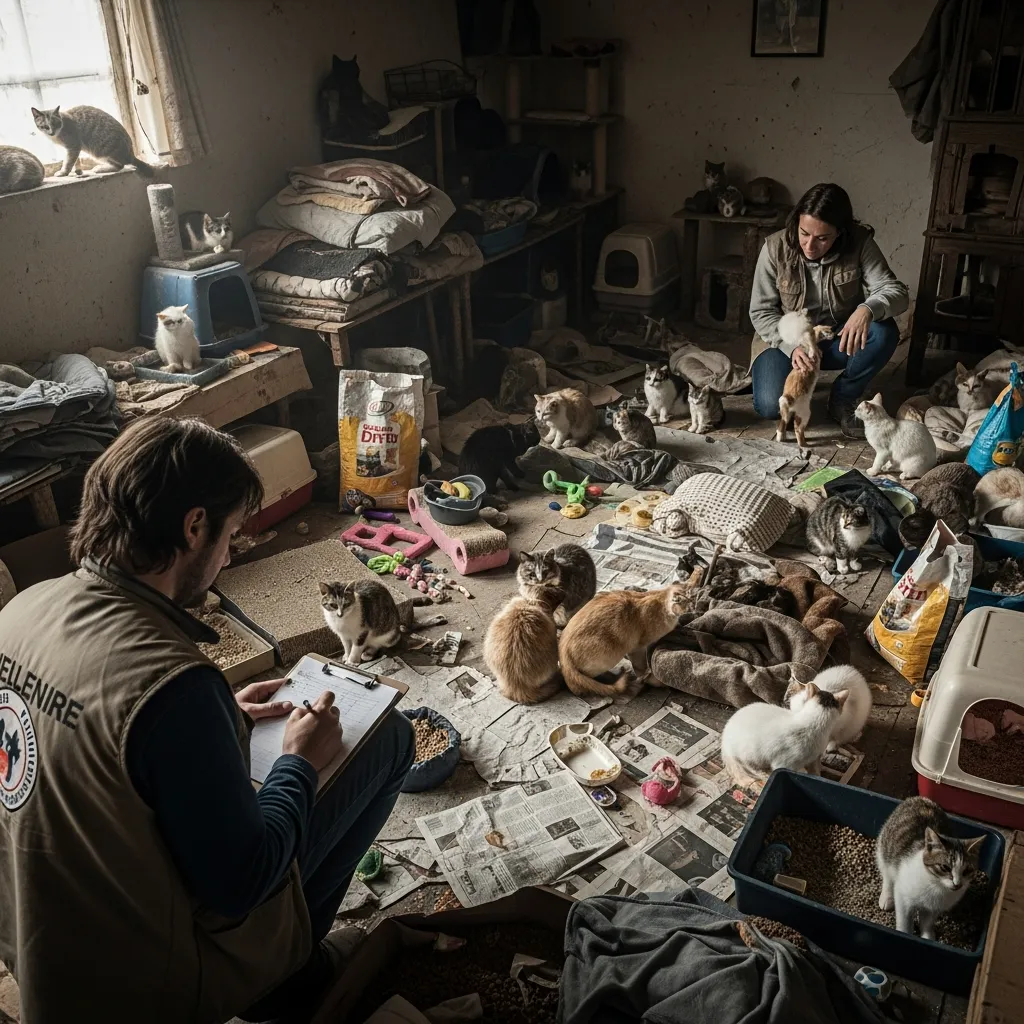
An animal hoarder is not simply someone who owns a lot of pets. The clinical and legal definition turns on three things working together: (1) accumulating more animals than the person can adequately care for, (2) failing to provide minimum standards of nutrition, sanitation, shelter, and veterinary care, and (3) denial of that failure even as conditions deteriorate around them. All three have to be present. A breeder with thirty well-cared-for dogs is not a hoarder. A neighbor with five cats in a clean apartment is not a hoarder. A self-described "rescuer" with seventy starving cats living in feces who insists the cats are fine — that is hoarding, and it's a recognized form of animal abuse.
Animal hoarding became a formal welfare category in the late 1990s through research at the Hoarding of Animals Research Consortium (HARC) and Tufts University's Center for Animals and Public Policy. In 2013 the DSM-5 added hoarding disorder as a distinct mental health condition, with animal hoarding listed as a recognized specifier. The estimate from HARC and the ASPCA is that roughly 250,000 animals in the United States are hoarding victims each year, with several thousand new cases identified annually.
The three diagnostic criteria, in detail.
Accumulation beyond capacity. The hoarder has more animals than they can house, feed, clean for, and provide veterinary care for. The threshold isn't a fixed number — it depends on the species, the housing, and the resources available. Two horses on five acres is fine; two horses in a backyard with no shelter is not. Six cats in a 3,000-square-foot home is fine; six cats in a 400-square-foot apartment with no litter maintenance is not. (For the numbers question specifically, see how many animals is considered animal hoarding?) Hoarders almost always continue acquiring animals — through "rescues," found strays, or unspayed females breeding within the home — even after capacity is exceeded.
Failure to meet minimum welfare standards. This is the welfare consequence that makes hoarding criminal. Common conditions found in hoarding cases include severe starvation, dehydration, untreated parasites, infected wounds and tumors, dental disease, ammonia exposure, upper respiratory infections, ringworm, dead and decaying animals on the property, and animals living in their own waste. The animals are objectively suffering. This is the core overlap with the neglect category of animal cruelty.
Denial of the suffering. This is the diagnostic feature that distinguishes hoarding from ordinary neglect. The hoarder genuinely does not perceive the conditions as harmful. They will tell investigators the animals are loved, well-fed, and happy — even when standing in the room with starving and dying animals. They typically insist they are "rescuing" the animals from worse fates. Many will describe themselves as "the only one who can save them" and frame removal of the animals as an act of cruelty toward the hoarder, not the animals. This denial, sometimes called *anosognosia* in clinical settings, is what makes hoarding a hoarding-disorder diagnosis rather than simple neglect.
The "rescue hoarder" subtype. A subset of hoarders operate under the explicit cover of being a rescue, sanctuary, or no-kill organization. They take in animals from shelters, from owner surrenders, and from concerned citizens — often presenting clean intake paperwork and a sympathetic mission statement. Internally, conditions deteriorate. This is the most dangerous form of hoarding for the broader rescue community because it traps animals in worse conditions than the shelters they were "rescued" from, and it damages public trust in legitimate rescues. This is why vetting any rescue before donating or adopting matters — request a site visit, ask about veterinary partners, look up tax-exempt status and inspection records.
Demographic patterns. Hoarders skew older (most case studies show median age around 50–65), single, and isolated; women outnumber men in case files roughly 2:1 to 3:1. Many hoarders have a significant trauma history, and many co-occur with depression, dementia, or untreated psychiatric conditions. None of this excuses the conduct or the criminal exposure — animals still suffer regardless of the hoarder's intent — but it shapes the intervention strategy.
Recidivism. This is the hardest single fact about hoarding. Without ongoing intervention — court-mandated psychiatric care, animal-ownership prohibitions, regular welfare check-ins — recidivism rates approach 100%. Hoarders typically reoffend within a few years of having their animals removed, often acquiring a new colony at a different address. Most successful intervention programs combine criminal prosecution with mental-health treatment and a long-term ownership ban.
Warning signs of hoarding (from outside the home).
- A property where animals are visible and audible in numbers that don't match the housing.
- Strong urine/ammonia odor noticeable from the sidewalk or driveway.
- Windows blocked, blinds permanently shut, or interior visibly cluttered through whatever can be seen.
- A self-described "rescuer" who refuses site visits, refuses to disclose veterinary records, and has no clear adoption process.
- Multiple complaints over time from neighbors that have produced no apparent change in conditions.
- Animals visible in poor body condition — emaciated, with visible skin disease, untreated injuries, or matted coats.
Reporting suspected hoarding. Call your local humane society, animal control, or the police non-emergency line. Hoarding cases require warrants and inter-agency coordination (animal control, public health, code enforcement, and sometimes fire marshal), so the response time is longer than for an immediate-danger call. Provide the address, your specific observations, dates, and any photos taken from public property. You can usually request anonymity. Welfare organizations specifically welcome neighbor reports because hoarders rarely self-identify and the people closest to the situation are usually the only ones who see it.
For the adopter — what to expect from a hoarding-rescue pet. Animals removed from hoarding cases are usually placed through specialized rescues (often through breed-specific networks for dogs, or through cat-specific rescues that can absorb large intakes). After medical rehabilitation — dental, parasite, skin, URI — the animals typically need several months of careful socialization. Cats from hoarding cases often present as undersocialized but settle beautifully in calm indoor placements. Dogs may have severe space anxiety from never having had personal space and may need patient crate training and decompression time. The 3-3-3 settling-in framework usually stretches to 3-3-3 *months* for hoarding survivors. The published behavioral history on each pet's profile tells you what kind of household environment the rescue believes the pet needs.
How PawMates Pro helps adopters and shelters handle hoarding-rescue pets
Animals removed from hoarding cases usually arrive at partner shelters in batches, with months of medical and behavioral rehab ahead. PawMates Pro publishes the rescue's full disclosure on each pet's profile — what conditions the pet was removed from, what triage they've received, and what kind of household the rescue believes the pet needs. The compatibility score weights that recommended-household profile against your specific situation, so a pet that needs a calm, patient, single-pet home doesn't surface for a high-energy multi-pet household.
PawMates Fund supports shelters that absorb large hoarding seizures and the long rehab work that follows.
Frequently asked questions
Is animal hoarding a crime?
Yes. Hoarding is prosecuted under state animal-cruelty statutes (typically the neglect provisions) and is now formally classified as one of the four recognized types of animal abuse. Most cases produce misdemeanor or felony charges depending on the number of animals and the severity of conditions. See what's the difference between animal cruelty and animal abuse? for how the conduct is charged.
Are hoarders mentally ill?
Most hoarders meet diagnostic criteria for hoarding disorder under the DSM-5, often co-occurring with depression, anxiety, or untreated trauma. The mental-health component does not preclude criminal charges — courts routinely combine prosecution with mandated treatment.
What's the difference between a multi-pet household and hoarding?
Three things together: capacity, welfare, and denial. A household can keep many pets responsibly if all of them get adequate food, water, shelter, sanitation, and veterinary care, and if the owner accurately recognizes the limits of what they can manage. Hoarding is the failure of all three at once.
Do "rescue hoarders" really exist?
Yes, and they're one of the most damaging subtypes. Operating under rescue or sanctuary cover, they collect animals from concerned citizens and other shelters and then fail to provide care. This is a major reason vetting any rescue matters — site visits, veterinary partner verification, and tax-exempt status checks are the single best protection.
What happens to animals removed from hoarding cases?
After veterinary triage and rehabilitation through specialized rescues, most are eventually placed for adoption. Some need long-term sanctuary placement, particularly cats from severe undersocialization cases. Adopting a hoarding-rescue pet usually requires patience and realistic expectations — but the success rates in the right households are high.
How can I tell if a neighbor is hoarding?
Strong ammonia odor, large numbers of visible/audible animals not matching the housing, blocked windows, refusal of site visits if they claim to be a rescue, and visible animals in poor condition. Report concerns to your local humane society, animal control, or police non-emergency line.
For the count question specifically, see how many animals is considered animal hoarding?.
Keep reading: animal hoarding, abuse, and the law
Hoarding is its own welfare category — but it overlaps with cruelty law and the abuse framework. These guides explain how.