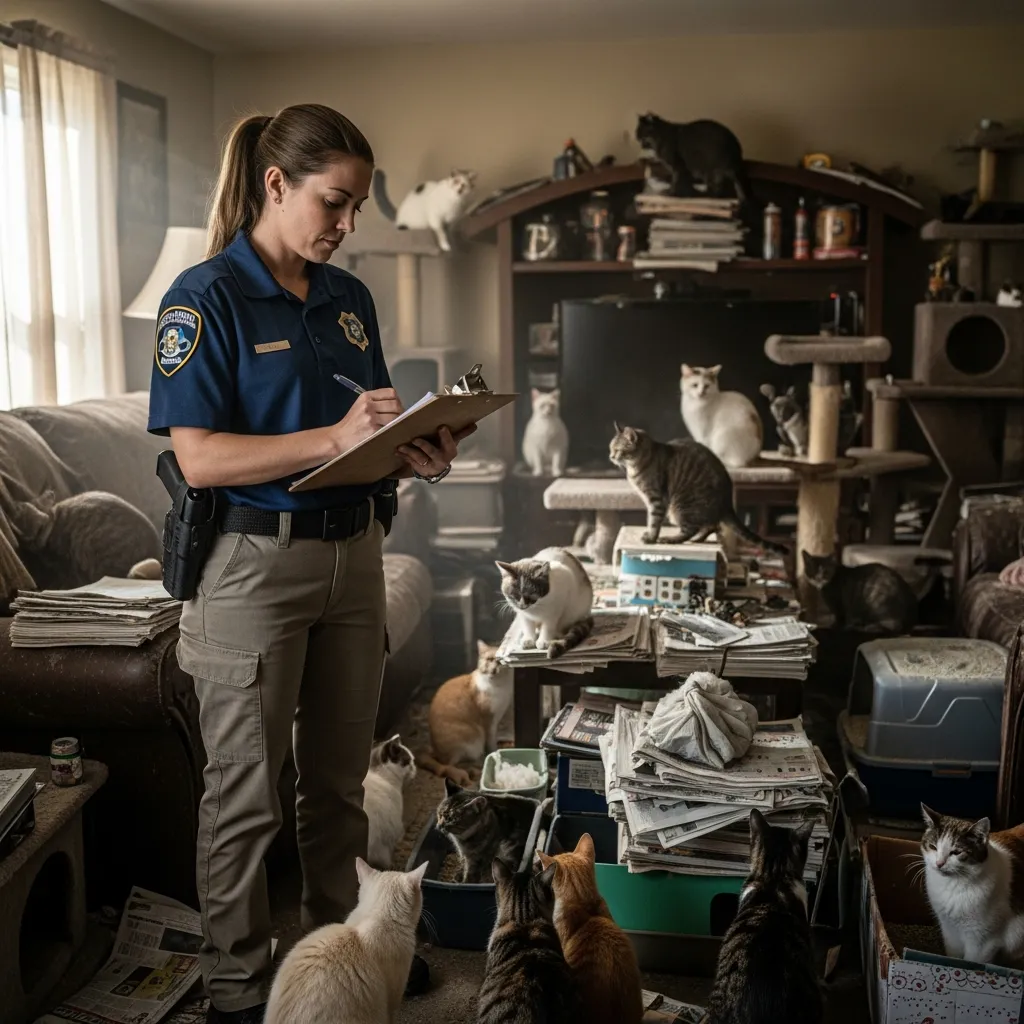
There is no fixed number of pets that automatically makes someone a hoarder. The legal and clinical definition isn't about the count — it's about whether the owner can provide adequate food, water, shelter, sanitation, and veterinary care for the animals they have, and whether they recognize the conditions if they can't. Six well-cared-for cats in a clean home is not hoarding. Six starving cats in a feces-covered apartment is. The same goes for sixty. The question welfare investigators ask is capacity, conditions, and denial — covered in detail in what makes someone an animal hoarder? — not the raw count.
That said, certain numbers do matter for legal purposes — many cities and counties cap how many companion animals a single residence can keep without a kennel or breeder license, and some jurisdictions use bright-line numbers for hoarding-specific statutes. The two questions ("How many can I keep legally?" and "How many is hoarding?") have different answers, and conflating them is one of the most common mistakes in this area.
Local pet-limit ordinances. Most U.S. municipalities cap the number of dogs and cats a household can keep without commercial licensing. Typical limits run 2–4 dogs and 4–6 cats per residence, though the exact numbers vary widely by city. Above the limit, the household needs a kennel license, breeder license, or rescue/sanctuary registration — which carries its own inspection, zoning, and welfare requirements. Exceeding the local pet limit is usually a code violation, not a hoarding charge — but if welfare conditions are also poor, both charges can be filed together.
State-level hoarding statutes. As of 2026, only a handful of U.S. states have hoarding-specific statutes; most prosecute hoarding under general animal-cruelty law. Of the states that do have specific statutes:
- Illinois defines a "companion animal hoarder" as someone who keeps a number of companion animals beyond their ability to provide adequate care, fails to provide that care, and is in denial of the resulting harm. There is no fixed number in the statute — the conduct, not the count, controls.
- Hawaii uses a similar three-part test under its 2008 hoarding statute, also without a numeric threshold.
- Other states (Vermont, Rhode Island, several others) have introduced or proposed hoarding-specific bills with similar conduct-based definitions.
The numbers researchers actually see. Case data from the Hoarding of Animals Research Consortium (HARC), Tufts University, and the ASPCA shows the median hoarding case in the U.S. involves roughly 30 to 50 animals, with the mean higher because of large-case outliers. Reported case counts span from as few as 10 animals (typically in tight urban housing) to several hundred or even thousands in extreme cases — many of them involving "rescue" or "sanctuary" cover. Cat cases tend to involve larger numbers than dog cases because cats reproduce quickly inside a closed environment if intake continues without spaying.
The American Psychiatric Association threshold for diagnosis. The DSM-5's hoarding-disorder criteria (and the proposed animal-hoarding subtype criteria from clinical literature) do not use a numeric threshold either. The diagnostic features are the accumulation pattern, the distress and impairment, and the denial — not the headcount. A person can meet hoarding-disorder criteria with 12 animals if the conditions and the denial are present. A person with 60 animals on a working farm with full veterinary support and accurate self-assessment does not.
Why the count matters less than people think.
- Two cats in a 200-square-foot studio with no litter maintenance is hoarding. Welfare conditions are the controlling factor.
- Twenty cats in a properly maintained house with a vet on retainer is not hoarding. Capacity and conditions are met.
- Sixty cats in a "rescue" with no vet records, no adoption process, and locked doors is hoarding. Even with the rescue label.
The point of the conduct-based definition is exactly this: a numeric threshold would catch responsible breeders, working-farm owners, and well-run sanctuaries, while missing tight-quarters cases that are causing the most acute suffering.
Practical implications if you keep multiple pets. If you legitimately keep more pets than your local ordinance allows, the right move is to apply for the relevant license — kennel, breeder, fancier, or rescue/sanctuary — *before* a complaint forces an inspection. Licensed multi-pet households are not hoarders by any definition, and they avoid the code-violation exposure entirely. If you're a legitimate small rescue operating from a private residence, register the rescue, document veterinary partnerships, run a real adoption process, and welcome inspections — these are exactly the practices that distinguish a real rescue from a "rescue hoarder." A growing share of pet surrender intake at municipal shelters traces back to hoarding seizures, which is one reason the welfare community is investing more in early identification and intervention.
For potential adopters. A pet listed as "rescued from a hoarding case" or "removed from a multi-pet seizure" usually went through veterinary triage and a stretch of careful socialization before reaching the adoptable feed. These pets are often medically resolved by adoption time but may need extra patience around food, space, and noise — common patterns from never having had personal space. The published behavioral history on each pet's profile tells you what the rescue thinks the pet needs.
How PawMates Pro helps you adopt a multi-pet seizure survivor
Pets from large hoarding seizures often spend months in veterinary triage and behavioral rehab before they reach the adoptable feed. PawMates Pro publishes each partner shelter's full notes on the pet's profile — the conditions they came from, what medical rehab they've completed, and what household environment the rescue believes will fit. The deterministic compatibility score weights that household-type recommendation against your specific situation, so the survivors that surface at the top of your feed are the ones the shelter believes can settle in your home.
PawMates Fund and the Recurring Giving Club support the shelters and rescues that absorb hoarding-case intakes — the most resource-intensive seizures in the welfare system.
Frequently asked questions
What is the legal limit on pets per household?
It varies by city, county, and state. Most U.S. municipalities cap dogs at 2–4 and cats at 4–6 per residence without a kennel or breeder license. Check your local code or call your animal control office for the specific number where you live.
Can you be charged with hoarding for having more than the local pet limit?
Not automatically. Exceeding a pet limit is usually a code violation. Hoarding charges require evidence of inadequate welfare conditions and (in most charging documents) some indication of the owner's denial. The two charges can be filed together if both elements are present.
What's the average number of animals in a hoarding case?
Research from HARC and the ASPCA puts the median around 30–50 animals per case, with cat cases skewing larger than dog cases. Cases involving "rescue" or "sanctuary" cover often run into the hundreds.
Can you hoard with just a handful of pets?
Yes, if welfare conditions are poor and the owner denies it. Hoarding is conduct-based, not count-based. Tight-quarters urban cases sometimes involve as few as ten animals.
Is having a lot of pets the same as hoarding?
No. The capacity, conditions, and denial test is what matters. Many people keep large multi-pet households responsibly. Many "rescues" with hundreds of animals operate to a high welfare standard. The number alone does not determine hoarding.
What if I'm worried I'm becoming a hoarder?
Honest self-assessment matters here, because denial is the diagnostic feature. If you're asking the question, that's a meaningful sign you don't meet the denial criterion. Talk to your vet about realistic capacity for your housing, consider a temporary intake freeze, and reach out to a mental-health professional if you're struggling. Reputable welfare organizations and legitimate rescues can help with rehoming if needed without judgment.
For the broader conduct framework, see what makes someone an animal hoarder? and what are the 4 types of animal abuse?.
Keep reading: hoarding, rescue, and welfare law
The line between a large multi-pet household and a hoarding case matters for adopters, rescuers, and small rescue founders alike.