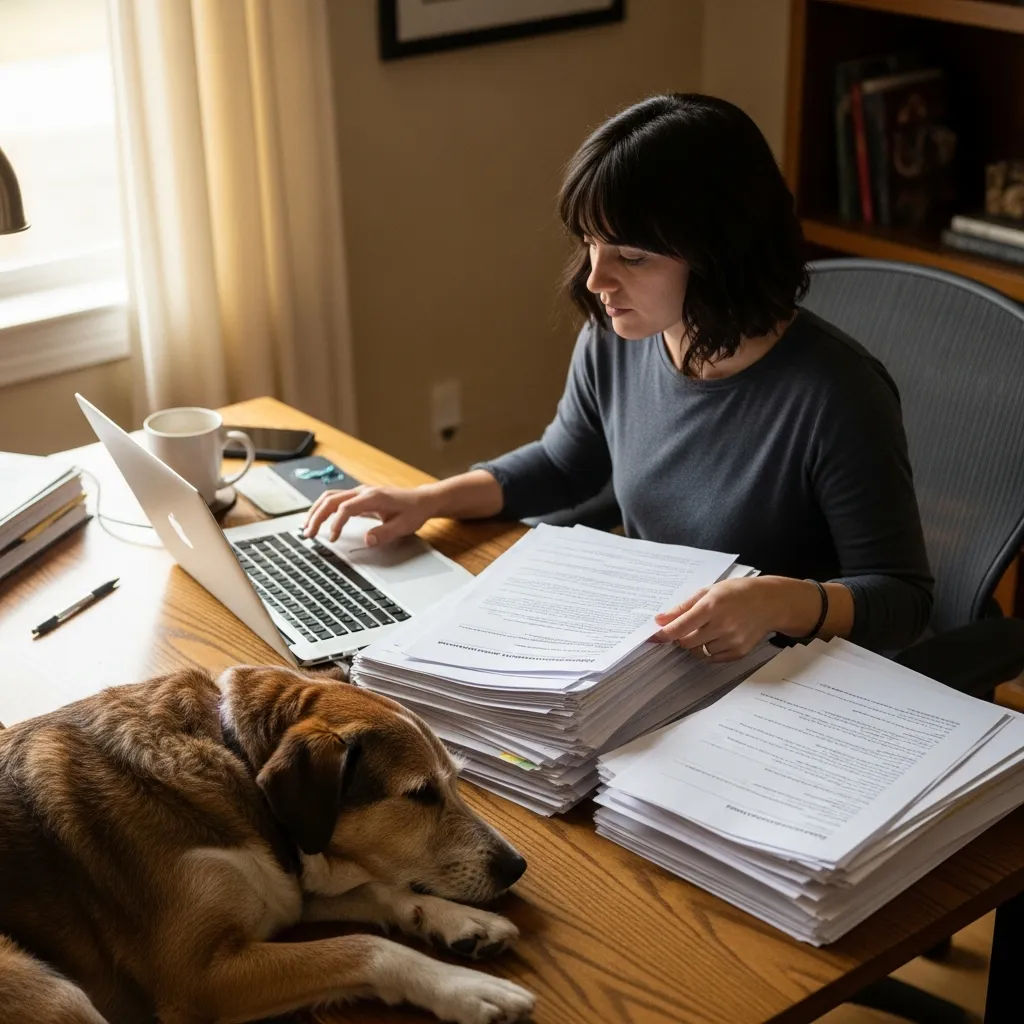
Starting an animal rescue means starting a small nonprofit. The animals come second to the paperwork in the first 6–12 months — not because the animals don't matter, but because every shortcut you take on incorporation, 501(c)(3) status, insurance, vet contracts, and intake protocols becomes a problem you'll spend years cleaning up. The rescues that survive past year three are almost always the ones that built the back office before the intake list. The rescues that fail or drift into hoarding-under-rescue-cover are almost always the ones that started with a litter of kittens and figured the paperwork could wait. This is the practical checklist.
This post assumes you've already worked through the self-assessment in do I have what it takes to start an animal rescue? and confirmed you have foster experience, a board, vet relationships, and at least $10,000–$25,000 in startup runway. If any of those are missing, fix them first — this is the next layer.
Step 1 — Define the mission and scope in writing. A workable rescue mission is specific: species, geography, and case type. "We rescue senior dogs from county shelters in [our county] and place them in foster-based adoptive homes." "We provide medical foster care for FeLV+ and FIV+ cats in [our metro area]." Specific missions keep you out of cases you can't handle, drive consistent fundraising messaging, and make it possible to say no without guilt. Broad missions ("we help animals in need") are the leading indicator of rescues that drift into over-intake.
Step 2 — Form the board first. A 501(c)(3) requires a minimum of three unrelated directors. Don't fill those seats with family members or your closest friends — fill them with people who bring real skills: a CPA or accountant for finance oversight, a lawyer for contracts and liability, a veterinarian or vet tech for medical protocols, a marketing or fundraising professional, and at least one experienced rescue operator from another organization. The board hires the executive director (often you), approves the budget, and is legally responsible for the organization's conduct. A weak board produces a weak rescue.
Step 3 — Incorporate as a nonprofit in your state. File articles of incorporation with your state's secretary of state. The form is short and the filing fee is usually $25–$200 depending on state. Use a name that's specific enough to be searchable and distinct from existing rescues — your state will reject duplicates. Adopt bylaws that specify board meeting frequency, voting procedures, conflict-of-interest policies, and document-retention practices. Most rescue-friendly nonprofit lawyers will produce a starter set of bylaws for $500–$1,500.
Step 4 — Get your EIN. Apply directly with the IRS at IRS.gov — it's free and takes about 10 minutes. You'll need the EIN for the bank account, the 501(c)(3) application, and every donor receipt you ever issue.
Step 5 — Apply for 501(c)(3) tax-exempt status. This is Form 1023 or Form 1023-EZ. The standard 1023 is $600 and runs 80+ pages with attachments; the 1023-EZ is $275 and is a streamlined application available to organizations expecting under $50,000/year in gross receipts for the first three years. Most small rescues qualify for the 1023-EZ. Approval typically takes 1–6 months for the EZ and 3–12 months for the standard form. Without 501(c)(3) status, donors can't write off contributions and most grants are unavailable. Do not start fundraising before you have at least filed, and disclose to donors that the application is pending.
Step 6 — Register for charitable solicitation in every state you fundraise from. Roughly 40 states require nonprofits to register before soliciting donations from residents — including online donations from those states. The fees range from $0 to several hundred dollars per state. The Multi-State Filer Project's Unified Registration Statement covers about 35 states with one form. Many small rescues skip this step and become liable for fines later. Don't.
Step 7 — Open a dedicated bank account. Use the rescue's EIN, not your personal Social Security number. Two signers minimum on the account. Never commingle rescue funds with personal funds — it's the fastest way to lose 501(c)(3) status and the easiest red flag for IRS or state audit.
Step 8 — Get insurance. A rescue without insurance is one bite, one car accident, or one volunteer injury away from being shut down personally. The standard package:
- General liability ($1M minimum) — covers visitor injuries, property damage at adoption events.
- Professional liability / errors & omissions — covers adoption disputes and behavioral disclosure claims.
- Animal bailee coverage — covers injuries to animals in your custody.
- Directors and officers (D&O) — protects board members personally from suits over rescue conduct.
- Workers' compensation if you have any paid staff (required by state law in most states).
- Auto coverage rider for personal vehicles used to transport animals.
Most rescues pay $1,500–$5,000/year total for this stack. Specialty insurers like Philadelphia Insurance Companies, Markel, and Pet Care Insurance cover most of the rescue market.
Step 9 — Sign written agreements with at least one veterinary clinic. A handshake deal with a friendly vet is not a vet contract. The written agreement should cover: rescue rates for routine care, after-hours emergency protocol, high-volume spay/neuter pricing, payment terms (most clinics require payment at time of service or net-30), and what happens if the clinic is at capacity. Many rescues build a rotation of 2–3 clinics so no single closure cripples them.
Step 10 — Build foster, intake, and adoption SOPs. Standard operating procedures sound bureaucratic, but they're the difference between a rescue that scales and one that drowns in disputes. Minimum SOPs:
- Intake: what species and case types you'll take, what triage you'll do, what the medical-clearance protocol is, how you decline cases without burning relationships.
- Foster placement: application form, vet check, home visit, signed foster agreement, supply provisioning, weekly check-ins.
- Veterinary care: vaccine schedule, spay/neuter timing, microchip protocol, what gets reported back to the foster vs. handled by the rescue.
- Behavioral assessment: standardized framework (most rescues use a modified ASPCA SAFER or Match-Up II) so your behavioral profiles are consistent and defensible.
- Adoption screening: application form, reference check protocol, home visit (in person or virtual), adoption contract with a return clause, fee schedule.
- Adoption contract: must include a return-to-rescue clause for the lifetime of the pet, spay/neuter requirement if not already done, and microchip transfer.
- Returns: how to handle returned adoptions without judgment — see the ugly truth behind returning pets to shelters for why this matters.
Step 11 — Set adoption fees that cover real cost. The ASPCA's national average adoption fee is currently around $150 for cats and $250–$400 for dogs, but the actual cost of getting an animal to adoption-ready averages $300–$700 (vaccines, spay/neuter, microchip, parasite prevention, intake medical, occasional dental or surgery). Adoption fees should cover most of that, with the gap closed by donations and grants. Fee waivers should be reserved for adopters of seniors, special-needs animals, or hard-to-place pets — not as a default discount.
Step 12 — Set up the website, donations, and adoption listings. At minimum:
- A clear mission statement and current adoptable pets on the website.
- Public posting of your 501(c)(3) status and most recent Form 990 (mandatory for transparency).
- An online donation form (Stripe, GiveButter, or Donorbox are common).
- Adoption listings on Petfinder and Adopt-a-Pet (free for registered rescues) and on PawMates Pro so adopters can find your pets through swipe-based matching with the same compatibility scoring every partner shelter uses.
Step 13 — Bookkeeping and tax compliance from day one. Set up QuickBooks (or a simpler equivalent like Wave) with a chart of accounts that separates restricted donations, adoption fee revenue, in-kind veterinary services, and operating expenses. Issue donor acknowledgment letters within 30 days of any donation $250+. File Form 990-N (e-Postcard) annually if your gross receipts are under $50,000, Form 990-EZ if between $50K and $200K, or full Form 990 if larger. Missing three consecutive 990 filings causes automatic loss of 501(c)(3) status — which is harder to get back than to maintain.
Step 14 — Build the volunteer pipeline. Most operating rescues need 5–10× more volunteer hours than founders initially estimate. Set up a simple volunteer application, basic background check process (especially for anyone transporting animals or working at adoption events with minors present), and an onboarding orientation. VolunteerMatch and SignUpGenius cover most coordination needs for free.
Step 15 — Plan for sustainability before scale. Don't take on more animals than your foster network can hold. Don't grow your annual budget faster than your fundraising base. Don't drop SOPs because you're "just doing this case differently this once." The most common death-spiral pattern: founder takes too many animals → care quality drops → adoptions slow → animals stay longer → costs rise → fundraising can't keep up → founder burns out or the rescue slides into hoarding territory. Sustainable scale beats heroic scale every time.
A note on the licensing trend. As of 2026, a growing number of states (Virginia, Pennsylvania, Maryland, Maine, others) have moved to require rescue-specific licensing — separate from general 501(c)(3) status — with annual inspections, intake limits, and welfare standards enforced by state agriculture departments. These laws are a direct response to the "rescue hoarder" subtype. If you're in one of those states, treat the licensing requirement as a feature, not a burden — it builds donor and adopter trust and produces real welfare protections.
A note on partnerships. New rescues should not try to do everything alone. Partner with municipal shelters for intake (many will give you priority pull privileges), with local breed clubs for breed-specific cases, with humane law enforcement for cruelty-seizure placements, with rescue-friendly veterinary specialists (cardiology, dentistry, dermatology) for cases you can't handle in-house. Most successful rescues operate as nodes in a regional network, not as solo operations.
The first-year reality check. Plan for the first year to be 80% administrative and 20% animal care. The mix shifts in years two and three as the back office is established and the intake/foster pipeline matures. Founders who try to flip that ratio in year one almost always end up in trouble. The animals are well-served by a rescue with bookkeeping, insurance, and SOPs — even a small one.
How PawMates Pro helps new rescues launch faster
PawMates Pro's partner network gives new rescues a free, swipe-based publishing surface for their adoptable pets, with the same deterministic compatibility scoring used by every partner shelter — including yard, energy, experience, kids, other pets, time alone, and housing. That means your adoptable pets are surfaced to the adopters whose households actually fit, which reduces returns and improves placement quality. Listing on PawMates Pro takes minutes after your 501(c)(3) application is filed.
PawMates Pro also routes funding to partner rescues through PawMates Fund and the Recurring Giving Club, both of which can supplement your operating budget once you've published your first listings.
Frequently asked questions
How long does it take to actually start a rescue?
Plan for 6–12 months from first board meeting to first intake. Incorporation takes 1–4 weeks, the EIN is same-day, the 1023-EZ application takes 1–6 months, charitable solicitation registration takes 2–8 weeks per state, vet contracts take 4–12 weeks to negotiate, and SOP development takes 1–3 months.
Can I take animals before 501(c)(3) approval?
Legally yes — but you can't issue tax-deductible receipts and you can't apply for most grants. Most rescues file their incorporation and 1023 first, then begin small-scale intake while the IRS application is pending, with explicit donor disclosure.
What's the minimum board size?
Three unrelated directors for federal 501(c)(3) eligibility. Most successful rescues operate with 5–9 board members because that spreads the workload and committee responsibilities.
Do I need a physical facility?
No. The majority of small and medium U.S. rescues are foster-based. A facility multiplies your operating costs by 5–10× and is rarely the right choice in the first 3–5 years.
What's the biggest legal exposure for a new rescue?
Bite cases (an adopted dog injures someone), behavioral non-disclosure (you didn't disclose a known issue), and adoption disputes (the adopter claims the pet was misrepresented). Insurance, written behavioral assessments, and a clear adoption contract are the three protections.
How do I know if my state requires rescue-specific licensing?
Check your state's department of agriculture (most common), department of consumer protection, or attorney general's office. As of 2026, more than a dozen states have rescue-specific statutes — and the list is growing.
What's the single most important thing to get right in year one?
Capacity discipline. Don't take more animals than your foster network can absorb. The rescues that fail almost always fail because they over-intake before the operations and fundraising can support it. See what makes someone an animal hoarder? for the failure mode that follows over-intake.
For the personal-readiness side of the same question, see do I have what it takes to start an animal rescue?. For the foster pathway, see what does it take to be a foster?.
Keep reading: rescue startup, fostering, and welfare law
Before you file 501(c)(3) paperwork, read how others got started — and where well-meaning rescues cross the line into hoarding.