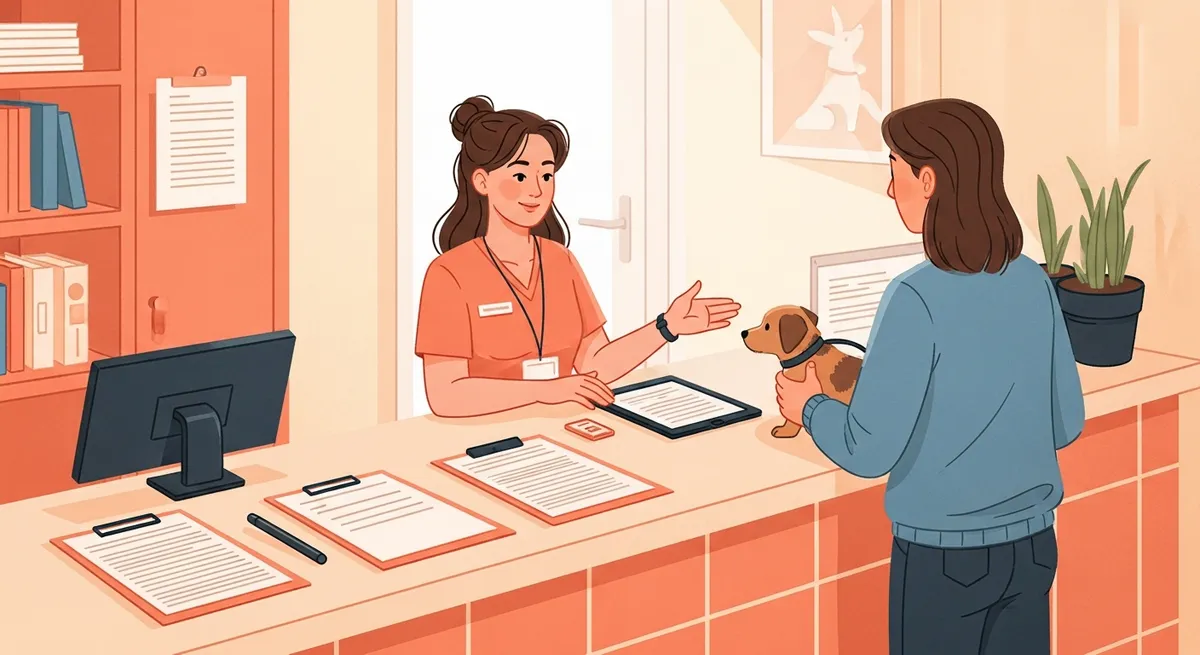
Intake is where every shelter's day starts going wrong. It's also where the day is most fixable. Overwhelmed shelter staff don't usually need more hands at intake — they need fewer steps, less duplicate data entry, and a workflow that actually fits the dozen different scenarios that walk through the door (stray, owner-surrender, transfer, born-in-care, return). Here are the intake solutions that meaningfully reduce staff load without cutting corners on data quality or animal welfare.
Why intake breaks under load
A typical intake on legacy systems involves: paper form, kennel card, Excel sheet, photo upload, microchip scanner, vaccine sticker book, and finally data entry into the shelter management system — sometimes the same fields entered three or four times. On a quiet Tuesday this is annoying. On a Saturday with seven strays, two surrenders, and a transfer, it's the reason your staff is still there at 8pm.
The downstream costs are worse than the on-the-day pain. Half-finished intakes mean missing medical history, wrong age estimates, no photo, and a kennel card that doesn't match the animal — which means longer length of stay, more returns, and more behavioral surprises later. (How to Reduce Animal Shelter Return Rates breaks down how intake quality affects returns specifically.)
The five intake scenarios and what each one actually needs
Most shelters use one intake form for everything. That's the root problem. The five real scenarios each need different fields and different workflows:
1. Stray intake. Microchip scan, found-location, hold-period clock, lost-and-found cross-check, photo for the public lost board.
2. Owner surrender. Surrender reason (in standardized values, not free text — see Surrender Prevention Programs: Alternatives Your Shelter Should Offer), full known-history, vet records if available, behavior history including bite history (How Shelters Should Handle Bite History Disclosures at Surrender covers this in detail), prior owner contact info.
3. Transfer in. Source shelter, transfer date, prior medical records, prior behavior notes — almost no duplicate work needed if the source shelter sends a clean record.
4. Return. Original adoption record lookup, return reason, what changed in the home, behavior in the home vs. behavior in the shelter.
5. Born in care. Mother's record link, litter ID, birth date, wean date, separate medical timeline.
A well-designed intake flow detects which scenario you're in from the first one or two questions and shows only the fields that matter for that scenario. Staff stops scrolling past 80% of irrelevant inputs.
Solutions that reduce intake time without losing data quality
- Mobile intake at the kennel. Staff doesn't have to go back to a desktop. Photos taken on the same device immediately attach to the record.
- Pre-filled forms from prior records. A returned animal pulls forward all known medical and behavior history. A transfer pulls forward the source shelter's records.
- Microchip-first lookup. Scan the chip before opening a new record — half of "new" intakes are actually returns or strays whose owners can be reached.
- Standardized dropdowns for surrender reason, condition on intake, and behavior flags. Free-text fields look flexible but make every downstream report useless.
- Auto-generated kennel card on save. No second data entry. The card prints from the same record the system already has.
Where staff burnout actually comes from at intake
It's not the number of animals. It's the *uncertainty* — whether the form is complete, whether the kennel card matches, whether anyone updated the spreadsheet, whether the vet knows about the new arrival, whether the photo got taken. Every uncertainty is a small open loop that the brain has to hold. A clean intake workflow closes those loops automatically. The phrase you hear in the lowest-burnout shelters is "the system already knows." How Automation Reduces Shelter Burnout goes into this in more depth.
What PawMates Pro changes here
PawMates Pro's intake wizard branches by scenario from the first question, looks up returning animals by microchip or prior-adopter email and pulls forward the original record (medical history, behavior notes, prior bio), captures the microchip number directly into the record, and generates a printable kennel card on save. Staff can intake from a phone at the kennel and the data is on the shelter dashboard before they're back at a desk. Photos taken in the wizard attach directly. Bite history is a required structured field for surrenders, and behavior and medical flags follow the animal everywhere their record appears. There's no second data entry anywhere in the flow.
For shelters drowning in paper-and-spreadsheet intake, switching to a flow built for the five scenarios — instead of one form for everything — usually saves 20–40 minutes per intake. On a shelter taking in 30 animals a week, that's two full staff-days a week recovered. (Cloud-Based vs. Legacy Shelter Software covers why legacy systems can't catch up here.)
A 30-day intake reset
If you can't replace your software tomorrow, you can still cut intake time meaningfully:
- Day 1–7: Audit your current intake form. Count how many fields are irrelevant to half of intakes. Build branched paper forms by scenario.
- Day 8–14: Standardize your dropdowns. Replace every free-text categorical field with a dropdown of allowed values.
- Day 15–21: Move photo capture and microchip scanning to mobile. Stop walking back to a desktop.
- Day 22–30: Write a one-page "what to do next" checklist for each intake scenario and put it on the back of the kennel card so any staff member can pick up the animal mid-flow.
Most shelters that do this see 30%+ reduction in intake time and a meaningful drop in incomplete records, even before any software change. After that, the case for a system built around branched intake usually makes itself.