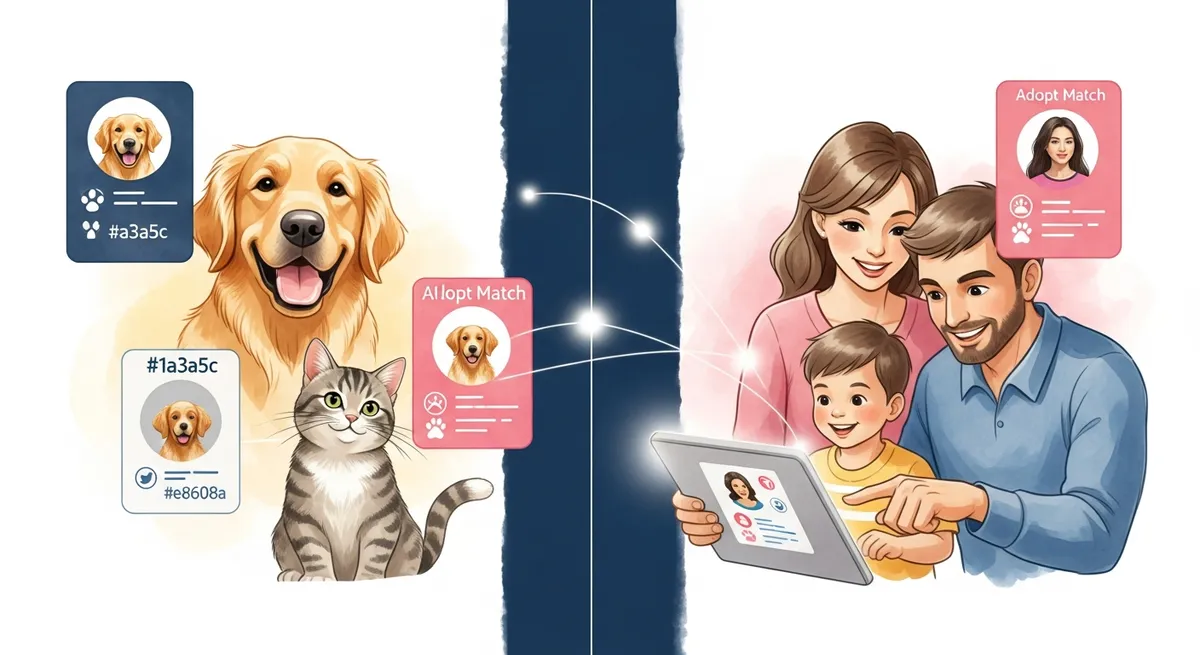
The traditional shelter adoption process relies heavily on intuition and manual effort. Staff review applications one by one, try to recall which animals might be a good fit, and hope the match sticks. When it doesn't, the animal comes back — stressed, confused, and harder to place the second time.
AI-powered adoption matching changes this fundamentally. Instead of relying on memory and gut feeling, shelters can use structured data to connect the right pets with the right people — faster, more accurately, and with better long-term outcomes.
Here's how it actually works, what it changes for shelter operations, and why it matters for the animals.
How AI Adoption Matching Works
At its core, AI adoption matching analyzes adopter applications against animal profiles. But it's not a simple keyword search — it's a multi-factor compatibility assessment that considers the full picture on both sides.
On the adopter side, the system evaluates:
- Living situation — apartment vs. house, yard access, square footage
- Household composition — children (and their ages), existing pets, number of adults
- Experience level — first-time owner, some experience, or experienced handler
- Lifestyle factors — activity level, work schedule, time available for a pet
- Preferences — species, breed, age range, energy level, size
On the animal side, the system factors in:
- Behavioral evaluation results — energy level, reactivity, sociability, resource guarding tendencies
- Medical needs — ongoing conditions, medication requirements, activity restrictions
- Compatibility flags — good with kids, good with dogs, good with cats, needs a yard
- Experience requirements — whether the animal needs a first-time-friendly home or an experienced handler
The system then scores each potential match across these dimensions, surfacing the most compatible adopters for each animal and the most compatible animals for each adopter.
Hard Filters vs. Preference Matching
Not all compatibility factors are weighted equally. The best AI matching systems use a two-layer approach:
Hard filters are non-negotiable. If an animal is marked as "not good with children" and an adopter has a 3-year-old, that match is blocked entirely — the adopter simply won't see that animal. These filters protect animal welfare and adopter safety. Common hard filters include:
- Household safety (children, existing pets)
- Yard requirements for dogs that need outdoor space
- Experience level minimums for animals that need experienced handlers
Preference matching scores the remaining candidates based on lifestyle alignment. An adopter who wants a low-energy companion gets higher compatibility scores with calm, older animals. An active runner sees high-energy dogs ranked higher in their results.
This layered approach means every match an adopter sees has already passed the safety checks — staff are reviewing pre-qualified applicants, not sorting through unsuitable ones.
What This Changes for Shelter Operations
*Staff time recovery*
In a traditional workflow, staff manually review every application, mentally cross-reference it against available animals, and make judgment calls about fit. This is time-consuming, inconsistent, and heavily dependent on individual staff knowledge.
With AI matching, the system handles the initial screening. Staff review a shortlist of compatible matches rather than an unfiltered queue. This reduces administrative workload significantly — the same team processes more applications in less time.
*Reduced return rates*
Poor matches are one of the leading causes of adoption returns. An apartment dweller who adopts a high-energy working breed. A first-time owner who takes home a dog with significant behavioral needs. A family with young children who adopts a pet that isn't kid-safe.
When compatibility is assessed systematically rather than subjectively, these mismatches are caught before they happen. Better initial matches mean fewer returns, which means less trauma for the animals and less wasted staff effort.
*Faster placements*
When adopters see animals they're genuinely compatible with, they move faster. The "browse and hope" model is replaced with curated matches that feel relevant. This reduces the time between application and adoption — and directly impacts length of stay for shelter animals.
*Consistent decision-making*
Human reviewers have good days and bad days. They develop biases. They forget details. They leave and take institutional knowledge with them.
AI matching applies the same criteria every time, to every application, for every animal. This doesn't replace human judgment — staff still make the final call on every placement. But it ensures the judgment is informed by complete, consistent data rather than incomplete recall.
Where Human Judgment Still Matters
AI matching is a tool, not a replacement for shelter expertise. There are dimensions of compatibility that data alone can't capture:
- Chemistry during meet-and-greets — sometimes a match that looks perfect on paper doesn't click in person, and vice versa
- Nuanced behavioral observations — a dog who's anxious in the shelter environment may behave completely differently in a calm home
- Adopter commitment and flexibility — willingness to work through adjustment periods, invest in training, or modify their routine
- Gut instinct from experienced staff — decades of adoption experience produces pattern recognition that algorithms can't fully replicate
The best outcomes happen when AI handles the data-heavy screening and experienced staff handle the nuanced, relationship-based decisions. The system narrows the field; your team closes the match.
The Behavioral Evaluation Connection
AI matching is only as good as the data it works with. The quality of your behavioral evaluations directly determines the quality of your matches.
When staff complete thorough evaluations during intake — interaction style, touch sensitivity, resource guarding, prey drive, response to sounds — that information drives the matching engine. Marking a dog as "needs experienced owner" isn't just a note — it's an active filter that determines which adopters can discover that animal.
Shelters that invest in consistent, detailed behavioral assessments see significantly better matching results. Conversely, incomplete or inconsistent evaluations lead to less precise matches and higher return risk.
Impact on Overlooked Animals
One of the most powerful effects of AI matching is visibility for animals that would otherwise be overlooked. In a traditional browse-and-choose model, adopters gravitate toward young, cute, photogenic animals. Older pets, black dogs, cats with medical needs, and animals with behavioral quirks get passed over repeatedly.
AI matching surfaces these animals to adopters who are specifically compatible with them. A senior dog with low energy needs appears first in results for a retired couple seeking a calm companion. A cat with medication requirements shows up for an experienced owner who's indicated willingness to manage health needs.
This doesn't replace the need for targeted campaigns for overlooked animals, but it adds a systematic layer that runs continuously for every animal in the system.
Bonded Pairs and Special Cases
AI matching can also handle complex placement scenarios like bonded pairs. When two animals must be adopted together, the system adjusts compatibility requirements — searching for adopters with the space, budget, and experience to take on multiple animals simultaneously.
Similarly, animals with specific needs — FIV-positive cats, dogs with mobility limitations, pets requiring prescription diets — can be matched to adopters who've indicated capacity and willingness for those needs, rather than relying on staff to remember which applicants might be open to a special-needs animal.
How PawMates Pro Implements Compatibility Matching
PawMates Pro uses a compatibility-based hard-filter system that evaluates each adopter against each available pet and only surfaces pets that pass every requirement. The filters mirror the structured fields shelters already capture at intake:
- Experience required — the adopter's experience level is matched against the pet's handling requirement; first-time owners are filtered out of pets that need experienced handlers
- Household safety — children in the home, existing dogs, and existing cats are checked against the pet's compatibility flags (good with kids / dogs / cats)
- Energy alignment — the adopter's energy preference is matched against the pet's energy level
- Living situation — yard requirement, breed/age preferences, sex preference, and distance are all checked
When an adopter has seen every pet that passes all filters, an opt-in "Potential Matches" view surfaces near-fit pets along with a "Why this is a stretch" line listing the specific filters that didn't match (e.g. "needs a fenced yard"). Staff see exactly which filters drove visibility, and adopters see plain-language reasons rather than a black-box score.
The Bottom Line
AI adoption matching isn't about removing the human element from shelter adoptions. It's about giving your team better information, faster.
Every application gets the same thorough review. Every animal gets visibility with compatible adopters. Every match comes with data that helps staff make informed decisions.
The result: more placements, fewer returns, and animals spending less time waiting for the right person to find them.
That's what modern shelter technology is supposed to do — not add complexity, but remove the barriers between animals and the homes they deserve.
Frequently Asked Questions
How does AI improve the pet adoption process at animal shelters?
AI improves adoption matching by analyzing adopter applications against animal profiles — factoring in lifestyle, living situation, experience level, household composition, and the specific pet's behavioral and medical needs. This surfaces the most compatible matches automatically, reducing the time staff spend manually reviewing applications and improving placement quality, which in turn reduces return rates.
Does AI replace shelter staff in the adoption decision?
No. AI handles the data-heavy screening — evaluating compatibility across multiple factors simultaneously — but shelter staff make every final placement decision. The system narrows the field to pre-qualified matches; experienced staff use their judgment, meet-and-greet observations, and institutional knowledge to close the adoption. The best outcomes happen when automated screening and human expertise work together.
What data does AI use to match pets with adopters?
AI matching systems use adopter profile data (living situation, household composition, experience level, activity level, and preferences) and animal profile data (behavioral evaluation results, medical needs, compatibility flags for children and other pets, energy level, and experience requirements). The quality of matches depends directly on the quality and completeness of the data — particularly behavioral evaluations completed during intake.
Can AI help overlooked shelter animals get adopted?
Yes. In traditional browse-and-choose models, adopters gravitate toward young, photogenic animals while older pets, black dogs, and animals with medical or behavioral needs get passed over. AI matching surfaces these animals to adopters who are specifically compatible with them — a senior dog appears first for a couple seeking a calm companion, or a cat with health needs shows up for an experienced owner willing to manage medications. This systematic visibility runs continuously for every animal.
How does AI adoption matching reduce return rates?
Poor matches are a leading cause of adoption returns — a high-energy dog placed with a sedentary owner, or a reactive pet placed with a family with young children. AI matching catches these incompatibilities before placement by applying hard safety filters (blocking unsafe matches entirely) and preference scoring (ranking compatible matches by lifestyle alignment). Better initial matching means fewer adjustment failures and fewer animals cycling back through the shelter system.
What makes AI shelter software different from traditional shelter management systems?
Traditional systems store data — animal records, applications, medical histories — but leave the analysis and decision-making entirely to staff. AI-powered platforms actively use that data to surface insights, automate screening, flag risks, and recommend actions. The difference is between a filing cabinet and an operational tool that helps your team work faster and make better-informed decisions.
Featured book — see full article for details.
Related Articles
- Why AI-Powered Shelter Software is Better Than Traditional Systems
- The Future of Animal Shelter Technology: AI Is Changing Everything
- Understanding Shelter Dog Behavior: What It Really Means
- What Happens to Pets That Don't Get Adopted Quickly
- Strategies for Getting Bonded Pairs Adopted Together
- 20 Questions PawMates Pro Shelters Never Have to Ask