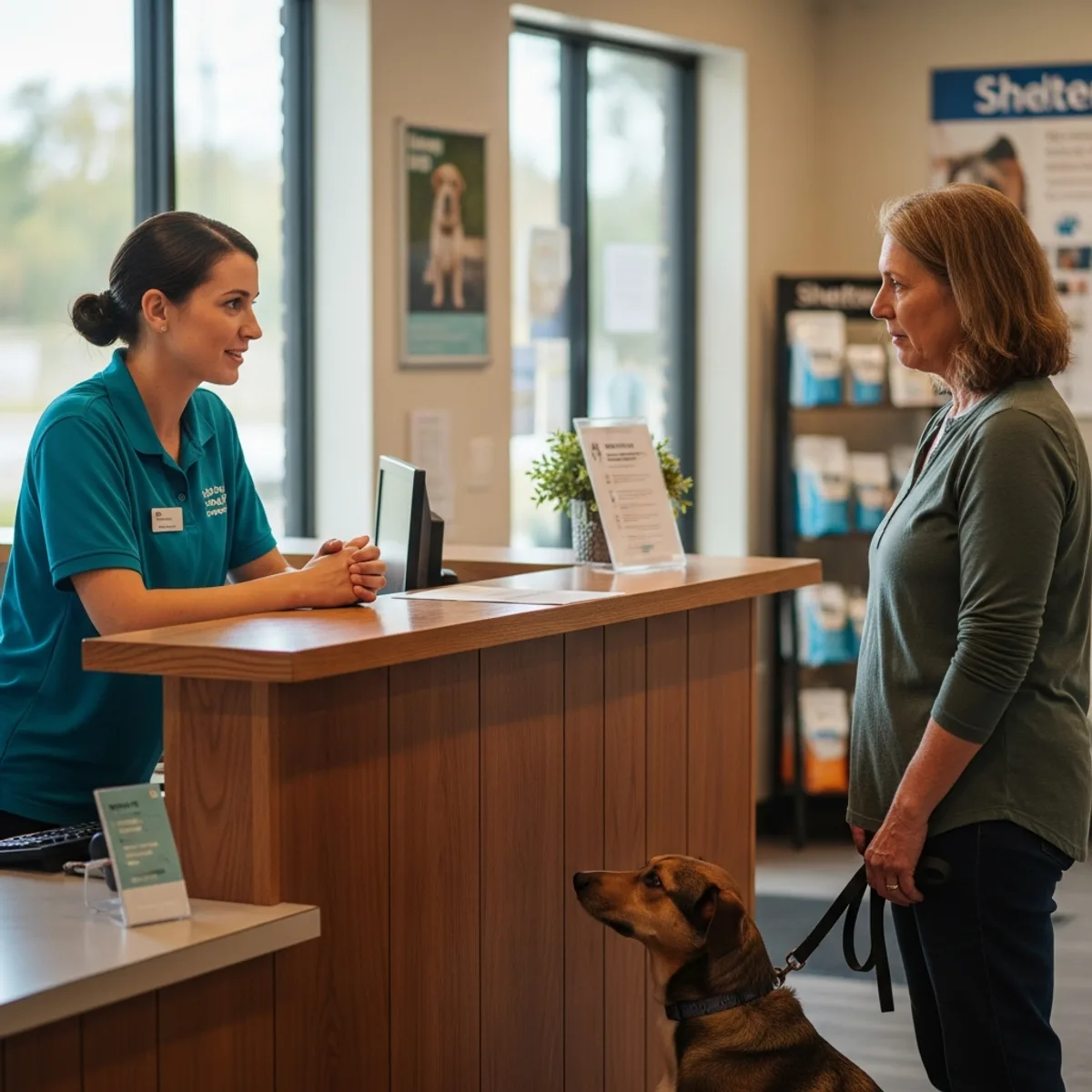
Every shelter has a few staff members who are unflappable at the front counter — the ones who can de-escalate an angry surrender, redirect a poorly-matched adopter, ask the hard questions on a stray hold, and end a hostile phone call without losing their composure or their compassion. The skill is real, but it is not magic. It is a small library of well-rehearsed sentences, used consistently, by everyone on the team.
This article is that library. Below are 24 ready-to-use scripts your staff and volunteers can deploy in the most common high-stakes public interactions, organized by situation. Print them, post them by the phone, embed them in onboarding, and log the conversations inside PawMates Pro so the next shift knows what was said and why.
For the operational case for documentation discipline behind every one of these conversations, see Turning Shelter Data Into Actionable Decisions and How Automation Reduces Shelter Burnout.
How to use these scripts
A few ground rules before the scripts themselves:
- Read them out loud once. Scripts that have never been spoken come out stilted. A single practice run is enough to make them sound like your own.
- Adapt the words, keep the structure. Each script has a job: acknowledge, reframe, offer an option, set a boundary. Keep the structure even when you change the phrasing.
- Document every difficult conversation. A two-line note in the animal's record or the surrender intake is enough to protect the team and the next decision. PawMates Pro's notes module is the place this lives.
- Train every shift, including volunteers. The script library only works if the public hears the same message from everyone.
---
1. When someone wants to surrender a pet
"I'm sorry you're going through this. Before we talk about surrender, I want to understand what's happening so we can see whether there's a way to help you keep your pet safely. Is the issue behavior, housing, cost, medical care, time, or something else?"
If surrender is still necessary:
"Thank you for being honest. Our goal is to get the most accurate information possible so we can place your pet safely. The more we know about their medical history, behavior, routines, and triggers, the better outcome they'll have."
---
2. When someone is angry about surrender fees or waitlists
"I understand this is frustrating. The reason we use appointments and fees is because every animal needs space, staff time, vaccines, medical care, food, and behavior assessment. We are not trying to make this harder for you. We are trying to make sure animals already here and animals coming in are cared for safely."
---
3. When someone says, "If you don't take this animal, I'll dump it"
"I hear that you're overwhelmed, but abandoning an animal is unsafe and may be illegal. Let's slow this down and figure out the safest next step. I can talk through emergency boarding, rehoming resources, pet food assistance, behavior support, or the soonest surrender option we have."
---
4. When someone wants to adopt but is not a good fit
"This animal is wonderful, but based on what you've shared, I don't think this is the safest match. That does not mean you're a bad adopter. It means this pet has needs that may not fit your household. My job is to protect you, your family, and the animal from a painful return."
Follow-up:
"Let's look at pets who are more likely to succeed in your home."
---
5. When someone is upset they were not approved
"I know this is disappointing. Adoption decisions are not personal judgments. We make them based on the animal's needs, safety, and long-term success. Our goal is not just to get pets adopted. Our goal is to keep them adopted."
---
6. When an adopter is choosing based only on looks
"They're definitely adorable. Let's also talk about energy level, behavior, medical needs, and your lifestyle. A cute face gets your attention, but compatibility is what makes the adoption work."
---
7. When someone asks, "Why is the adoption fee so high?"
"The adoption fee helps cover care the animal has already received, which may include vaccines, spay/neuter, microchip, medical exams, food, housing, and staff care. In most cases, the fee is far less than what those services would cost privately."
---
8. When someone wants a same-day adoption but the process takes longer
"I understand you're excited. We want that too. We also need to make sure the match is safe and informed. A little time up front can prevent heartbreak, returns, injuries, or another stressful transition for the animal."
---
9. When someone complains about application questions
"These questions are not meant to invade your privacy. They help us understand the environment the animal would be going into so we can make a responsible match. Different pets have very different needs."
---
10. When someone finds a stray and wants to keep it immediately
"I understand you may already feel attached. Legally and ethically, we have to give the original owner a chance to reclaim their pet. The animal may have a family looking for them right now. We can explain the stray hold process and what options may be available afterward."
For the adopter-side mechanics of identification and reunification, see the microchip lookup hub and why a microchip alone is not a registration.
---
11. When someone is angry their lost pet was adopted out
"I'm very sorry. I know this is painful. Let me review the record carefully so I can explain the dates, the stray hold period, identification checks, and notices. I don't want to guess or give you incomplete information."
---
12. When someone says shelter staff "don't care"
"I understand why it may feel that way in a stressful moment. The truth is, everyone here is trying to help as many animals as possible with limited space, time, and resources. We may not always be able to give the answer people want, but we do care."
---
13. When someone is rude or abusive to staff
"I want to help you, but I can't continue the conversation if I'm being yelled at or insulted. I'm happy to keep talking when we can speak respectfully."
If it continues:
"I'm ending this conversation now. You're welcome to contact us again when you're ready to speak respectfully."
---
14. When someone wants medical advice
"We can share what we know about the animal's history, but we can't diagnose or replace veterinary care. For anything medical, especially symptoms or medication questions, you'll need to speak with a veterinarian."
The VetPetz integration lets you hand the adopter a clean copy of the medical chart so their vet has the same record you do.
---
15. When someone asks if a pet is "good with kids"
"We can tell you what we've observed, but no shelter can guarantee behavior in every situation. What we look at is the animal's history, handling tolerance, energy level, fear responses, and how they react in different environments."
---
16. When someone asks if a dog is "aggressive"
"Aggression is a broad word, so we try to be specific. We look at what behavior happened, what triggered it, how intense it was, how quickly the dog recovered, and whether it can be safely managed."
---
17. When someone wants to return an adopted pet
"I'm sorry it hasn't gone the way you hoped. Before we process a return, can you tell me what's happening? Sometimes the issue is fixable with decompression time, training support, medical care, or a different routine."
If return is needed:
"Thank you for bringing them back safely instead of rehoming them without support."
The patterns behind returns are covered in Why Animals Get Returned After Adoption.
---
18. When someone says, "You should just euthanize aggressive animals"
"Behavior decisions are not made casually. We evaluate safety, quality of life, severity of behavior, available resources, and whether the animal can be responsibly placed. These are serious decisions, and they deserve careful review."
---
19. When someone says, "No-kill means you never euthanize"
"No-kill does not mean no animal is ever euthanized. It generally means healthy and treatable animals are not euthanized for space. Animals with severe suffering or serious public safety risks may still require humane euthanasia."
---
20. When someone asks why the shelter is full
"Shelters are full because more animals are coming in than leaving through adoption, rescue transfer, or reunification. Housing issues, veterinary costs, behavior challenges, and lack of spay/neuter access all contribute."
For the operational side of the same question, see Fixing Bottlenecks That Keep Pets Stuck in Shelters and How Data Can Predict Long-Stay Animals.
---
21. When asking for donations
"If you're able to help, donations directly support food, medical care, vaccines, enrichment, and emergency needs for the animals here. Even small donations make a real difference because our daily care costs never stop."
---
22. When recruiting fosters
"Fostering is one of the fastest ways to help. It opens kennel space, lowers stress for the animal, and gives us better information about how that pet behaves in a home. Even short-term fostering helps."
Rescues running PawMates Rescue can manage the entire foster registry, placements, and per-foster notes in one place.
---
23. When explaining why accurate records matter
"Good records protect animals. Medical notes, behavior observations, bite history, medications, vaccines, and adopter conversations all help us make safer decisions and avoid repeating mistakes."
---
24. When ending a difficult conversation professionally
"I know this is not the answer you wanted, but I've explained the options available right now. I'm going to document this conversation and make sure the appropriate staff member has the information."
---
Logging these conversations inside PawMates Pro
A script library is only as good as the institutional memory behind it. The minimum data you should be capturing inside PawMates Pro:
- Conversation notes on the animal record for every surrender intake, return, and behavior-related call. Two lines is enough: what was said, what was agreed.
- Conversation notes on the person record for repeat callers, denied adopters, and any interaction that needed script #13 (the boundary script). The next staff member to take that call deserves the context.
- Tagged outcomes — surrender prevented, surrender scheduled, alternative resource offered, application declined, return processed — so the team can review what is actually happening at the counter each month.
- Trigger flags for any person whose interaction required de-escalation, so the next shift opens the conversation with the right posture.
- Cross-shift handoffs. Anything sensitive should be tagged for the supervisor on the next shift, not left to chance. (PawMates Pro - Eliminate Admin Bottlenecks covers the broader handoff pattern.)
None of this requires new software. It is the standard notes module and tagging system, used consistently.
Training the team on the script library
A few practical recommendations:
- Onboard with the library, not after. New staff and volunteers should see the 24 scripts in their first week, not their first crisis.
- Roleplay the hardest five. Scripts 1, 3, 4, 13, and 17 are the highest-stakes. Practice them in a low-stakes setting at least once per quarter.
- Debrief difficult calls within 24 hours. A two-minute team conversation about what worked and what didn't is the cheapest training investment available.
- Update the library. If a situation keeps coming up that isn't covered, write the script, share it, and add it to the binder. The library should grow.
For foster-based rescues
Most of these scripts apply with minor tweaks for fosters and rescue coordinators. Scripts 1, 3, 4, 6, 10, 14, 17, and 22 are the most directly useful. Rescues running PawMates Rescue can attach the relevant scripts to the foster onboarding flow so every new foster has the same playbook the staff team uses.
FAQ: Public-facing scripts for shelter staff
Why scripts? Doesn't every conversation need to be personal?
Scripts are not a substitute for empathy. They are scaffolding so empathy can happen under pressure. The structure is what frees the staff member to listen.
What's the most important script in the library?
Script #13 — the boundary script. Staff and volunteers need a sanctioned way to end an abusive interaction without escalating it or losing their job over it.
How do we get the team to actually use them?
Onboard with them, roleplay them, debrief difficult calls, and post them physically near the phone and the front counter. Repeat exposure is what makes them automatic.
How do we track whether the program is working?
Tag the outcomes of difficult conversations in PawMates Pro and review monthly. Specifically watch the surrender-prevention rate, the return-processed-without-escalation rate, and the staff-reported "felt supported" rate.
Does any of this apply to small foster-based rescues?
Yes. Most of these conversations happen by phone or text rather than at a front counter, but the structure is identical. PawMates Rescue supports the same notes-and-tagging discipline at rescue scale.
What about written communication — emails and texts?
Adapt the scripts. The opening acknowledgment and the closing offer-an-option structure work in writing too, and a written record is even easier to log against the animal or the person.
Related shelter-operations reading
- Noise in Animal Shelters: How Kennel Soundscapes Affect Welfare, Adoptions, and Staff
- Music in Animal Shelters: The Science of Sound for Stressed Dogs
- How Automation Reduces Shelter Burnout
- Why Animals Get Returned After Adoption
- Turning Shelter Data Into Actionable Decisions
To compare tier features and pricing for the platform the program runs on, see shelter pricing. More on the PawMates shelter blog.