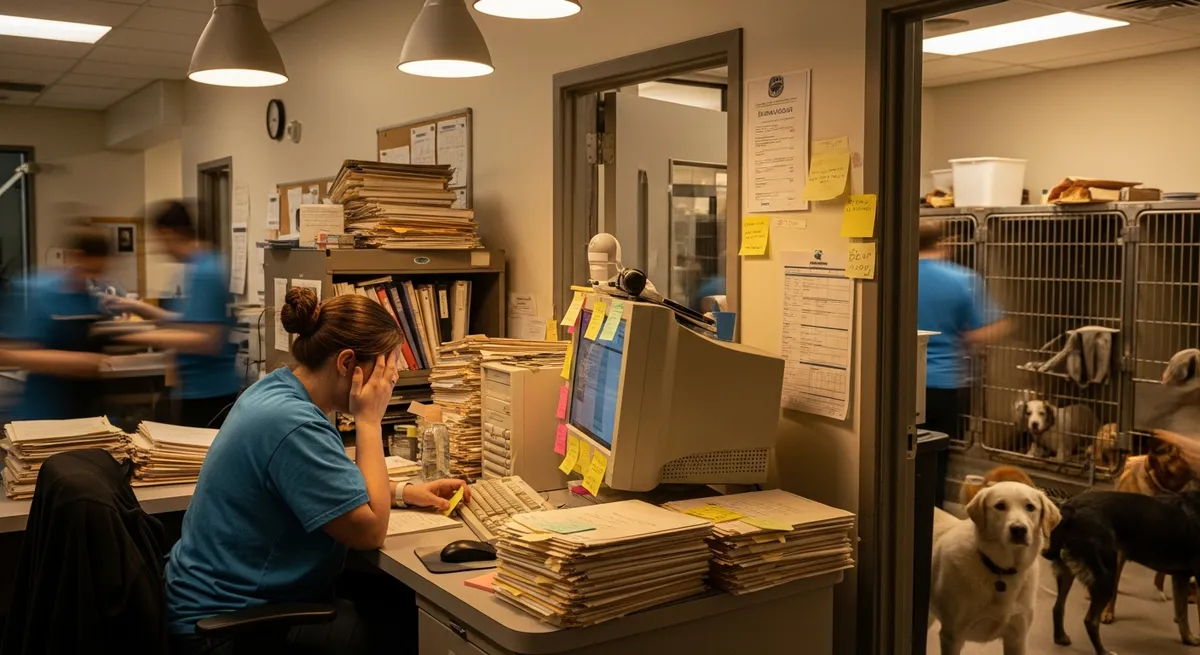
Most shelter directors can quote their annual budget down to the dollar — food, medical, payroll, facility. What they cannot quote is what inefficiency is actually costing them. And in almost every shelter we work with, the hidden cost dwarfs the line items on the budget.
Inefficient operations don't show up as a single invoice. They leak out as longer length of stay, missed adoptions, staff burnout, donor attrition, and animals euthanized for space that didn't need to be. By the time a board notices, the shelter has spent a year of capacity it never had to spend.
This guide breaks down where the real money goes when shelter operations are broken — and how modern systems recover it.
What "Inefficient Operations" Actually Means
Inefficiency in a shelter rarely looks like laziness. It looks like good people doing duplicate work in a system that fights them. The most common patterns:
- Intake data captured on paper, then re-typed into a spreadsheet, then re-typed into a database. Applications scattered across email, voicemail, paper forms, and Facebook DMs
- Medical and behavioral notes living in three different places that never sync
- Volunteer hours tracked on a clipboard nobody reviews
- Foster placements coordinated entirely through text messages
- Reporting built once a year, by hand, the week before the board meeting
Each of these on its own looks survivable. Stacked together, they consume staff hours that should be spent placing animals.
The Five Hidden Costs Every Shelter Pays
1. Length-of-Stay Costs
This is the largest hidden cost in almost every shelter, and the one most directors underestimate. Every additional day an animal sits in a kennel costs money — food, medical, cleaning, staff time, utility load — and that cost compounds quickly.
A reasonable industry estimate puts the daily cost of housing one shelter dog between $25 and $45, depending on region and medical needs. If inefficient adoption workflows add even seven days to your average length of stay across a population of 80 animals, you are spending an extra $14,000 to $25,000 per month on housing animals that should already be home. (For a deeper look at how applications get stuck, read What Causes Delays in the Adoption Process?.)
2. Lost Adoptions
When an adopter has to wait three days for a callback, fill out a paper application, then come in for a meeting only to be told the dog they wanted was already adopted, they don't try again. They go to a breeder, a different rescue, or Craigslist.
Lost adoptions are invisible because there is no invoice for them. But every adopter you fail to convert is a kennel that stays full and a donation relationship that never starts. Streamlined application flows, pre-screening, and same-day responses recover most of this loss. (See Strategies That Increase Adoption Applications for the playbook.)
3. Staff Burnout and Turnover
The single most expensive hidden cost in animal welfare is replacing a coordinator who quit because the systems were broken. Recruiting, hiring, onboarding, and training a new shelter coordinator typically costs 6 to 9 months of their salary in lost productivity — and the institutional knowledge they took with them is unrecoverable.
Inefficient operations are a top-three driver of shelter staff turnover. Manual data entry, duplicate paperwork, after-hours catch-up, and the inability to find a piece of information when you need it grinds people down. Shelters that modernize their workflows consistently report measurable drops in turnover within a year.
4. Donor Attrition
Donors fund shelters they trust. When a donor asks "how many animals did my donation place last quarter?" and the answer is "let me get back to you next week," that donor remembers. Modern donors expect dashboards, impact metrics, and transparency — not Excel attachments six weeks late.
Inefficient reporting doesn't just hurt grant applications. It quietly erodes the donor relationships that fund your operating budget. A shelter that can show real-time adoption outcomes, length-of-stay trends, and live-release rates inside an email is a shelter that retains donors. (Related: Why AI-Powered Shelter Software is Better Than Traditional Systems.)
5. Preventable Returns
Returns are expensive twice — once for the original adoption work that didn't stick, and again for the medical evaluation, behavioral re-assessment, and re-marketing required to place the animal a second time. Returns also damage that animal's chances; a returned dog is harder to place than one with no history.
Most preventable returns trace back to incomplete information at adoption, weak post-adoption follow-up, or a mismatch between the animal's needs and the home. (For the full picture, see Why Animals Get Returned After Adoption and Building Post-Adoption Support Systems That Keep Pets in Homes.)
How to Find Your Shelter's Hidden Costs in One Week
You do not need an audit firm. You need one week and a willingness to look honestly. Run this exercise with your operations lead:
1. Track time-in-process for ten random adoptions. Measure the hours from "application received" to "animal walked out the door." If the median is more than 72 hours, application workflow is one of your biggest hidden costs.
2. Pull your average length of stay by species. Compare it to the prior 12-month period. Any upward drift translates directly into food, medical, and staff hours you are spending without a corresponding outcome.
3. Count duplicate data entry. Walk one intake from start to finish and write down every place the same data point gets re-entered. Three is normal. Five is expensive. Seven is a five-figure annual leak.
4. Survey staff anonymously. One question: "What part of your job feels like wasted time?" The answers will name your hidden costs faster than any spreadsheet.
5. Pull your return rate. Returns within 30 days are an operational signal, not a personality problem. Above 8 percent, your matching, screening, or post-adoption support has gaps worth fixing.
The ROI of Modernizing Operations
Shelters that move from manual workflows to a unified platform consistently see four shifts in the first 90 days:
- Adoption application response time drops from days to hours
- Length of stay declines by 10 to 25 percent on the most adoptable populations
- Staff hours reclaimed from data entry get redirected to enrichment, photography, and adopter follow-up
- Reporting moves from quarterly hand-built spreadsheets to live dashboards
The dollar value of those shifts almost always exceeds the platform cost within the first quarter — before counting the harder-to-quantify gains in donor retention and staff morale.
How PawMates Pro Helps
PawMates Pro is built specifically to eliminate the hidden costs above. The platform unifies intake, medical, behavioral, application, foster, adoption, and post-adoption follow-up in one system, so data is captured once and surfaced everywhere it is needed. Compatibility-based matching shortens length of stay by surfacing the right adopters to the right animals quickly. Live dashboards give directors real-time answers to board, donor, and grant questions without a separate reporting workflow. Role-based permissions and a complete audit log protect your organization legally and operationally.
The shelters that adopt modern, integrated tooling stop paying the hidden tax of inefficiency — and redirect that capacity into more lives saved. (See also How Can Shelters Improve Efficiency Without Hiring More Staff?.)
The Bottom Line
Inefficient operations are the single largest expense in most shelters, and the only one that never appears on the budget. The good news is that every dollar of hidden cost is recoverable — it just takes a system that captures data once, surfaces it instantly, and frees your team to do the work only humans can do.
Find the leaks, fix the workflow, and watch capacity, morale, and outcomes improve together.
Frequently Asked Questions
What are the biggest hidden costs in animal shelter operations?
The five largest hidden costs are extended length of stay, lost adoptions from slow application response, staff burnout and turnover, donor attrition due to weak reporting, and preventable adoption returns. Each one rarely appears on a budget line, but combined they often exceed the visible cost of running the shelter.
How much does inefficient data entry cost an animal shelter?
A coordinator who spends two hours a day on duplicate data entry costs a shelter roughly $12,000 to $18,000 per year in lost productivity, depending on wage. Across a team of five, that is six figures of payroll redirected away from animal care.
How do you measure efficiency in an animal shelter?
Track median time-from-application-to-adoption, average length of stay by species, return rate within 30 days, staff hours per adoption, and live-release rate. These five metrics together capture the operational health of a shelter better than any single figure.
Can shelter management software pay for itself?
In most cases, yes. Shelters that move to a unified platform typically recover the platform cost within the first quarter through reduced length of stay, faster adoptions, and reclaimed staff hours. The compounding gains in donor retention and staff retention extend the ROI well beyond year one.
How long does it take to see results after modernizing shelter operations?
Most shelters see measurable improvements in application response time and length of stay within 30 to 60 days. Full operational gains — including donor reporting, staff morale, and return rate reduction — typically materialize within 90 to 180 days.
Related Articles