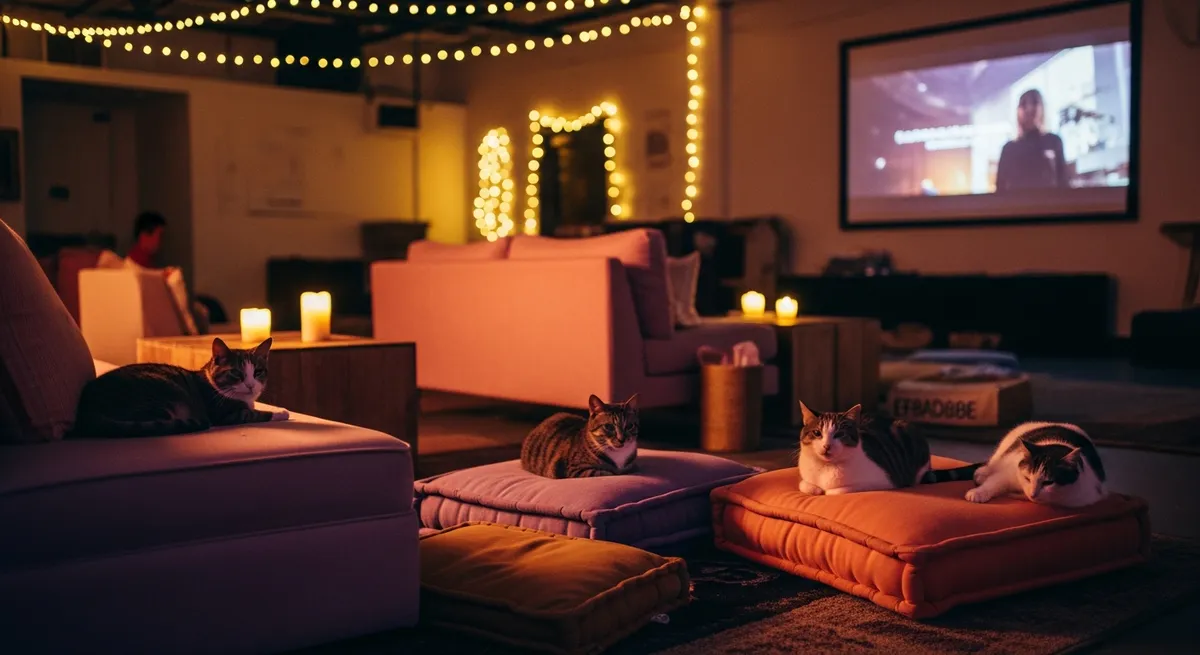
Most cat adoption events are loud, fluorescent, and over in two hours. The cats are stressed, the visitors are rushed, and the connections are shallow. Catflix & Chill is the opposite — a small, ticketed, lounge-style movie night where guests sink into a couch, watch a film, and let adoptable cats come to them on the cats' own terms.
It is one of the highest-engagement fundraising formats a small or mid-sized shelter can run, and it produces something most adoption events do not: time. The kind of unhurried, low-pressure time that turns a casual visitor into an adopter, and a one-time donor into a regular supporter.
This guide breaks down exactly how the format works, the revenue math, the setup requirements, and the operational details that separate a successful Catflix & Chill program from a chaotic one.
What Catflix & Chill Actually Is
Catflix & Chill is a ticketed, small-group event where attendees relax in a comfortable, lounge-style environment while interacting with adoptable cats and watching a movie. The experience blends a casual social setting with direct animal interaction, creating a low-pressure environment that encourages both donations and adoptions.
Instead of a traditional adoption event, this format slows everything down. Guests are seated, relaxed, and immersed in the space, which allows cats to behave more naturally and potential adopters to connect with them over time.
It is not a cat cafe. It is not an open house. It is a curated, capped, environment-first experience that converts because it stops trying to convert.
Why the Format Works
This model works because it combines three powerful drivers: comfort, time, and emotional immersion.
First, it removes the chaos of typical adoption events. Loud environments and constant movement often stress cats and limit meaningful interaction. A calm, controlled setting allows cats to approach people on their own terms — which is the only way most cats will reveal who they really are. (For more on why environment shapes behavior, see Enrichment Is Not Optional — It's the Key to a Happy Pet.)
Second, it increases interaction time. Instead of a quick meet-and-greet, guests spend one to two hours in the space. That extended exposure significantly increases the likelihood of forming a connection. Cats who would have been overlooked in a 15-minute browse get a real chance to be seen.
Third, it reframes the experience as entertainment. People are not just attending to adopt — they are attending to enjoy themselves. That expands your audience beyond active adopters to include supporters, donors, and community members who might never have stepped into a traditional adoption event.
Revenue Potential: The Numbers
This model is highly flexible and can be run repeatedly with low overhead.
A typical session might include:
- 10–15 attendees
- Ticket price: $20–$40 per person
That produces:
- $200–$600 per session
If run weekly:
- $800–$2,400 per month from a single recurring event
Additional revenue can be layered through:
- Concessions (snacks, drinks)
- Branded merchandise
- On-site donations and tip jars
- Adoption conversions (and the long-tail giving that follows)
Because it is small and repeatable, it becomes a steady micro-revenue stream rather than a one-time fundraiser. A shelter that runs this consistently for a year is looking at $10,000–$28,000 in direct ticket revenue, before adoptions and add-ons. That is the budget for a part-time staff person or a year of vet care for dozens of animals.
For ideas on stacking complementary fundraising programs alongside this one, see Creating Special Campaigns for Overlooked Animals.
Setup Requirements: The Environment Is Everything
This is not just a room with cats and a TV. The environment is the entire product. A poorly executed setup will damage your shelter's reputation and stress the cats — get this part right or do not run the event.
You need to create a space that feels:
- Comfortable
- Clean
- Calm
- Intentional
Essential elements include:
- Seating: couches, bean bags, floor cushions arranged in a loose semicircle
- A large screen or TV positioned so it is visible but not the focal point
- A streaming setup (Netflix, Disney+, or equivalent) with reliable Wi-Fi
- Soft lighting — string lights, lamps, or dimmable bulbs (avoid harsh overhead fluorescents)
- A cat-safe layout with no hazards and all escape points blocked
- Discreet but accessible litter boxes
- Food and water stations for cats away from seating
- Hand sanitizer and lint rollers near the entrance
Sanitation is critical. The space must be cleaned thoroughly between sessions — surfaces wiped, cushions vacuumed, litter boxes scooped, water refreshed. Allergen control matters; one bad review about a "filthy" event can sink your ticketing for months.
Action Plan: Step-by-Step Implementation
Start by identifying a suitable room within the shelter or a partner location. The space should be enclosed, quiet, and large enough to accommodate both people and cats comfortably. A community room, a converted office, or a partner brewery's back room can all work.
Next, select cats that are appropriate for the environment. Not every cat is a good fit. Choose animals that are social, calm, and comfortable around people. Use your behavior team's notes — and be honest. Putting a fearful cat in this environment is unkind to the cat and unsafe for guests.
Design the layout to encourage interaction. Seating should be arranged so cats can move freely between guests. Avoid crowding or forcing interaction. Provide cat-only retreat spots (a high shelf, a covered bed) so cats can opt out without leaving the room.
Set a schedule for sessions. Limiting attendance per session is critical to maintain a calm environment and ensure a quality experience. Friday or Saturday evenings sell best; Sunday afternoons appeal to a different audience.
Create a simple ticketing system. This can be handled through your website, Eventbrite, or your existing donor platform. Require pre-registration to control capacity and to capture attendee emails for follow-up.
Promote the event using social media, email lists, and local partnerships. Lean on the experience first ("a cozy night out with cats and a movie") and the adoption opportunity second. The cat-loving audience is much larger than the actively-adopting audience, and you want both.
During the event, staff or volunteers should be present to guide interaction, answer questions, and facilitate adoption interest without being intrusive. Train them to read the room — and the cats. The right host can quietly turn three guests into three adoption applications without anyone feeling pitched.
After each session, clean and reset the space immediately. Don't leave it for the morning crew. Trust is built session by session.
The Tech and Automation Layer
Technology can quietly multiply both the revenue and the adoption outcomes of every session.
Use a digital system to:
- Display each cat's profile, story, and medical history (via QR codes on each kennel or seating area or tablets at the door)
- Let guests "favorite" cats during the event
- Submit adoption interest forms on the spot from their phone
You can also:
- Capture attendee emails during ticket purchase
- Send follow-up emails featuring the cats they interacted with — by name, with photos
- Track which cats generated the most interest so your team knows who to feature next time
This turns a simple event into a data-generating adoption funnel. The cats who weren't quite the right match for one guest get re-introduced to another guest the next week — a process that is impossible to do well manually but trivial when the data is being captured automatically. (For why this kind of structured data matters, see The Power of a Great Pet Description.)
Common Failure Points
One of the most common mistakes is overcrowding the space. Too many people create stress for the cats and degrade the experience. Cap attendance and stick to it — even when an extra ticket is tempting.
Another issue is poor cat selection. Placing anxious or reactive cats in this environment can lead to negative interactions, bad reviews, and welfare concerns. The behavior team's word is final.
Lack of structure can also hurt the event. Even though it is casual, there should be clear expectations for guest behavior — no picking up cats who don't approach you, no flash photography, no chasing — communicated warmly at the door.
Finally, failing to connect the experience to adoption or follow-up eliminates much of the long-term value. The event should not end when the movie does — it should lead into continued engagement, follow-up emails, and a repeatable invitation to come back. (For more on what happens after the connection, see Building Post-Adoption Support Systems That Keep Pets in Homes.)
Example Scenario: A Real-World Walkthrough
A shelter launches Catflix & Chill as a weekly Friday evening event. Each session is capped at 12 attendees and priced at $25 per ticket.
They consistently sell out, generating $300 per session. Over the course of a month, the event brings in $1,200 in direct ticket revenue.
More importantly, several attendees return for multiple sessions, and a percentage of guests go on to adopt. The shelter also builds a growing list of engaged supporters who can be reached for future appeals, volunteer asks, and capital campaigns.
Over time, the event becomes a regular part of the shelter's programming, providing both income and a steady stream of potential adopters. Within six months, Catflix & Chill alumni make up a meaningful slice of the shelter's monthly donor base — and the cats featured at sessions adopt out at noticeably higher rates than the general population.
How PawMates Pro Helps Run Catflix & Chill (and Programs Like It)
PawMates Pro gives shelters everything needed to run a recurring event series like Catflix & Chill without bolting together five different tools. Inside one platform, your team can:
- Maintain rich, photo-driven cat profiles that adopters can scan with a QR code at their seat
- Capture adoption interest forms directly from a guest's phone during the event, with the cat already pre-selected
- Track which cats generated the most interest at each session, so your behavior and matchmaking team knows who to feature next
- Send branded follow-up emails to attendees featuring the cats they met — automatically segmented by who attended which session
- Accept event ticket sales and on-site donations through the same Stripe-backed checkout that powers the rest of your fundraising
- Tie every adoption back to the event that generated it, so you can prove ROI to your board and your funders
The shelters that run the most successful recurring events are the ones whose tooling makes follow-up effortless. PawMates Pro is built for that kind of compounding work — see Why AI-Powered Shelter Software Is Better Than Traditional Systems for the broader picture.
The Bottom Line
Catflix & Chill works because it shifts the environment from transactional to experiential. It creates space for genuine connection, which drives both revenue and adoption outcomes.
When structured correctly, it is not just a novelty event — it is a repeatable, low-cost, high-engagement fundraising system that can run indefinitely. The shelters that build a habit out of it create something that an annual gala never can: a weekly reason for the community to show up, sit down, and fall in love.
Frequently Asked Questions About Catflix & Chill Events
What is a Catflix & Chill event?
Catflix & Chill is a ticketed, small-group fundraising event where attendees relax in a cozy lounge-style space, watch a movie, and interact with adoptable cats at their own pace. It blends a casual social experience with direct animal interaction, producing both ticket revenue and cat adoptions.
How much money can a shelter make from a Catflix & Chill event?
A typical session of 10–15 attendees at $20–$40 per ticket generates $200–$600 per event. Run weekly, that is $800–$2,400 per month in direct ticket revenue, before concessions, merchandise, on-site donations, and the long-term giving that follows from new adopters and supporters.
How many cats and people should be in the room?
Most successful events cap attendance at 10–15 guests with 4–8 adoptable cats. The exact mix depends on room size, but the rule of thumb is that every cat should have at least one accessible retreat spot and every guest should have a comfortable seat. Overcrowding is the single most common cause of a bad event.
Which cats are good candidates for Catflix & Chill?
Cats who are confident around people, comfortable in new environments, and tolerant of moderate noise. Your behavior team should make the call. Anxious, reactive, or under-socialized cats should not be placed in this setting — it is unfair to them and unsafe for guests.
Do guests need to sign waivers?
Yes. Every shelter should have a simple liability waiver for any event involving direct animal interaction. Include allergy disclosures, photo release, and a basic conduct agreement. Most shelters collect waivers digitally at ticket purchase to speed up arrival.
How do we handle the ticketing and follow-up?
Use whatever platform your shelter already uses for events or donations — Eventbrite, your website, or an integrated shelter platform. Capture attendee email addresses, then follow up within 24 hours with photos of the cats they met and a low-pressure invitation to apply. Shelters using PawMates Pro can do all of this from one system, including tying adoptions back to the event that produced them.
How often should we run Catflix & Chill?
Most shelters start monthly and move to weekly once they have proof of demand. Friday and Saturday evenings sell out fastest. Sunday afternoons attract a different (often family-oriented) audience. Avoid running the same time slot more than once a week to keep tickets feeling scarce.
What if attendees want to adopt the same cat?
Have a clear, written tie-breaker policy and communicate it upfront. Most shelters use first-application-completed wins, with an honest waitlist for the cat. Treat the runner-up like gold — offer to introduce them to similar cats, invite them back to a future session, and add them to your foster outreach.
Related Articles
- 10 Creative Ways to Promote Adoptable Pets
- Creating Special Campaigns for Overlooked Animals
- 10 Ways QR Code Kennel Cards Increase Shelter Adoptions
- The Power of a Great Pet Description
- Enrichment Is Not Optional — It's the Key to a Happy Pet
- Community Outreach: Teaching Pet Responsibility in Your Neighborhood
- Building Post-Adoption Support Systems That Keep Pets in Homes
- Why AI-Powered Shelter Software Is Better Than Traditional Systems