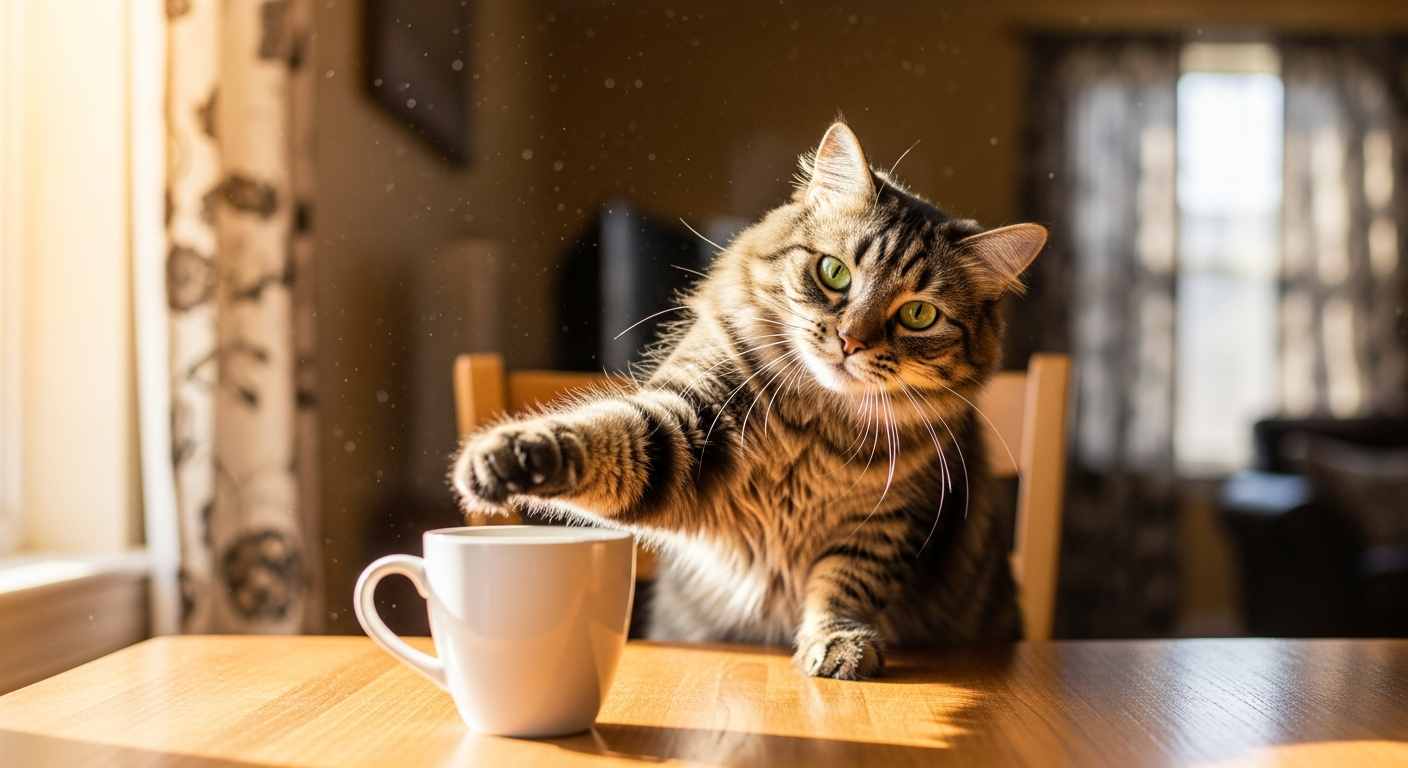
You set a pen on the table. Your cat strolls over, locks eyes with you, and with the deliberation of a tiny supervillain, paws it slowly toward the edge — and off it goes. Then they look at you again. Few cat behaviors are as universal, as funny, or as quietly maddening as the great Knocking-Things-Off-Surfaces ritual. So why do they do it? The honest answer is: a few overlapping reasons, and understanding them is the key to stopping it.
1. It scratches the hunting itch
Cats are predators, and a huge amount of their brain is wired for hunting that pet life rarely lets them use. Pawing at a small object, watching it move, and "capturing" it triggers the same satisfying predatory sequence as stalking prey. The object skittering across the floor is basically a fake mouse. To your cat, your lip balm is wildlife.
2. It gets a reaction — and reactions are currency
Here's the big one. The first time a cat nudges a cup off the table and you leap up, gasp, and rush over, the cat learns something powerful: this action makes my human appear instantly. For a social animal who wants attention (especially a bored or under-stimulated one), that's a jackpot. They're not being spiteful — they've simply discovered a reliable button that summons you. Negative attention still counts as attention.
3. Curiosity and "object testing"
Cats explore the world with their paws. Batting an object tells them about its weight, texture, and how it behaves. Will it roll? Will it slide? Cats are essentially running tiny physics experiments, and the edge of a table is the perfect lab bench. (If you enjoy feline physics, you'll like why cats almost always land on their paws.)
4. Boredom and pent-up energy
A cat with not enough to do will invent jobs. An indoor cat without enough play, climbing, or hunting outlets has energy that has to go somewhere — and "redecorate the desk" is an easy outlet. Much of the time, knocking things off surfaces is a symptom of a cat who needs more enrichment, not a cat who needs more discipline.
How to actually reduce it
You won't override millions of years of instinct, but you can redirect it:
- Don't reward the reaction. This is the hard one. If knocking the cup off summons a dramatic human, calmly minimizing your response (where safe) removes the payoff. Don't chase, scold, or make a show of it.
- Increase real play. Two short sessions a day with a wand toy that mimics prey — quick, erratic, then a "catch" — drains the hunting drive that the table is currently satisfying. A genuinely tired cat knocks fewer things over.
- Add enrichment. Window perches, cat trees, puzzle feeders, and rotating toys give that busy brain legitimate jobs.
- Make the surface boring or off-limits. Keep tempting small objects out of reach, and give your cat a more appealing spot nearby (a perch with a toy) so the table loses its appeal.
- Never punish. Punishment doesn't teach a cat what to do instead; it just teaches them to fear you, which damages the bond and rarely stops the behavior.
When it might be worth a closer look
A sudden spike in attention-seeking or restlessness can occasionally signal stress, a change in the household, or a medical issue — cats often express discomfort through behavior. If your cat's habits change abruptly, it's worth a chat with your vet. Knowing your cat's baseline personality helps here, which is one reason shelters on PawMates Pro give adopters an honest profile of each cat's temperament and quirks up front.
Frequently asked questions
Why does my cat knock things off the table while looking at me?
Usually because it works. Your cat has learned that this specific action reliably gets your attention. The eye contact is them checking whether you're watching — the reaction is the reward.
Are cats being spiteful when they knock things over?
No. Cats don't act out of spite. The behavior is driven by hunting instinct, curiosity, and learned attention-seeking — not revenge or malice.
How do I stop my cat from knocking things off counters?
Remove the payoff by not reacting dramatically, increase daily interactive play to satisfy the hunting drive, add enrichment like perches and puzzle feeders, and keep tempting objects out of reach. Avoid punishment, which doesn't work and harms trust.
Could knocking things over be a sign of a problem?
It's usually normal, but a sudden, marked increase in attention-seeking or restlessness can reflect boredom, stress, or occasionally a medical issue. If the change is abrupt, check in with your veterinarian.
Your cat isn't plotting against you — they're hunting, experimenting, and pressing the one button that makes you appear. Give that clever brain better jobs, and your coffee mug stands a fighting chance.
Related reading
- Why cats always land on their paws — the physics behind the chaos.
- Why black cats are overlooked at shelters — meet the cats most likely to be waiting for you.
More on the PawMates adopter blog.