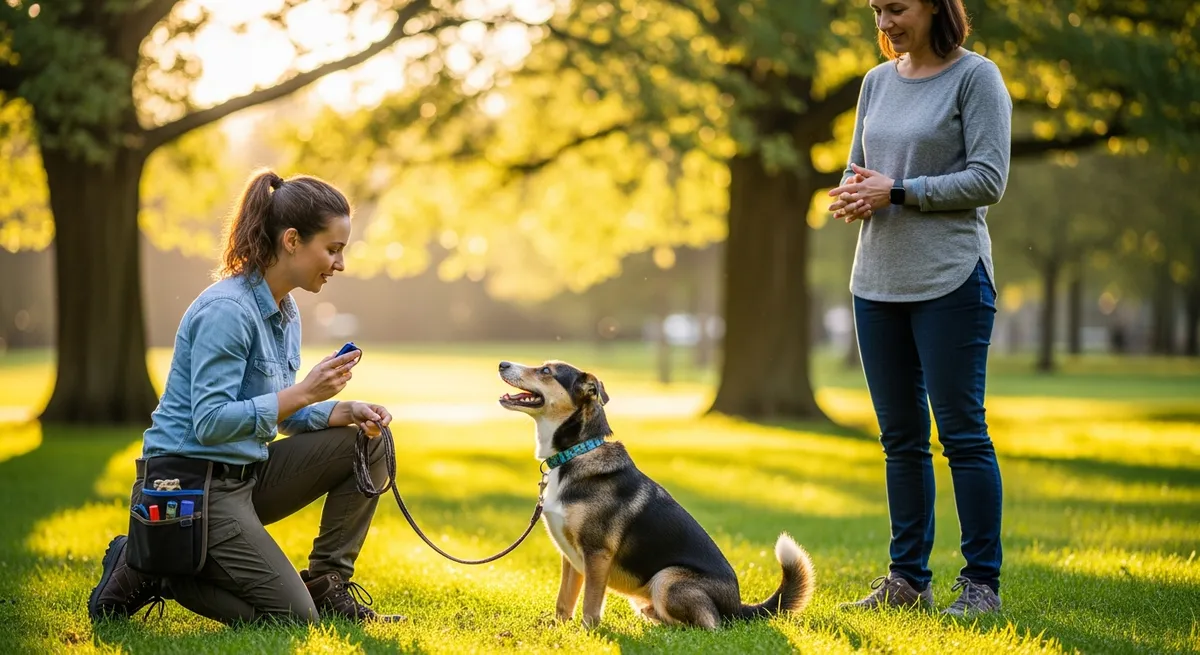
One of the most expensive mistakes new adopters make is waiting too long to call a trainer. The other most expensive mistake is calling one for things they could have handled themselves with a $20 book and three weeks of consistency. Both errors come from the same source: nobody told you what's a "you" problem and what's a "pro" problem.
Here's the decision framework, color-coded like a traffic light.
🟢 GREEN — handle it yourself
These are normal behaviors that respond to consistent home training. You'd waste a trainer's time and your money on these — but you should commit real, structured time to them at home.
- Leash pulling. Front-clip harness, stop-and-go method, reward at your side. 4–6 weeks of consistency.
- Basic manners (sit, down, stay, come, leave it, drop it). YouTube has thousands of credentialed trainers teaching these for free. Kikopup, McCann Dogs, and Zak George are reasonable starting points.
- Mild jumping on people. The four-on-the-floor protocol from how to fix jumping, barking, and chewing fast.
- House training regression in the first 3 weeks. Treat them like a new puppy — frequent outings, enzymatic cleanup, reward outside.
- Mild demand barking. Decide the bark earns nothing, ride out the extinction burst.
- Crate training a dog with no prior crate trauma. The 7-day plan in crate training do's and don'ts.
- Mild chewing on inappropriate items with no destruction of doors/walls. Manage, provide chews, exercise harder.
- A new adopted dog hiding for the first 1–14 days. That's not a behavior problem; that's decompression.
The honest test for green issues: if you put 30 minutes a day into the protocol for 4 weeks, is the behavior at least 50% better? If yes, keep going. If no, escalate.
🟡 YELLOW — consult a trainer (group class, private lesson, or phone consult)
These behaviors won't get worse fast, but they aren't going to fix themselves. A 1–3 session investment with a credentialed positive-reinforcement trainer will usually do it. Group classes are also great for socialization and accountability.
- Persistent leash reactivity (barking/lunging at other dogs or people) that hasn't improved with distance management after 3–4 weeks.
- Generalized fearfulness of normal household stimuli (the broom, the vacuum, your husband's beard) that isn't fading with gentle, voluntary exposure.
- Mild resource guarding of food, beds, or toys — growling but no snapping, and only with specific triggers.
- Recall failures in distracting environments — your dog comes when called inside but vanishes at the dog park.
- Persistent counter surfing despite 6+ weeks of strict management.
- Mild separation distress — vocalizing for 20–30 minutes when alone but no destruction or self-injury.
- Pulling on leash that hasn't yielded to a front-clip harness and 6 weeks of stop-and-go.
- Excitable behavior around guests that you can't extinguish with the visitor protocol.
For yellow issues, expect 1–3 sessions, $80–$200 per session, plus homework. A group class ($150–$300 for 6 weeks) is also great if your dog is reasonably social.
🔴 RED — call this week, not next month
These are the behaviors where the cost of waiting is high — physical injury, deepening trauma, or a return to the shelter.
- Any bite or near-bite to a human — broken skin, bruising, a snap that missed because the human pulled back fast.
- Stalking or pursuing small animals you live with — chasing the cat, fixating on the rabbit, hunting posture toward a small dog.
- Severe resource guarding — snapping or biting over food, beds, toys, or a person.
- Growling at children in the home — even once. Children are not the right group to test "training will fix it on" with.
- Sudden behavior changes in a previously settled adult dog — vet visit FIRST (rule out pain, thyroid, neurological), then a trainer.
- Self-injury during alone time — broken teeth, bloody paws, ripped toenails from confinement panic.
- Fearful body language that escalates to defensive aggression within a few weeks of adoption.
- Any escalating reactivity — week 2 worse than week 1, week 4 worse than week 2.
- Bite history disclosed by the shelter — start with a behaviorist before the first incident in your home.
For red-flag issues, you want one of two credentials:
- A certified animal behavior consultant (CDBC, IAABC) for serious behavior modification.
- A veterinary behaviorist (DACVB) for cases involving suspected medical contributors, fear/aggression cases that need medication, or any case where a regular trainer has failed.
A "balanced trainer" who recommends e-collars, prong collars, or "alpha" approaches for fear or aggression cases is the wrong choice. Modern force-free behavior modification has 30 years of research behind it; aversive methods consistently make fear-based behaviors worse.
How to find a credentialed trainer
Look for letters after the name. The credible ones for North America include:
- CCPDT-KA (Certified Council for Professional Dog Trainers, Knowledge Assessed) — solid baseline.
- CCPDT-KSA (KA + Skills Assessed) — proven hands-on skills.
- KPA-CTP (Karen Pryor Academy Certified Training Partner) — strong positive-reinforcement chops.
- CDBC (Certified Dog Behavior Consultant) — IAABC behavior credential.
- DACVB (Diplomate, American College of Veterinary Behaviorists) — veterinary behaviorist.
Ask the trainer how they'd handle your specific issue *before* booking. If the answer involves "show the dog who's boss," "alpha rolls," "correction collars for anxiety," or "the dog is stubborn," call someone else.
The shelter is your first phone call
Most shelters keep a referral list of trainers and behaviorists they trust — people who've worked with shelter dogs specifically and understand decompression and adoption-related stress. Many PawMates Pro shelters send post-adoption check-ins at 3 days, 3 weeks, and 3 months anchored to your adoption-approved date, and the 3-week check-in is the natural moment to flag escalating issues. Answering "we're seeing growling when I approach his food bowl" gets you a referral and usually an offer to consult; saying "everything is great" gets you nothing.
If your shelter didn't send a check-in, call them anyway. Adoption isn't a transaction — it's a relationship, and most shelters genuinely want to help in the first 90 days.
Pet insurance and behavior coverage
A few pet insurance plans cover behavior modification with a credentialed trainer or veterinary behaviorist; most do not. If you're shopping for insurance, ask specifically about behavior coverage. Treatment for serious fear or aggression cases can run $1,500–$5,000 over six months, so this matters. (See is pet insurance worth buying? for the full breakdown.)
The bottom line
If you think you might need a trainer, you probably do. Most behavior issues compound — a 3-week-old growl becomes a 3-month-old bite if the underlying anxiety isn't addressed. The best time to call was last week; the second-best time is today.
For the front end of the decision — how to spot what's actually a behavior problem versus normal adjustment — see the most common behavior issues after adoption and the truth about rescue trauma.