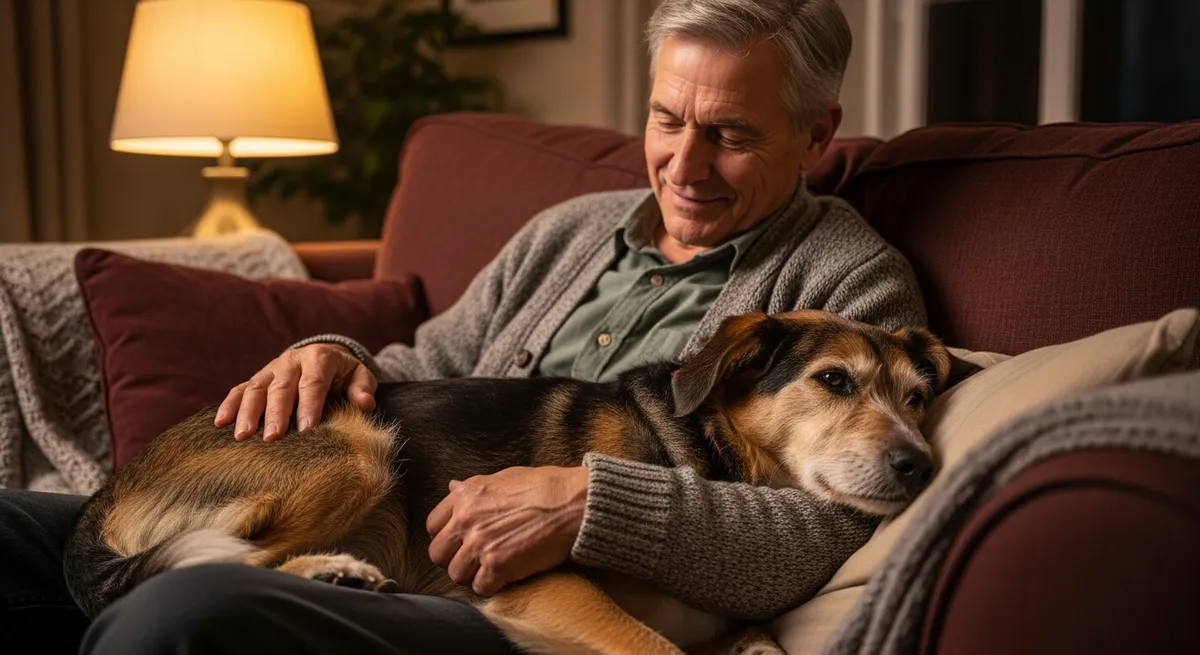
No. Decades of research from the Center for Canine Behavior Studies and behaviorists like John Bradshaw consistently show that bond strength is determined by daily interaction, predictability, and shared activities — not by where the pet came from or how old they were when you got them. Adult adopted pets often form especially deep bonds.
It's a question that comes up more often than people admit. The implicit worry is that a shelter dog or cat — already shaped by another life, with another household, maybe with some kind of past — won't bond as deeply as a puppy or kitten you raised "from the start."
Decades of research, consistent observation by veterinary behaviorists, and millions of adopter experiences all point the same direction: the bond a pet forms with you has almost nothing to do with where they came from. It has everything to do with what you do together.
The strongest predictors of a deep human-animal bond, according to research from the Center for Canine Behavior Studies, the University of Helsinki canine cognition lab, and decades of work by behaviorists like John Bradshaw and Patricia McConnell, are:
- Quality and frequency of daily interaction. Pets bond with the person who feeds them, walks them, plays with them, and is present during stressful moments — regardless of how that person came to own them.
- Predictability and trust. Pets bond more deeply with humans who are consistent, calm, and reliable.
- Shared activities. Training, walks, play, and "do-things-together" time build bond more than passive co-existence.
- The pet's individual temperament. Some animals are more bond-prone regardless of source. None are incapable.
Notice what's not on the list: where the pet came from, or whether they were a puppy or an adult when you got them.
A common belief is that pets need to be raised from puppyhood or kittenhood to bond with you. This isn't quite how it works. Dogs and cats have a developmental socialization window (roughly 3–14 weeks for dogs, 2–7 weeks for cats) when they form fundamental ideas about humans, environments, and other animals. Missing that window can produce a fearful or undersocialized pet — but this is about overall comfort with humans as a category, not about which specific human they bond to.
After the socialization window, dogs and cats form individual relationships with humans throughout their lives. A 7-year-old shelter dog can fall completely in love with a new person. A 12-year-old senior cat can choose a new lap and stay there forever.
Many adopters describe the moment their adult shelter dog "chose" them as one of the most powerful experiences of their lives. The dog has lived enough life to know what they're picking. That's not a weaker bond — arguably it's a more conscious one. See the science of human-animal bonding for the deeper dive.
There's a pattern anyone who has worked in adoption notices: many rescued pets bond *more intensely* than pets purchased as babies, particularly when they've been waiting in a shelter for a while. Why this might be:
- Comparison effect. A pet who has experienced shelter life knows the difference. The contrast can produce profound gratitude-adjacent behavior.
- Adult pets are honest. Puppies are universally affectionate because they're babies. Adult pets show you who they really are.
- They've already had their adolescence. No teenage dog phase, no kitten destructo period. Bonding happens in calmer water.
- Shelters know who they are. A shelter that's had a dog for 3 months knows that dog's quirks, fears, and ideal household far better than a breeder selling an 8-week-old puppy ever can.
This isn't to say puppies and kittens don't form deep bonds — they obviously do. But the idea that they form *deeper* ones is not supported by research or by adopter experience.
Bonding with a newly adopted pet takes longer to *visibly emerge* than the puppy-from-day-one experience. The standard framework is the 3-3-3 rule: 3 days to start decompressing, 3 weeks to start understanding the routine, 3 months to feel fully at home and bonded. See what is the 3-3-3 rule for puppies? for the full breakdown.
Many adopters who give up too early — at week 1 or 2, when the pet is still shut down — assume the bond will never form. It does, almost universally. But the patience required is one reason adoption is sometimes harder emotionally than buying.
- Hand-feeding for the first 1–2 weeks. Direct association of you with food.
- Daily training sessions, 5–10 minutes — even with senior dogs and cats. Cats are absolutely trainable for tricks, recall, and harness walking.
- Predictable routine. Same wake-up, walk, dinner, and wind-down times every day for the first month at least.
- Calm, low-pressure presence. Sit on the floor, read a book, let the pet approach you.
- One-on-one walks without other people or dogs.
- Showing up during stressful moments — vet visits, thunderstorms, fireworks — as the calm one in the room.
These work on every pet, every age, every source.
In dogs: following you from room to room, checking in on walks, sleeping where they can see you, settling at your feet during work. In cats: slow blinking (the cat "I love you"), choosing to share rooms with you, head bunting, sleeping in physical contact. These behaviors emerge in adopted pets at the same rate and intensity as in pets bought from breeders — often more so.
Almost always one of three things is happening:
1. They adopted within the last 4 weeks — the pet is still in decompression. The bond hasn't had time to form.
2. They were expecting a "rescue narrative" of instant gratitude — the pet is acting like a normal animal who needs time, not a dramatic story arc.
3. They're missing depression-style signs that look like distance but are actually anxiety.
In each case, the answer is more time, more routine, and more low-pressure togetherness — not "I picked the wrong pet."
Frequently asked questions
Will an adopted pet bond as strongly as one I buy as a puppy or kitten?
Yes. Research and decades of adopter experience consistently show that bond strength is determined by the relationship you build, not by where the pet came from. Adult adopted pets often form especially deep bonds.
Will my adopted pet still love their previous owner?
Pets don't pine for previous humans the way humans do for ex-partners. Once they're in your routine, you become their person.
How long does it take for an adopted pet to bond?
Surface bonding starts in days. Deep bonding typically takes 2–3 months as the pet fully decompresses and settles into your routine. See the 3-3-3 rule for shelter pets.
My new shelter dog seems distant. Did I pick the wrong one?
Almost certainly not — you're probably in week 1 or 2 of the 3-3-3 timeline. Distance early on is decompression, not personality.
Aren't puppies easier to train and bond with?
Puppies are highly bondable but also a tremendous amount of work — months of housetraining, chewing, biting, and adolescent behavior. Adult adopted dogs often skip those phases entirely.
Is it true that a pet bonds most strongly with the person who feeds them?
Partially. The person who feeds is part of it, but the person who walks, trains, plays, and shows up during stressful moments matters at least as much.
Are there any animals who don't bond?
A small number of pets with severe early-life trauma may form less obvious bonds, especially with strangers — they almost always still form one strong bond with their primary caregiver. See the truth about rescue trauma.
How PawMates Pro predicts which bond will actually form
The PawMates Pro compatibility score is built directly on the research about what predicts bond strength: matching energy levels, household composition, daily schedule, experience level, and lifestyle. The pets surfaced at the top of your swipe feed are the ones the data says will form the deepest bond with your specific household — not just the pets that happen to be cute or popular. That's how you avoid the most common adoption mistake: picking on appearance and ending up with a mismatch.
Keep reading: adoption vs buying, and what to expect after
If you are weighing adoption against buying, these three PawMates articles answer the next questions adopters typically ask.