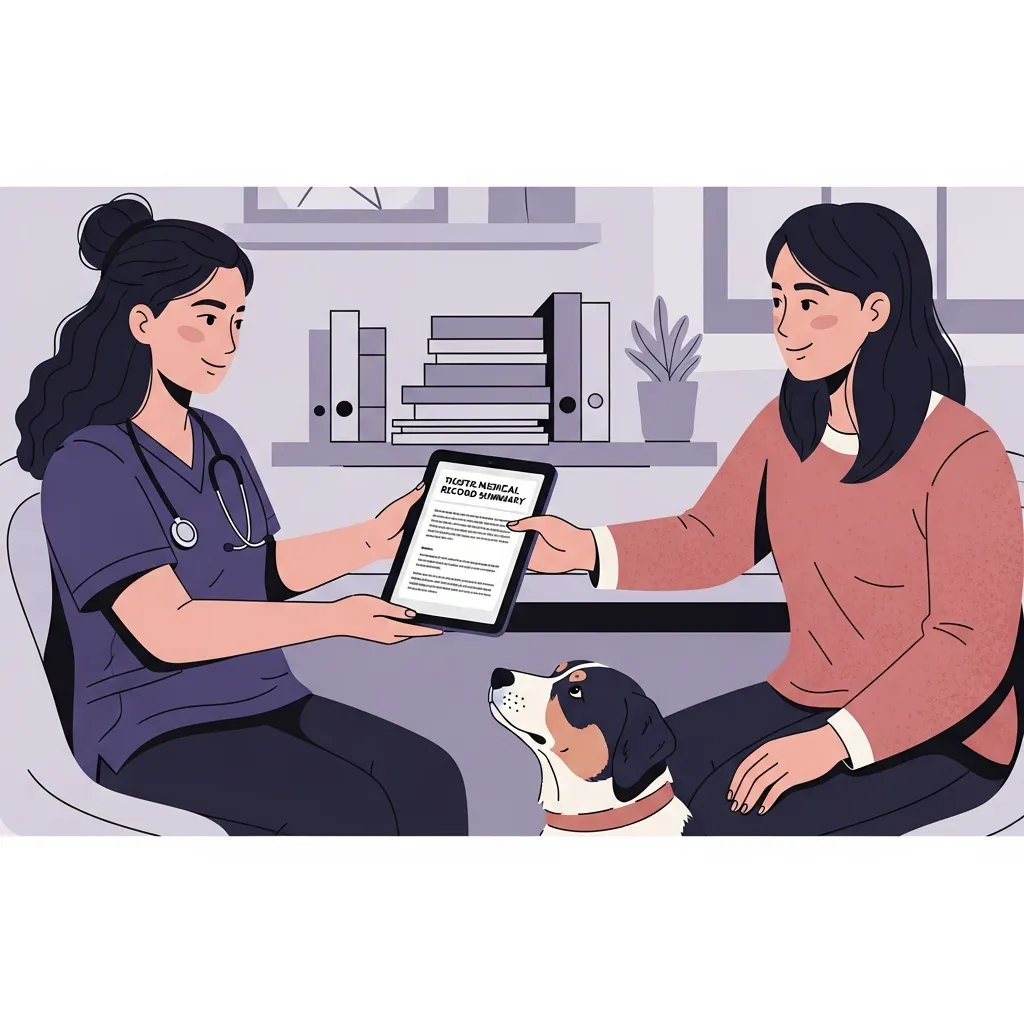
Every shelter has at least one folder, drawer, spreadsheet, or proprietary database full of medical and behavioral information about every animal in residence. Most of that information dies at adoption. The adopter gets a printed vaccine record, a one-page summary if they're lucky, and a verbal "she was great with the staff" — and the months or years of careful notes that the medical team and the behavioral team built up disappear into your archive, useful only if the dog comes back.
This is one of the highest-leverage and lowest-effort operational changes a shelter can make: build a culture and a workflow where every medical and behavioral record an animal accumulates at the shelter follows that animal home. Done well, it reduces returns, improves outcomes, strengthens the relationship with the adopter, and meaningfully lowers the load on shelter staff in the weeks after adoption. Done badly, it produces the same printed packet everyone else hands out.
This post is the case for doing it well — what to share, with whom, how, and why the operational dividend is much bigger than most directors expect.
Why this matters: the cost of letting records die at adoption
The single biggest cause of preventable 30-day returns is the post-adoption period going sideways for reasons the shelter already knew about. The new owner discovers the dog has noise sensitivity (the shelter noted it on day 5). They learn about food allergies the hard way (the medical team flagged a likely allergy at the second exam). They get blindsided by the dog's reaction to a stranger entering the home (the behavioral evaluator had written it up in detail).
Most of this information existed. It just didn't reach the person who needed it. The return that resulted cost your shelter another intake event, another medical exam, another kennel night, another adoption process — between $400 and $1,200 in loaded operational cost, plus the welfare cost to the animal of another transition.
For a 60-pet shelter doing 600 adoptions a year with a 10% return rate, dropping returns by even three percentage points by sharing records better saves roughly $14,000 to $40,000/year and prevents 18 returns. The records were already in your system. The fix is operational, not financial.
What's worth sharing
Not every internal note belongs in the adopter packet. The medical team's working differential diagnosis from week one is not for the adopter. But the right shape is much broader than most shelters share today.
Medical:
- Complete vaccine history with dates, lot numbers, and next-due dates.
- Spay/neuter date, surgeon, and any complications.
- All medications administered during the stay, with doses and stop dates.
- Any chronic condition diagnosed during the stay (allergies, joint issues, dental disease, ear infections, skin conditions).
- Any acute condition treated during the stay (URI, kennel cough, GI episode) and how it resolved.
- Weight at intake, weight at adoption, and target weight if relevant.
- Microchip number, registry, and the registration status at adoption (already in the adopter's name, or pending transfer).
- Heartworm test result and date; flea/tick prevention status.
- Any known or suspected food sensitivities and the diet the shelter was feeding.
Behavioral:
- Full formal evaluation (if one exists), narrative first, then ratings.
- Daily-care observations from staff — what the dog is like on the morning walk, who their favorite handler is, how they greet visitors, how they respond to being left alone in the kennel.
- Known triggers (skateboards, loud trucks, men in hats, other dogs barking at the fence).
- Resource guarding observations, with specifics and trigger items.
- Response to handling, restraint, nail trims, baths, vet exams.
- Stress signals the dog shows when overwhelmed (panting, pacing, retreating, snapping).
- Recommended decompression considerations (sound sensitivity, separation tolerance, crate training status).
- Any incidents during the stay (snaps, bites, fence reactivity, fights) with full context.
Operational context the adopter benefits from:
- How long the dog has been at the shelter.
- Where the dog came from (transfer, owner surrender, stray hold, scenario).
- Whether the dog has been in a foster home, and if so, what the foster reported.
- What the staff specifically liked about this dog.
- What the staff specifically worried about.
The right rule of thumb: share everything that helps the adopter succeed, withhold only what genuinely doesn't (internal cost notes, staff personnel comments, etc.). When in doubt, share.
Why honest sharing reduces returns instead of scaring adopters away
Many shelters quietly worry that sharing the full record will lose adoptions. "If we tell them about the resource guarding, they won't take her." This concern is understandable and almost always wrong.
What actually happens when you share the full record:
- Adopters who weren't a fit self-select out before adoption, not after. The dog goes home with someone who can handle the noted behaviors — and the adoption sticks.
- Adopters who do take the dog arrive home prepared. They know what to watch for. The behaviors don't surprise them, and they're far less likely to interpret them as "the shelter lied to us" and return the dog.
- The adopter trusts you more, not less. A shelter that gives you a thoughtful, honest record establishes itself as a serious organization. That trust translates into post-adoption questions instead of returns, and into future referrals and donations.
The data on this is consistent across the literature: shelters that share full behavioral and medical disclosures see lower return rates and higher adopter satisfaction than shelters that share thin or sanitized records. The full version of the case is in How Shelters Should Handle Bite-History Disclosures at Surrender on the adopter side; the same logic applies to every other record category.
Sharing beyond the adopter: the four other audiences
The adopter is the primary audience but not the only one. Three or four other audiences should be receiving structured record handoffs as part of normal operations.
1. The adopter's veterinarian. Every new owner takes the dog to their own vet within the first few weeks. That vet's first visit is dramatically better when they have the shelter's complete medical record in advance. With PawMates Pro and the VetPetz integration, the medical record can be transmitted directly to the adopter's vet practice at adoption — no PDF, no scanning, no manual data entry. The adopter signs a release at adoption; the records flow.
2. Rescue partners receiving transferred animals. Most shelters transfer animals out to breed-specific or regional rescues. Most of those transfers happen with an incomplete records packet that the receiving organization has to rebuild from scratch. Standardize the transfer packet — same fields as the adopter packet plus internal medical detail — and the receiving rescue's load drops, their outcomes improve, and they keep transferring with you.
3. Foster homes. Every dog placed in a foster home is being managed by someone who is not on shelter staff and doesn't see the shelter's internal systems. Foster homes that get the same full record as adopters do are dramatically more effective — they know what to feed, what to watch for behaviorally, what medications to give, and what to escalate. The Rescue mode foster registry on PawMates Pro pushes the full record into a foster-facing view automatically.
4. The shelter itself, on return. If a dog does come back, the records of their first stay are gold. With the right system, those records are still in the animal's file, joined to the records from the second stay, so the team that gets the dog back has continuity. Most legacy shelter management software does this badly — the second intake is a new record, the first stay's information is buried or lost.
The operational pieces
Implementing record sharing well requires four operational pieces.
A complete medical and behavioral record by adoption day. This is the prerequisite. If the record is incomplete on adoption day, the handoff will be incomplete. The medical team has to be closing out exams in real time, the behavioral team has to be writing observations into the record (not on paper that gets typed up later), and the daily-care staff has to have a way to add observations from the kennel. The intake-to-record pipeline is essentially the inverse of the intake-to-listing pipeline — see The One Thing You Can Do Today To Improve Shelter Efficiency for the operational lever.
A standardized adopter packet format. Same fields, same layout, every adoption. Don't reinvent it per dog. The adopter should be able to open the packet and find vaccine history in the same place every time, food and feeding in the same place every time, behavioral notes in the same place every time. Standardization is what makes the packet useful.
A delivery mechanism that survives the adoption-day chaos. Adoption day is chaotic and the printed packet often gets lost in the new owner's car. The right delivery is: a printed packet handed to the adopter, plus a digital copy emailed to them at adoption, plus a copy in the adopter's PawMates account accessible from any device, plus (with consent) a copy sent directly to their vet. Belt and suspenders. The information has to land somewhere that survives the first month.
Permission to ask post-adoption questions. Sharing the record is half the relationship. The other half is making clear that the adopter can come back to you with questions in the first weeks and months. Every adopter packet should end with: "If anything we shared raises a question or doesn't match what you're seeing at home, contact us — we'd rather hear from you in week two than have you return the dog in week four." Most adopters never call. The ones who do save you a return.
The financial dividend
Done across a full adoption year, this single operational change pays meaningful dividends.
- Returns drop. Conservative estimate: 2-5 percentage points off the 30-day return rate, which for a 600-adoption shelter is 12-30 fewer returns per year, $5,000-$36,000 in saved operational cost.
- Foster outcomes improve. Better-equipped foster homes means longer-term fosters take harder cases, faster turnaround on medical fosters, fewer foster-to-shelter returns.
- Vet handoffs improve adopter satisfaction. Adopters whose new vet has the full record in advance feel taken care of from day one. This is one of the highest-impact components of long-term donor conversion.
- Staff time saved on post-adoption phone calls. When the packet has the information, adopters look there first. The "what was she eating again?" calls drop substantially.
- Reputation effect compounds. Shelters known for thorough handoffs get higher-quality applications, more referrals, and stronger relationships with local vet practices and rescue partners.
The cost side is real but small: maybe two hours per adoption-coordinator workflow redesign, an afternoon to standardize the packet template, and ongoing discipline from medical and behavioral staff to close out records on time. The payback shows up inside one quarter.
The platform piece
Some of this is operational discipline that works on any platform. Some of it is meaningfully easier on a platform built for it. PawMates Pro was designed around the adoption-day record handoff — the standardized packet generates automatically from the medical, behavioral, and operational records already in the system, the adopter receives both a printed copy and a digital copy in their account, and the VetPetz integration handles the vet-direction transmission with the adopter's consent.
If you're on a legacy shelter ERP where the records live in three different modules and the adopter packet is built manually each time, the discipline is harder but still worth implementing. The financial argument is the same. The migration argument lives in What To Do When Your Software Is Not Working For You.
A small note on privacy and consent
The records you share with the adopter belong to them once the adoption finalizes — it's their dog. The records you share with the adopter's vet require the adopter's consent, captured at adoption (the PawMates Pro adoption flow includes the release as a standard checkbox). The records you share with rescue partners on transfer require the receiving organization to handle them with the same care; most do. The records you keep internally on the animal after they've left your care are your records, retained per your policy and your local regulations.
None of this is hard. It's worth being explicit about so the legal posture is clear.
The bottom line
The records your shelter accumulates on every animal are one of your most underused operational assets. Sharing them well — with the adopter, the vet, the rescue partner, and the foster — reduces returns, improves outcomes, builds trust, and saves money. It costs almost nothing to implement and pays back inside one quarter. The shelters that do this well separate themselves from the shelters that don't, on every metric the board cares about.
For the operational mechanics, see The One Thing You Can Do Today To Improve Shelter Efficiency. For the cost framework, see Glitchy Software Is Costing You Money, Time and More. For the metrics that show whether record-sharing is moving your returns, see How to Measure Operational Efficiency.
PawMates Pro pricing and tiers ships the adopter-packet generator and the VetPetz medical-record bridge on every tier, including Starter and both Rescue tiers.
FAQ: sharing pet medical and behavioral records
Won't sharing the full record scare some adopters off?
Yes, occasionally — and that's the point. An adopter who self-selects out at the application stage is far better for the animal than an adopter who takes the dog home and returns them in three weeks. The shelters that share thoroughly see lower return rates, not lower adoption rates.
What if some of our medical or behavioral notes are messy or informal?
Clean them up before they go in the packet. The packet should be professionally formatted and readable. The internal record can stay in whatever shape it's in — the packet is the adopter-facing surface.
Do we need adopter consent to share records with their vet?
Yes. Build the consent checkbox into the adoption paperwork. Almost every adopter checks it; it's a clear benefit to them.
What about animals returned to a shelter — do we share their first-stay records with the new adopter?
Yes, fully. Continuity matters even more for animals on a second stay. The new adopter needs every piece of information from both stays to set the dog up well.
Can we do this on our current shelter management software?
Almost always, with discipline. The packet can be built as a template, populated from the medical and behavioral modules, and printed/emailed at adoption. The friction depends on the platform; the workflow is universal.
For the adopter's side of this conversation, see What Are the Benefits to Receiving Pet Medical and Behavioral Records?. More on the PawMates shelter blog.