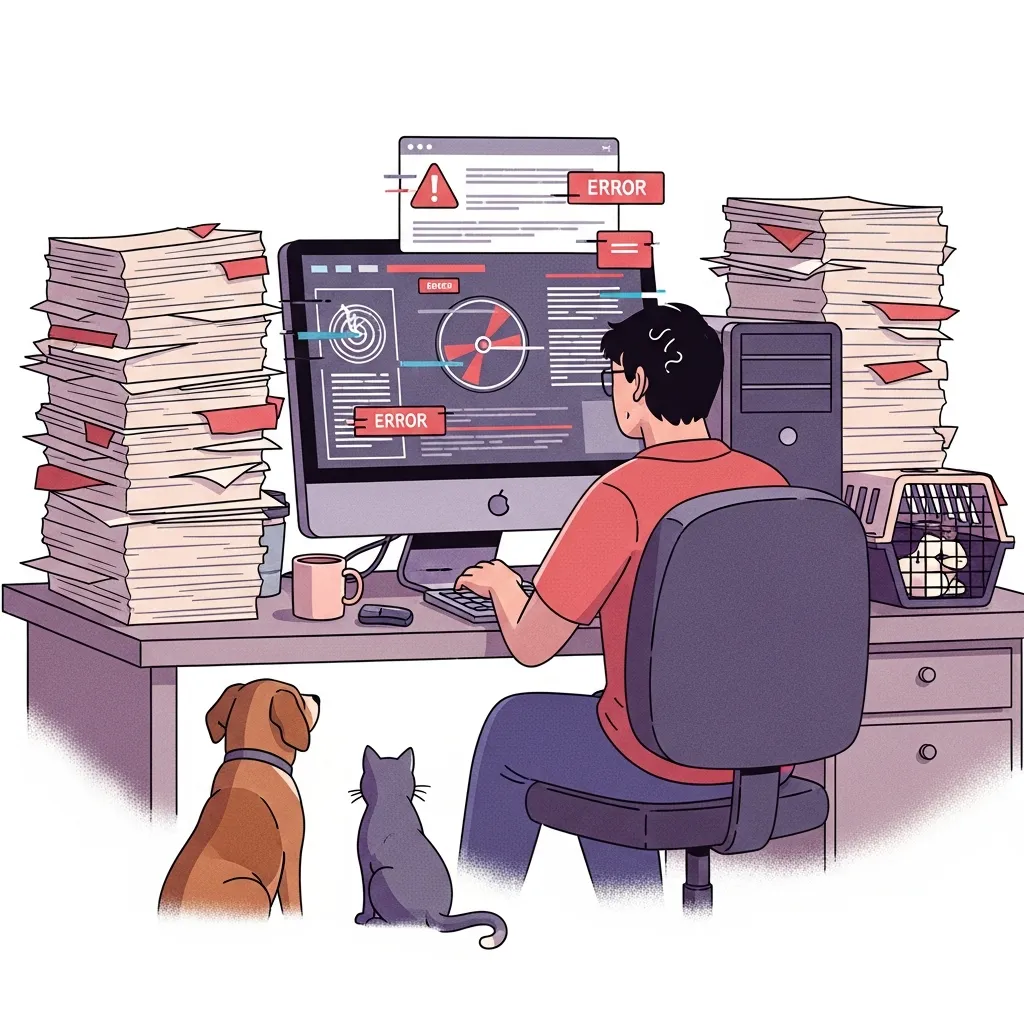
Every shelter director has a story about the morning the software went down. The intake line stretched into the parking lot, the adoption couple in the lobby gave up and left, and someone on staff had to handwrite vaccine records on a clipboard that later, mostly, got typed back in. Then the vendor sent the same one-paragraph apology they sent the last time. Nothing changed.
Glitchy shelter management software doesn't fail in big visible ways. It fails in a thousand small ways that compound — minutes per day, applications per week, donors per quarter, audits per year. The total cost is enormous, and almost none of it shows up on the invoice. Here's the real accounting.
The line-item cost of a glitchy platform
When a shelter pays $200, $400, or $800 a month for software, that's the visible cost. The invisible cost — the actual operating tax that glitchy software puts on a shelter — is almost always 10x to 50x the subscription itself. The categories below are the ones we see most often when shelters migrate to PawMates Pro from a legacy animal shelter ERP.
1. Staff hours lost to workarounds. Every workaround is a recurring tax. The kennel card that prints sideways becomes a daily two-minute trim-and-retape ritual. The intake form that won't save the second page becomes a daily five-minute "save, log out, log back in, retype" ritual. Multiply by every shelter staffer, every day, every year. A shelter with 12 employees doing 15 minutes of workaround-per-day is burning 750+ hours per year — roughly half a full-time position. At a fully loaded $25/hour that's almost $19,000/year in pure friction, before you've adopted a single animal.
2. Lost adoptions during downtime. When the adoption application flow throws an error at submission, a meaningful percentage of those adopters don't try again. They don't email. They don't call. They move to the next listing on Petfinder or to a breeder. Industry benchmark: every minute of public-facing downtime on the adoption flow costs a mid-sized shelter roughly $8 to $40 in deferred-or-lost adoption revenue plus the harder-to-measure pet-welfare cost of an extra week in the kennel. A vendor with three meaningful outages a year costs you a small adoption event every year, with no replacement.
3. Donor trust erosion. When the donation form double-charges, fails silently, or sends a receipt that lists the wrong amount, the donor doesn't email support — they quietly stop giving. Fundraising software for shelters that glitches on the checkout page is the single most expensive bug class in this category, because the customer relationship is asymmetric: one bad receipt cancels three years of monthly giving. We've watched shelters migrate after one Stripe webhook misfire dropped $12,000 of recurring revenue without anyone noticing for six weeks.
4. Audit and compliance exposure. When the audit log skips events, the vaccine register loses entries, or the disposition record is editable without a timestamped change history, the shelter loses the ability to defend itself in a state inspection, a county RFP review, or a bite-history liability claim. The legal cost of one bad audit can wipe out a decade of platform savings.
5. The "we'll just hire a person" trap. Most shelters running glitchy software don't characterize the cost as software cost — they hire a part-time data person to keep the platform sane. That role is the software bill, hidden. A $35,000/year coordinator whose actual job is data hygiene on a broken ERP is a software invoice with a payroll line.
6. Volunteer churn. Volunteers don't quit shelters because of the dogs. They quit because the kiosk crashes in front of an adopter and they're left apologizing. Glitchy volunteer scheduling software and broken kiosk flows are a top-three reason for volunteer attrition in shelters surveyed in 2025-2026.
7. The opportunity cost of features you can't ship. When your vendor's roadmap is three quarters behind because the engineering team is stuck firefighting, every feature your shelter actually needs — better matching, mobile foster check-ins, donor segmentation, dispatch integration — is permanently deferred. Glitchy software doesn't just cost you operations; it costs you the future capabilities you'd have under a vendor that wasn't drowning in tech debt.
What glitchy actually looks like (the symptom list)
If three or more of these are happening on your current platform, you are paying the hidden tax described above. This is the list of the most common rot signals we see when shelters audit their current stack against PawMates Pro.
- Pet records save inconsistently — sometimes a refresh shows the new field, sometimes it doesn't.
- The kennel card or cage card has alignment problems that staff have learned to live with.
- Volunteer scheduling overwrites itself if two people edit the same week.
- Donation receipts get the donor's name wrong, or omit the tax-deductible language.
- The application status page shows "pending" for applications that have actually been approved.
- The mobile app and the desktop dashboard show different counts for the same query.
- Reports take long enough to generate that staff have stopped running them.
- Photo uploads fail on the second attempt and you've trained staff to always upload twice.
- Push notifications arrive hours late, or duplicate.
- The Stripe payout digest doesn't reconcile to the bank deposit and nobody's figured out why.
- A staff change requires a vendor support ticket instead of a self-service settings page.
- The vendor's status page is always green even when you can't log in.
Every line in that list is a real symptom from a real shelter we've onboarded in the last 18 months. None of them are individually catastrophic. All of them, together, are how a shelter loses control of its operations.
Why glitches happen (and why most vendors can't fix them)
The dominant shelter management software products in the U.S. are 15-to-25-year-old codebases built on architectures that predate modern web frameworks, modern testing tools, and modern observability. The companies that own them are not staffed to do the kind of foundational rewrite that would actually fix the rot. Their incentive is to keep the existing customers minimally functional while charging for new modules layered on top of the original mess.
That's why bugs persist for years across version upgrades. That's why support tickets get marked resolved without the bug being fixed. That's why the same five complaints show up on every G2 review thread for the major incumbents. It is not laziness — it is structural. Old codebases on old architectures, owned by companies whose investors are extracting rather than reinvesting, produce glitchy software as a matter of physics.
A new entrant built on a modern stack — typed end-to-end, tested at every meaningful seam, observable with structured logging and audit trails, designed for the actual workflows of intake, foster, kennel, adoption, fundraising, and dispatch — does not produce these symptoms. That's the bet behind PawMates Pro: the only durable fix for glitchy software is a platform that was never glitchy to begin with, built on a stack where fixing one bug doesn't break three others.
What "non-glitchy" looks like in practice
When a shelter migrates from a legacy ERP, here's what changes inside the first 60 days. None of these are aspirational — they're the baseline of a modern, well-built platform.
- Saves are atomic and synchronous. When you press save, the record is saved. The page does not lie about state. If a save fails, the platform tells you exactly why and preserves the data you typed.
- The kennel card prints correctly. Every time. With your shelter's logo, the pet's microchip, the intake date, the vaccine record, and a QR code that goes to the public pet page. The page break is in the right place. It looks like a brand.
- The adoption application flow is end-to-end stable. The applicant fills it out, hits submit, gets a receipt, the shelter gets a push notification, the application appears on the dashboard, the compatibility score is computed within a second.
- Donation flow reconciles to the cent. Every Stripe transaction has a matching record in the donation ledger, every receipt has the right name and amount, every recurring subscription has a single source of truth. The weekly payout digest lands in the bank on the documented day.
- Audit logs are immutable and queryable. Every meaningful change to a pet record, an application, or a donor file has a who, when, what, and old-value-vs-new entry. Inspections become a quiet morning instead of a panic.
- Notifications arrive on time, once. Application approved? One email, one push. Donor disputed a charge? One alert to the right staff member. No duplicates, no silent failures.
- The mobile and desktop views agree. The same record looks the same and contains the same data regardless of where you open it.
- Reports are fast and accurate. Personnel reports, financial KPIs, statistics for board meetings — generated in seconds, formatted as one-click PDFs, not Excel exports your accountant has to clean.
That is the baseline. If your current vendor is not at the baseline on most of these, the cost is not the bug — it is the daily compounding tax described above.
The migration question every director eventually faces
Every shelter director eventually has the conversation internally: "Is this the year we move?" The decision usually goes one of two ways.
The shelters that don't move tell themselves the migration cost is too high. They estimate the staff time, the data export, the parallel-running period, the training, and they decide to absorb another year of the hidden tax. Three years later they have absorbed three years of the hidden tax and the migration cost is exactly the same as it was when they first considered it.
The shelters that do move discover that the migration cost is real but recovers in well under 12 months. The hidden tax stops compounding the day the new system goes live. The lost adoptions stop being lost. The donor reconciliation problem disappears. The data person hired to clean broken records can be redeployed to the work the shelter actually needs.
PawMates Pro ships migration tooling that is built for this — an automated importer for partner-shelter data, multi-section export PDFs for the legacy system's last day, and a transition workflow that runs both systems in parallel for a documented period so nothing falls through the cracks. We've done this migration from Shelterluv, Chameleon, PetPoint, Petstablished, Gingr, Shelter Buddy, Animal Shelter Manager, Pawlytics, RescueGroups, and 24Pet ShelterCare. It is a known, repeatable process — not a science experiment.
Calculating your own hidden tax
Before you make any vendor decision, do the math for your shelter. This is the back-of-the-envelope calculation we walk every prospective shelter through. Fill in your own numbers.
- Staff time lost to workarounds. (Number of staff) x (minutes per day lost to known software issues) x 250 working days x (loaded hourly rate / 60). A shelter of 12 with 15 minutes per day at $25/hour: $18,750/year.
- Lost adoption applications. (Average monthly adoption applications) x (vendor downtime percentage) x (your average lifetime adoption value). A shelter receiving 200 applications/month with 0.5% downtime and a $400 average value: $4,800/year.
- Donor revenue erosion from failed receipts. (Recurring donors) x (annual gift) x (estimated quiet-quit rate after one bad receipt, typically 5-10%). A shelter with 300 recurring $25/month donors at 7% quiet-quit: $6,300/year.
- Hidden data-hygiene headcount. Is there a person on staff whose actual job is software workarounds? That salary is the software bill.
- Audit and compliance risk. This is harder to quantify but real. Reserve a contingency.
- Lost feature velocity. Estimate the value of one feature your vendor has been promising for 18+ months that has not shipped.
Add the rows. Compare to the difference between what you pay today and what a modern shelter platform costs. The math is almost always not close.
What to look for in a non-glitchy vendor
If you are evaluating the best shelter management software 2026 and you want to avoid repeating this cycle, here is the evaluation rubric we recommend. None of these are about features — they're about whether the vendor can actually keep the lights on.
- Publicly visible engineering velocity. Is the platform shipping meaningful changes monthly, or is the changelog a graveyard?
- A real status page that shows real outages. A vendor that has never reported an outage either has zero customers or zero honesty.
- Self-service settings for every routine change. If changing a staff role requires a support ticket, the platform's architecture is wrong.
- End-to-end typing and testing. Ask the vendor what fraction of their codebase is covered by automated tests. The answer separates serious vendors from theater.
- Modern observability. Ask how they would diagnose a customer reporting that "saves are sometimes lost." A serious vendor has an answer involving structured logs and traces; a glitchy vendor has an answer involving "have you tried logging out and back in."
- Modular, transparent pricing. Tier-based pricing aligned to shelter size means the vendor's incentives match yours. PawMates Pro pricing is Starter, Growing, Pro, Large, Enterprise, plus PawMates Rescue tiers (rescue_free and rescue_plus) and the Animal Control module gated to Pro and above. The donation engine has tier-graduated fees: Starter free, Growing 1%, Pro 2%, Large 3%, Enterprise 4%, both Rescue tiers free.
- Integrated medical record continuity. Ask whether the platform can hand a structured medical record to the adopter's new vet. The VetPetz integration on PawMates Pro is the only commercial answer to this question today.
The bottom line
Glitchy software is not annoying. It is expensive. The invoice you see is the smallest line item in the actual cost — staff hours, lost adoptions, donor erosion, audit risk, and deferred features are the real bill, and they compound every quarter you stay on a broken platform.
The fix is not patience. The fix is migration to a platform built on a modern stack where the symptoms above don't exist as a matter of architecture. That is what PawMates Pro is and why the migrations we've run consistently pay back inside 12 months.
The right time to start the conversation is the morning after the next outage. There will be one.
FAQ: shelter software reliability
How much downtime is "normal" for shelter software?
Industry-typical legacy ERPs run 95-98% uptime — that is 7 to 35 hours of unplanned downtime per year, much of it during business hours. A modern platform targets and achieves 99.9% (8 hours/year). The difference between 97% and 99.9% is roughly 250 hours of operational chaos per year for a single-shift shelter.
Won't migration be just as painful as the bugs?
Migration is finite and front-loaded. Glitchy software is infinite and compounding. The migration cost in real shelter dollars is almost always under 90 days of the hidden tax described above. PawMates Pro ships an automated importer for partner-shelter data and runs the old and new system in parallel during the cutover.
How do I know if my vendor's bugs are normal or a sign to switch?
If three or more symptoms from the list above are present, your platform is past the threshold. If your vendor's promised fixes are 6+ months overdue, your platform is past the threshold. If you've hired a person to do data hygiene, your platform is past the threshold.
What's the smallest shelter that can justify a switch to PawMates Pro?
The Rescue Free tier is $0/month for foster-first rescues, and kennel shelter plans start at $149/month (Starter). There is no minimum size — there is a maximum tolerance for friction, and most directors find theirs faster than they expected.
What's the largest shelter you've migrated?
The Enterprise tier is designed for multi-site county and regional shelter networks with Animal Control contracts. Migration scope and timeline scale predictably with shelter size.
For the financial argument, see PawMates Pro - Eliminate Admin Bottlenecks. For the platform strategy, see Why VetPetz and PawMates Pro Are on Track to Dominate the Market. More on the PawMates shelter blog.