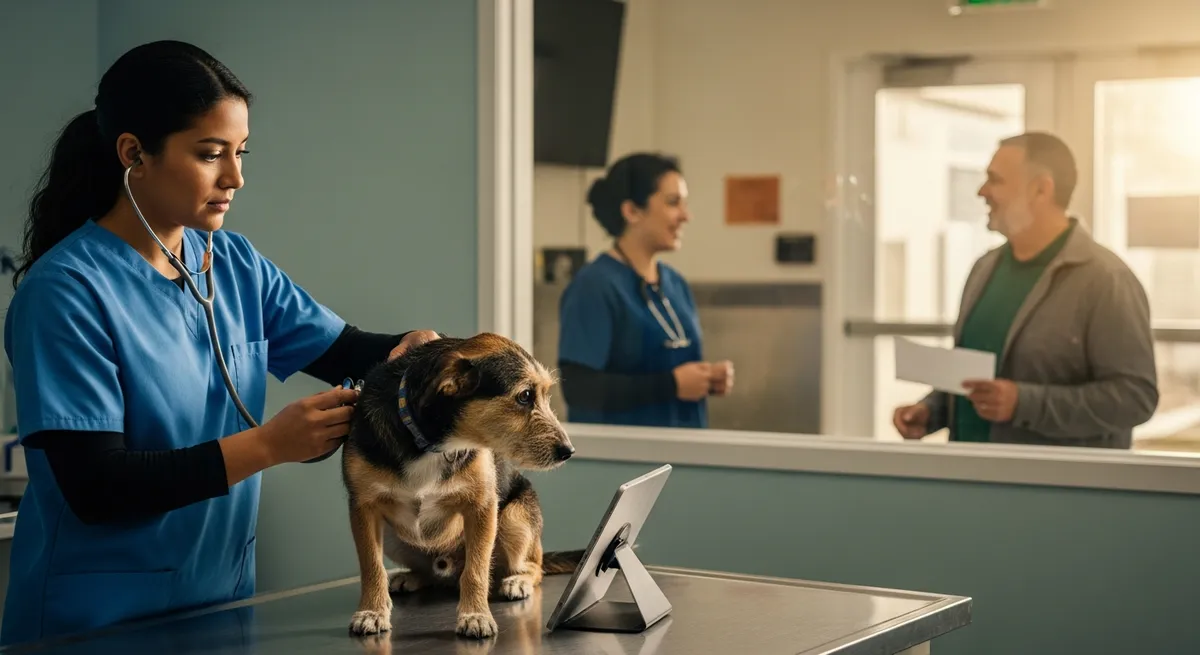
Most shelter software draws a hard line between "operations" (intake, kennel management, medical, adoptions, returns) and "fundraising" (campaigns, donations, donors, events). On the org chart, those are different departments. In the actual life of an animal, they are the same workflow — and pretending otherwise costs shelters money, time, and adoptions.
The complete shelter workflow, from intake to donation, is one continuous process. Connecting it end-to-end is one of the highest-leverage things a shelter can do.
The full workflow, end-to-end
*Intake.* An animal comes in. The intake record captures species, breed, age, source, medical priorities, behavior screening, and bite history. (See PawMates Pro - Reduce Return Rates on why the intake record is the single most important data event in the animal's entire shelter life.)
*Medical and behavioral assessment.* Vet exam, vaccinations, spay/neuter, behavior eval. Costs accrue against the animal's record. Long-stay risk gets flagged early (see How Data Can Predict Long-Stay Animals).
*Marketing and matching.* The animal is published on the PawMates adopter app after import from your shelter website. Compatibility scoring routes applications to the right matches.
*Foster or kennel.* Foster placement happens or doesn't (see How to Match Fosters With the Right Animals). Length of stay starts ticking.
*Application and meet-and-greet.* The funnel runs.
*Adoption.* The animal goes home. The 3-3-3 decompression starts.
*Post-adoption check-ins.* 3 days, 3 weeks, 3 months.
*Donor stewardship loop.* The adopter is now the warmest possible future donor. The donors who supported this animal during their shelter stay get a specific update: "The dog you helped is home." Some convert to recurring givers. Some become peer-to-peer fundraisers for the next animal.
That's the full workflow. In most shelters, it's run across 4–7 different software systems with manual handoffs at every transition. In a unified system, it's one workflow with one record set.
The transitions that break in disconnected systems
The expensive failure points are at the transitions:
- *Intake → fundraising opportunity*. A medically expensive case comes in. The development team finds out three days later via Slack. By then the urgency has cooled. A unified system flags the case for the development team at intake.
- *Adoption → donor outreach*. The adopter walks out the door. The development team gets a CSV export at the end of the month. The first donor ask happens 60 days later, when the warmth has faded. A unified system can trigger the right outreach at the right interval automatically.
- *Donor → adopter conversion*. A monthly recurring donor wants to foster. They have to fill out a foster application from scratch as if they were a stranger. A unified system already has them as a known supporter; the foster application is one click and a few additions.
- *Return → stewardship reset*. An adoption fails. In a disconnected system, the adopter gets removed from the donor list and re-added to a "do not contact" list inappropriately. In a unified system, the return record is part of the relationship history, and stewardship can be handled with the right context.
Why this is now possible
A decade ago, "operational platform" and "fundraising platform" were honestly different software categories with different buyers, different vendors, and different update cycles. That distinction has collapsed. Modern shelter platforms — including PawMates Pro — treat the animal, the adopter, the donor, and the staffer as four roles a person or animal can occupy in one system. The intake form, the campaign page, the adoption application, the donor stewardship note, and the post-adoption check-in are all touchpoints in the same workflow.
When the workflow is one workflow, the shelter operates differently. Decisions get made faster because the data is right there. Staff burnout drops because the work isn't reconciliation. Donors stay engaged because the story is continuous from the day the animal arrived to the day they went home.
For the operational case, see Fixing Bottlenecks That Keep Pets Stuck in Shelters. For the burnout case, see How Automation Reduces Shelter Burnout.