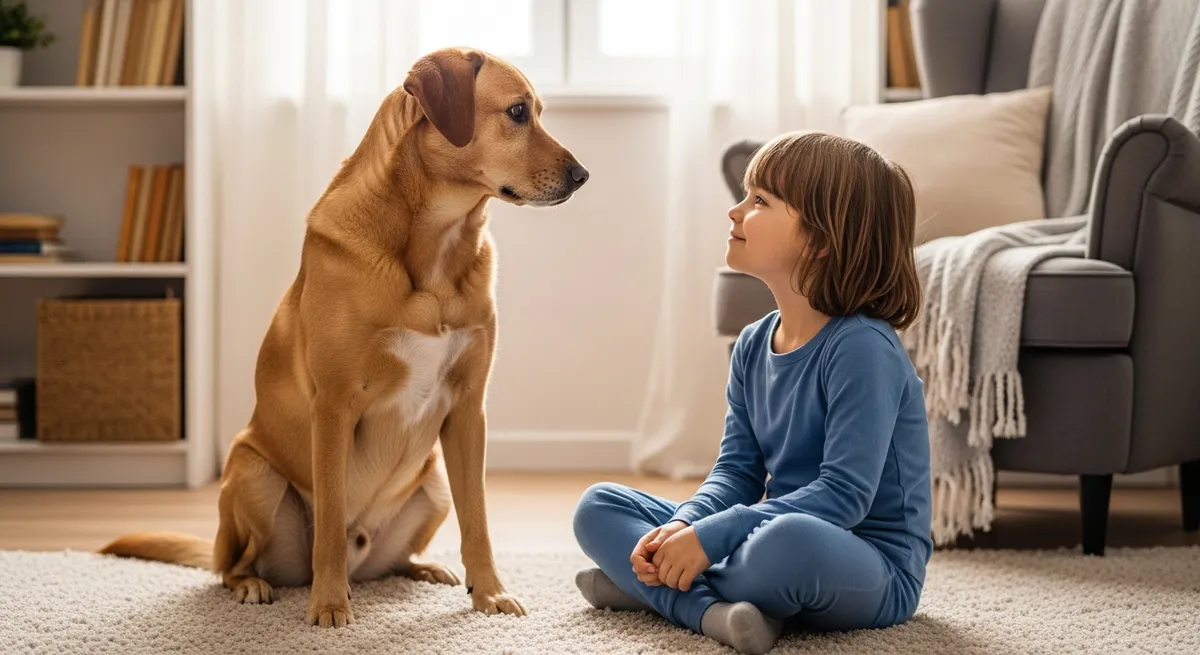
You're scrolling through shelter listings with your family, and you see it on a pet's profile: "Good with kids." Three words that feel like a green light. But what do they actually mean? How was it determined? And should you trust it?
The answer is more complicated than most adopters realize — and understanding what's behind that label can make the difference between a safe, successful adoption and one that goes sideways.
How Shelters Determine "Good With Kids"
There's no standardized test. Every shelter assesses this differently, and some don't formally assess it at all. Here's how that label typically gets applied:
- Owner surrender information. If a pet was surrendered by a family with children, the intake form may note how the pet interacted with kids. This is the most common source — and it's self-reported by the previous owner, who may have a different definition of "good with kids" than you do.
- Foster family observations. Pets that have been in foster care may have been around children. The foster family's notes about those interactions are usually more detailed and reliable than intake forms.
- Behavioral assessment. Some shelters test for handling tolerance — how the pet responds to being grabbed, poked, hugged, or startled. These tests give a rough sense of bite threshold but don't replicate real life with children.
- Staff observation. Shelter staff and volunteers interact with pets daily and develop a general sense of temperament. If a dog is calm, tolerant, and gentle with handling, they may note "good with kids" even without direct child exposure.
What almost never happens: the pet being formally evaluated in a controlled setting with actual children of different ages. That's not practical for most shelters.
What "Good With Kids" Doesn't Mean
Here's what that label does not guarantee:
- It doesn't mean the pet will tolerate everything a child does. A pet that was fine with the previous owner's 10-year-old may not be fine with your 2-year-old who grabs tails and screams.
- It doesn't mean the pet won't be overwhelmed. A calm, tolerant dog can reach a breaking point. Every animal has a threshold, and children are uniquely good at finding it.
- It doesn't mean the pet has been tested with your specific child's behavior. Kids vary enormously — in volume, physicality, unpredictability, and energy. "Good with kids" in one household might mean something completely different in another.
- It doesn't mean no supervision is needed. This is the most dangerous assumption. No pet — regardless of breed, temperament, or label — should be left unsupervised with young children. Period. This is true even for pets evaluated in foster homes where children were present.
Age of Kids Matters Enormously
A pet that's great with a quiet 8-year-old who knows to approach calmly may not be great with a crawling baby who grabs fur and pulls. Shelters rarely differentiate between age groups when they apply the label, but you should.
General guidelines for matching pets with children by age:
- Under 5: Look for pets with documented high tolerance for handling, noise, and unpredictable movement. Cats are generally less tolerant of toddler behavior than dogs. Always supervise.
- Ages 5 to 10: Most pets can adapt well to this age group if the child has been taught basic pet interaction rules — no chasing, no cornering, no taking food or toys.
- Over 10: Most shelter pets can thrive with older kids who understand body language and boundaries. This is the age group where "good with kids" is most likely to mean what you think it means.
Body Language the Label Doesn't Cover
Even a pet labeled "good with kids" will communicate stress before they react. Learning to read those signals is more important than any label on a profile:
In dogs:
- Lip licking when not eating
- Whale eye (showing the whites of the eyes)
- Yawning when not tired
- Turning the head away from the child
- Freezing or becoming very still
- Low tail or tucked tail
- Moving away repeatedly
- Growling (this is a warning, not aggression — never punish a growl)
In cats:
- Flattened ears
- Tail twitching or lashing
- Dilated pupils
- Hissing or swatting
- Leaving the room repeatedly
- Crouching or flattening the body
- Skin rippling along the back
If your pet shows these signals around your children, they're telling you they're uncomfortable. That's not a failure of the pet — it's information you need to act on.
Questions to Ask the Shelter
Before adopting a pet for a household with children, ask:
- Has this pet lived with children before? What ages?
- How does this pet react to loud noises and sudden movements?
- Has this pet ever snapped, growled, or shown avoidance behavior during handling?
- Is there a foster family report available?
- How does this pet behave when startled or cornered?
- Does this pet have any known resource guarding (food, toys, sleeping spots)?
A shelter that can answer these questions in detail is giving you useful information. A shelter that just says "yeah, great with kids" without specifics is guessing — and you should dig deeper.
Setting Up for Success at Home
Even with a pet that truly is great with kids, the home environment needs structure:
- Teach children how to approach the pet — slowly, from the side, with a hand extended for sniffing. Not from above, not from behind, not while the pet is eating or sleeping.
- Create pet-only zones where the animal can retreat and not be followed. A crate, a gated room, a high shelf for cats — somewhere that is always off-limits to children.
- Supervise every interaction until you've had the pet for at least a month and have a clear sense of their comfort level.
- Teach children to recognize stress signals — make it a game, not a lecture.
- Never force interaction. If the pet walks away, the child lets them go. Every time.
The Bottom Line
"Good with kids" is a starting point, not a guarantee. It means someone, at some point, observed positive or neutral interactions between the pet and children. It doesn't mean the pet will be good with your kids, in your home, under all circumstances.
Treat the label as useful information, not a safety certification. If you're bringing a pet into a family for the first time, also read How to Prepare Your Family for an Adopted Pet and Common Mistakes New Pet Owners Make before your adoption day. Ask questions. Observe carefully. Supervise always. And remember that the best kid-friendly pet is one in a home where the adults take responsibility for managing the relationship between child and animal.
How Better Data Leads to Better Matches
The "good with kids" problem is fundamentally a data problem. Shelters often don't have enough information about a pet's history to make confident assessments — and adopters don't always know what questions to ask.
Platforms like PawMates Pro help bridge this gap by structuring the matching process around detailed household information. When an adopter's profile includes the ages of children in the home, the platform can surface pets with documented tolerance for that age group — not just a generic "good with kids" label. Combined with foster reports and behavioral notes that staff can attach to each pet's profile, the result is a more informed match that's safer for kids and less stressful for the pet.
Frequently Asked Questions
Is "good with kids" a guarantee that a pet won't bite?
No. No label, breed, or temperament assessment guarantees a pet will never bite. Every animal has a threshold. "Good with kids" indicates that the pet has shown tolerance and positive interactions with children in previous settings, but it requires ongoing supervision and appropriate child behavior.
What dog breeds are best for families with young children?
Breed alone is a poor predictor of individual temperament. A calm, well-socialized mixed breed may be a far better fit than a purebred known for being "family-friendly." Focus on the individual dog's documented behavior, energy level, and tolerance for handling rather than breed stereotypes.
Should I let my child pick the family pet?
Children can participate in the process, but the final decision should be made by the adults based on compatibility, temperament, and lifestyle fit. A child will almost always pick the cutest or most energetic pet, which may not be the safest or most appropriate match for the household.
At what age can a child be left alone with a pet?
There is no universal age. It depends on the child's maturity, understanding of animal body language, and the pet's individual temperament. As a general guideline, children under 10 should never be left unsupervised with a pet, and even older children should be monitored until the pet-child relationship is well-established.
My pet growled at my child — should I return them?
A growl is a warning, not an attack. It means the pet is uncomfortable and communicating that boundary. Punishing a growl removes the warning and increases the chance of a bite without warning. Instead, separate the pet and child, identify what triggered the discomfort, and adjust the environment. Consult a certified animal behaviorist if growling is frequent or escalating.
Related Articles