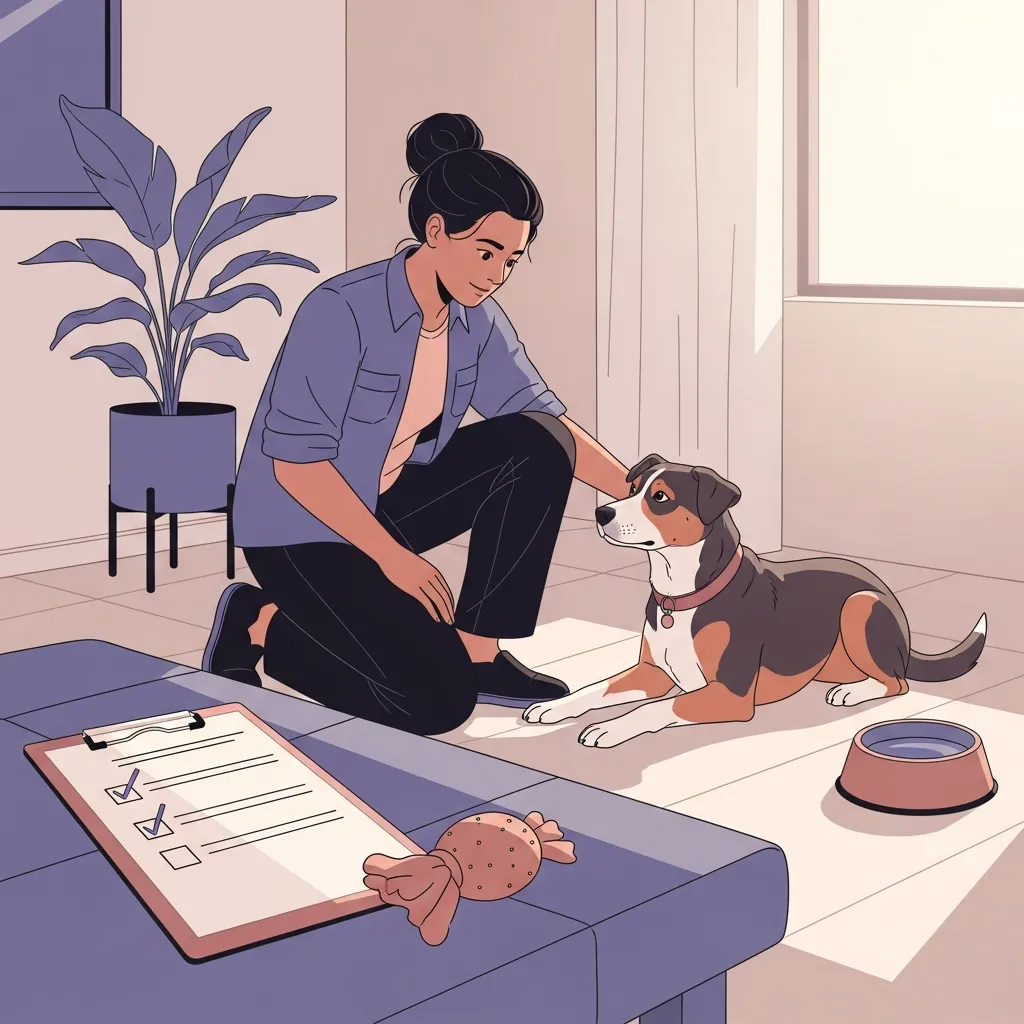
If you've ever browsed shelter dog listings and seen phrases like "passed behavior evaluation," "SAFER-tested," "child-safe certified," or "no resource guarding observed," you've already met the world of shelter behavior evaluations. Most adopters glance at these notes, assume they mean the dog is "approved" or "vetted," and move on. The reality is more interesting, more useful, and — if you understand what these evaluations actually do — much more helpful in choosing a dog who will fit your life.
This post explains what behavior evaluations are, what they can and can't predict, and how to read them like an informed adopter instead of a hopeful one.
What is a behavior evaluation?
A shelter behavior evaluation is a structured assessment, usually 20-45 minutes long, where a trained staff member or volunteer takes a dog through a series of standardized scenarios and records how the dog responds. The scenarios are designed to surface information about the dog's typical reactions to common life situations — being handled, eating with someone nearby, encountering a stranger, meeting another dog, having a toy taken away, hearing a sudden loud noise.
The most widely-used formal protocols are SAFER (developed by the ASPCA), Match-Up II, and Assess-a-Pet. Many shelters use a hybrid of one of these protocols plus their own internal additions, and some use a less formal "in-house behavior profile" that captures the same kinds of observations without a scored rubric.
Whatever the protocol, the output is some combination of three things: a written narrative ("Bella was relaxed during the handling section and eagerly accepted treats from the evaluator"), categorical ratings (low/moderate/high stress response in each scenario), and recommendations ("would do best in a home without small children" or "needs to be the only dog in the household").
What evaluations are actually trying to do
It's important to understand what shelter evaluations are designed for, because they're often misread. They are not personality quizzes. They are not predictions of what the dog will be like in your living room six months from now. They are a structured way for the shelter to gather and share specific behavioral observations made under specific conditions, so you can make a more informed adoption decision.
The closest analogy is a medical history at a doctor's appointment. The history tells you what the doctor observed and what the patient reported, in the conditions of that visit. It doesn't tell you what will happen in the next year. It tells you what the relevant baseline is and what to watch for. A good behavior evaluation works the same way.
What evaluations can predict reasonably well
The research on shelter behavior evaluations — and there's a lot of it now, much of it summarized in How Reliable Are Shelter Behavior Evaluations? — is reasonably encouraging in a narrow set of areas.
Clear, repeated handling tolerance. A dog that allows ear, paw, mouth, and body handling calmly across multiple sessions is very likely to tolerate these things in a home. This matters more than it sounds; routine vet visits and grooming get much easier with handling-tolerant dogs.
General sociability with adult humans. A dog that approaches strangers with a loose body, soft eyes, and a wagging tail in the evaluation environment is very likely to do the same in a home environment — and a dog that consistently retreats, freezes, or stiffens is genuinely communicating discomfort with strangers, which will show up in your home too.
Severe resource guarding. Severe resource guarding (snapping, biting, or sustained hard staring when food or high-value items are present) is one of the things behavior evaluations identify most reliably. If a shelter's evaluation specifically flags severe resource guarding, take it seriously. Mild guarding (a stiffening or quiet growl) is more situational and often improves with training and time.
Obvious comfort or discomfort with other dogs. When a dog meets another dog in a controlled, on-leash introduction and the body language is unambiguous either way, it generalizes reasonably well. Ambiguous responses (interested but tense, polite but distant) are less predictive.
What evaluations cannot predict well
This is the part most adopters don't hear, and it's the most important part.
Behavior in a home environment. A shelter is loud, stressful, full of unfamiliar smells and sounds, and emotionally exhausting for most dogs. A dog who is anxious, withdrawn, or hyperactive in the shelter is often a totally different dog three weeks into a home environment. Conversely, a dog who is calm and focused in the shelter (sometimes because they're shut down from stress) may become more reactive or anxious as they decompress and feel safe enough to show it.
Behavior with children. "Child-safe" testing usually involves a stuffed doll or a brief controlled introduction. Neither generalizes well to a real child who runs, screams, hugs, or grabs. The honest answer for any dog being adopted into a home with young children is "we don't know until we see them together over time, in supervised conditions." Reputable shelters say this out loud.
Behavior with cats and small animals. Without a long supervised assessment in a calm environment, predicting cat-friendliness from a shelter evaluation is a coin flip. Some shelters do better cat tests than others; ask specifically.
Reactivity on leash. Most evaluations don't or can't include a long enough on-leash environmental walk to surface the kinds of triggers (bikes, joggers, other leashed dogs, skateboards) that produce leash reactivity in real-world settings.
Separation behavior. Almost nothing in a typical shelter evaluation predicts whether the dog will tolerate being alone in your apartment for six hours. This is the single most common surprise in the first month post-adoption.
The honest summary: behavior evaluations are good at flagging serious issues that are likely to persist, and good at identifying broad sociability profiles. They are not good at predicting the specific texture of how a dog will fit your specific life. Treat the evaluation as a starting hypothesis, not a verdict.
How to read an evaluation as an informed adopter
When you find a dog you're interested in, here is how to actually use the behavior evaluation in the listing.
1. Read the narrative first, ratings second. The narrative tells you what the evaluator actually saw. The ratings are an abstraction of that. The narrative often contains important nuance ("Bella growled briefly during the food bowl approach but immediately re-engaged when given space") that gets flattened in the rating ("moderate guarding observed"). The texture matters.
2. Note what's missing. If the evaluation doesn't mention cats and you have a cat, that's a question to ask. If it doesn't mention how the dog responds to being left alone, that's a question. If it doesn't mention how the dog responds to children and you have children, that's a question. A good shelter will be honest about what wasn't tested and why.
3. Pay attention to consistency. Most shelters do at least two evaluations a week or two apart. A dog whose behavior was consistent across both is a more predictable adoption candidate than one whose behavior varied significantly. If only one evaluation is mentioned in the listing, ask whether a second was done and what it showed.
4. Look for context, not labels. "Reactive to other dogs" can mean many different things — frustration-based barking, fear-based snapping, prey drive, or play-style mismatch. The label is much less useful than the description. Ask the adoption coordinator to walk you through the specific observations.
5. Treat the evaluation as one source of information, not the only source. The shelter staff who interact with the dog daily — feeding, walking, kennel cleaning — often have much richer information than the formal evaluation captures. Ask them. "What's this dog like on the morning walk?" or "Who is this dog's favorite staff member and why?" will tell you more than the rating sheet.
The two questions worth asking every shelter
When you find a dog you're seriously considering, ask the adoption coordinator these two questions specifically.
"What does this dog do when they're stressed?"
Every dog has a stress response. The honest answers range from "shuts down and tries to hide" to "becomes vocal" to "snaps at the nearest target." None of these are deal-breakers on their own; they're useful information about what to anticipate in the first two weeks at home. A shelter that gives you a real answer is a shelter doing its job. A shelter that says "she's perfect, she never gets stressed" is not.
"What kind of home is this dog NOT a fit for?"
This is the most useful question you can ask. A good adoption coordinator can name two or three home environments that would be a bad match. If the answer is "any home is fine," push gently — every dog has some constraints, and the shelter knowing them is what protects you and the dog from a return.
What about the dog with no behavior evaluation?
You'll find listings without an evaluation, especially at high-volume municipal shelters where capacity outstrips the staff time for formal assessment. This is not automatically a red flag. It often means the dog hasn't been there long enough for a full evaluation, or that the shelter relies on observational notes from daily care rather than a formal protocol.
If you're interested in a dog without a formal evaluation, ask:
- How long has the dog been here?
- What have staff observed in daily care?
- Has the dog had any incidents (snapping, guarding, fence fighting)?
- Has the dog interacted with other dogs at the shelter, and how did that go?
- Would the staff be willing to do an informal handling and sociability check with you present?
A shelter that responds thoughtfully to these questions is giving you better information than a formal evaluation form would.
Why the first two weeks at home matter more than any evaluation
Here's the part adopters most need to internalize. Every behavior evaluation, no matter how good, was conducted in a shelter — which is a high-stress, unfamiliar environment for the dog. The truer behavioral picture emerges in your home, gradually, over the first two to three weeks as the dog decompresses.
This period is so important that experienced trainers and shelter staff almost universally recommend the two-week shutdown approach: keep your new dog's world small and predictable for the first 10-14 days. Same room, same routine, same handler, no visitors, no dog parks, no exciting outings. This isn't deprivation; it's recovery time. A dog who's been overstimulated by months of shelter living needs quiet to remember what calm feels like.
For most dogs, the behaviors you saw in the shelter evaluation will moderate during this period — some hyperactivity will fade, some withdrawal will lift, and the dog's actual personality will begin to surface. Behaviors the evaluation didn't see (separation anxiety, leash reactivity, sound sensitivity) may emerge here, and the shutdown period is the best possible window to recognize and start addressing them gently before they become entrenched.
The full version of the decompression playbook — including week-by-week expectations, what's normal versus what to watch for, and when to call a trainer — is in The Decompression Period: What to Expect in Your New Dog's First Two Weeks Home.
Red flags in evaluations that deserve a serious conversation
Most behavioral observations from a shelter evaluation are workable in a thoughtful adoption. A handful are not, and deserve a real conversation with the adoption coordinator before you commit.
Documented bite history. A bite history (especially one that broke skin or required medical attention) is the single most predictive shelter observation. It doesn't automatically disqualify a dog, but it requires an honest conversation about the circumstances, the trigger, and what kind of home can manage it safely. Reputable shelters disclose bite history explicitly — see How Shelters Should Handle Bite-History Disclosures at Surrender for the disclosure standard.
Severe resource guarding with known triggers. As noted above, severe guarding is one of the more reliably-predicted behaviors. If the evaluation flagged it, that pattern is likely to follow the dog into the home environment unless you have specific training experience.
Predatory behavior toward small animals. Strong predatory chase response to small animals is durable. If you have or plan to have cats, rabbits, chickens, or small dogs, this needs to be a deal-breaker conversation.
Documented child-directed aggression. If a dog has shown aggression specifically toward children — even once — that's a hard constraint for any home with children, regardless of how the dog presents in the evaluation room.
None of these mean a dog is "bad." They mean the dog needs a specific kind of home, and the wrong home will fail both the dog and the humans. The point of disclosing them is to find the right adopter, not to discourage adoption.
The honest reframe
The single most useful reframe for adopters is this: the behavior evaluation is a conversation starter, not an answer key. The dog's actual fit for your home will be determined by the first three weeks at home, the structure you provide, and the patience you bring during decompression — not by a 30-minute assessment in a stressful environment.
Use the evaluation to surface specific questions, identify constraints worth taking seriously, and shape a sensible adoption conversation with the shelter. Then bring the dog home, run the two-week shutdown, and let the actual dog show up.
The bottom line
Behavior evaluations are a useful but limited tool. They're good at flagging severe issues, identifying broad sociability profiles, and surfacing the questions you should ask. They're not good at predicting how a specific dog will fit a specific life. Read the narratives, not just the ratings. Ask the two questions above. Take serious red flags seriously, and treat everything else as the starting point of a relationship that develops over weeks, not a verdict that arrives on day one.
Browse adoptable dogs with full evaluation notes and shelter histories on the PawMates adoption app — the swipe interface shows the same behavior notes the shelter staff see, with the option to ask follow-up questions before you apply.
FAQ: shelter dog behavior evaluations
Are behavior evaluations the same at every shelter?
No. Some use formal scored protocols like SAFER or Match-Up II; some use internal hybrid systems; some rely on observational notes from daily care. All can be useful if the shelter is honest about what they tested and what they didn't. Ask the adoption coordinator which protocol they use and what it covers.
My dog passed the evaluation but is acting differently at home. Did the evaluation fail?
Probably not. The most common explanation is that the shelter environment was suppressing some behaviors (anxiety, reactivity, separation distress) that are now emerging as the dog decompresses. The first two to three weeks are when the real behavioral picture emerges. See The Decompression Period for the playbook.
Should I avoid dogs without a formal evaluation?
No. Many adoptable dogs at high-volume shelters don't have formal evaluations simply because of capacity constraints, not because anything is wrong with them. Ask what the daily-care staff have observed. Often the informal observations are richer than the formal evaluation would be.
What's the most important thing to ask the shelter?
"What kind of home is this dog NOT a fit for?" The shelter knowing the answer is the strongest possible sign they've actually evaluated the dog thoughtfully, and the answer protects you from a return.
How accurate are evaluations at predicting aggression?
Reasonably accurate for severe, repeatable aggression with clear triggers (resource guarding, child-directed aggression with a documented history). Much less accurate for situational reactivity (leash reactivity, fence fighting, fear-based snapping in novel environments). Always ask whether the behavior was repeated across multiple sessions.
For the decompression playbook, see The Decompression Period. For evaluation reliability research, see How Reliable Are Shelter Behavior Evaluations?. For the disclosure standard, see How Shelters Should Handle Bite-History Disclosures at Surrender. More on the PawMates adopter blog.