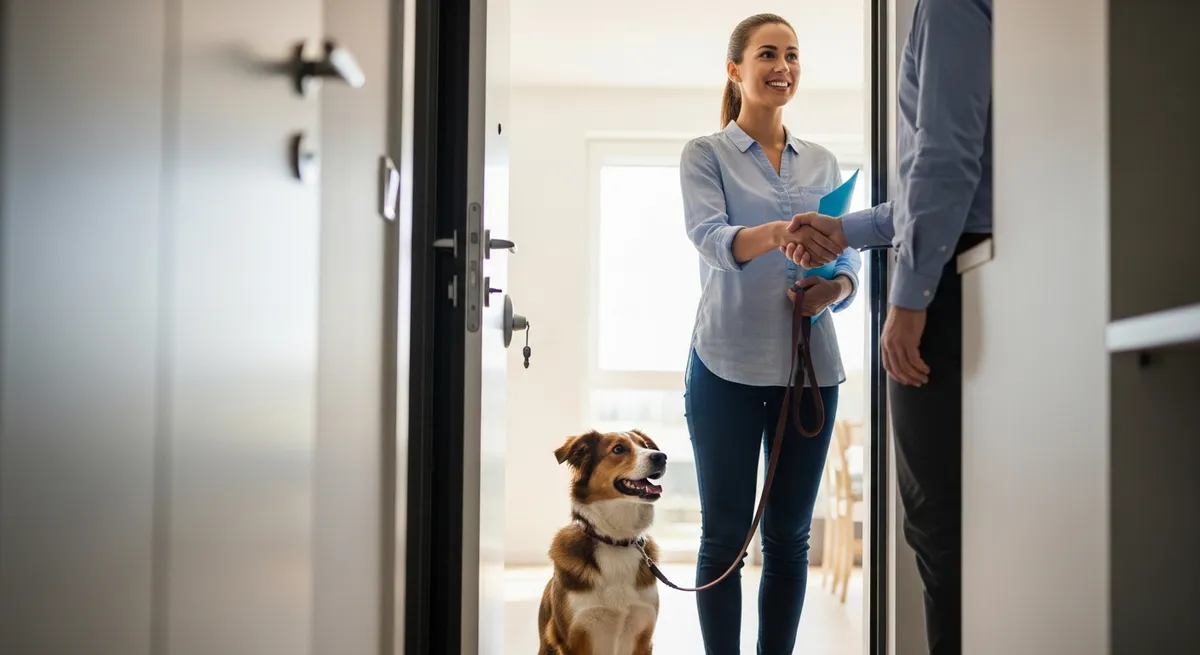
Roughly one in four pet adoption returns is housing-related. The adopter signed the lease without reading the pet clause, the landlord said no after the fact, the building's "okay with pets" policy turned out to mean cats only, the breed restriction was buried on page 14. Almost all of it is preventable — but only if you handle the landlord conversation *before* you fall in love with a specific dog.
If you're a renter trying to adopt, this is the playbook. Used in order, it gets the yes.
Step 1: Read your lease — actually read it — for the pet clause
Before you do anything else, find your lease and read the pet section line by line. You're looking for:
- Allowed? Some leases say "no pets." Some say "no pets without written approval." Some say "pets allowed with deposit." A "no pets" clause is *not* always final — many can be renegotiated, especially in soft rental markets.
- Weight or size limit. Common: under 25 lbs, under 50 lbs, under 75 lbs.
- Breed restrictions. Common restricted lists include "pit bull-type," Rottweilers, Dobermans, German shepherds, huskies, chows, akitas, mastiffs, presa canarios. These often originate from the building's *insurance policy*, not the landlord's preference.
- Number of pets allowed. Many leases cap at one or two.
- Pet rent. Often $25–$75/month per pet.
- Pet deposit. Often refundable, sometimes not. Range $200–$500.
- Notice requirements. Many leases require written notice and approval *before* getting a pet.
- Exotic/aquarium clauses. Less relevant for dogs and cats.
If your lease is silent on pets, that's not automatically permission — most leases default to landlord approval required. Confirm in writing before adopting.
Step 2: Talk to your landlord BEFORE you apply to adopt — not after
This is the step almost every first-time renter-adopter skips, and it's the most important one.
Schedule a 10-minute conversation with your landlord or property manager. Frame it as a request for guidance, not an announcement. Have it in person if possible, on the phone if not, and follow up in writing. Sample script:
> "Hi [landlord], I'm thinking about adopting an adult dog from a local shelter, and I want to make sure I understand the building's policy and your preferences before I move forward. Could I ask a few quick questions?
>
> First, the lease mentions a [weight limit / breed restriction / pet rent] — is there flexibility on that based on the specific dog?
>
> Second, are there any breeds or sizes you've had good or bad experiences with in this building?
>
> Third, what would you need from me to feel confident approving — a vet reference, renters insurance with a pet liability rider, a meet-and-greet with the dog, anything else?"
The benefits of this conversation, in order of importance:
1. You get the real rules, which are often different from the lease language.
2. You get the landlord on your side before they have a yes/no decision in front of them. Landlords who feel consulted approve. Landlords who feel ambushed deny.
3. You learn what kind of dog will get approved, so you can filter your search.
4. You can ask for the approval in writing, which protects both of you.
Get the approval — including any size, breed, or behavioral parameters — *in writing* (email is fine). Adoption coordinators will ask for proof of landlord approval; a forwarded email from your landlord is gold.
Step 3: Build your "Pet Resume" packet
If your landlord is hesitant or wants to vet you more carefully, professionalize your case with a packet. Most adopters never do this; the few who do almost always get approved.
Include:
- A one-page cover letter describing your work schedule, the kind of dog you're considering (size, energy level, age), and your plan for daily care.
- Vet references if you've ever owned pets — name and phone of a previous vet who can vouch for responsible care.
- A renters insurance quote with pet liability coverage ($300,000+ limit). Lemonade, State Farm, and most major carriers offer this for $5–$15/month extra. Many landlords' biggest fear is liability; this neutralizes it.
- Training plan. "I'll work with the dog using positive reinforcement, crate-train for the first month, and enroll in a 6-week group class within 60 days." (Even better if you've already paid for the class.)
- Pet deposit offer (above any required deposit) if you're worried they'll say no — "I'd be willing to put down an additional $300 refundable pet deposit."
- Crate and management plan so they know the dog won't be unsupervised destroying the unit.
- Neighbor letters of support if you live in an apartment building — written notes from immediate neighbors saying they're comfortable with you having a pet often tip the scales.
A landlord who receives this packet sees a tenant who is going to *handle* their dog like an adult. That's almost always who gets the yes.
Step 4: Handle weight and breed restrictions honestly
The weight rule is usually firm. Don't try to pass off a 75-lb dog as 50 lbs — your landlord will see the dog. Apply for dogs that meet the weight limit, plus a small buffer (most "50 lb max" leases will tolerate a 53-lb dog).
Breed restrictions are more negotiable than they look, because most are insurance-driven. Useful moves:
- Ask the landlord whether the restriction is theirs or the insurer's. If it's the insurer's, ask whether they'd allow the breed if you carried renters insurance with sufficient liability coverage *yourself* (which transfers the risk). Many will say yes.
- For mixed-breed dogs that look like restricted breeds: get a written shelter assessment of the dog's behavior and a breed identification (or DNA test if needed). "Mixed-breed, no aggressive history" is what landlords need to see.
- Don't lie about breed. Insurance and HOA exclusions are written broadly enough that calling your pit-mix a "boxer-lab mix" can void coverage at exactly the moment you need it.
If a hard "no" on a specific breed survives all of this, accept it and adopt within the rules. Adopting a dog who can't legally live in your home is a guaranteed return.
Step 5: ESA and service animals — only if it's real
If you have a documented disability and the dog meets the legal definition of an Emotional Support Animal (ESA) or service animal under the Fair Housing Act, your landlord is generally required to allow the animal regardless of pet policy. This is real federal protection.
It's also widely abused, and that abuse is hurting people with legitimate disabilities. Don't pay $50 for a "certificate" online and claim ESA status. Letters must come from a licensed mental health professional with whom you have an actual treatment relationship. Fake ESA documentation is fraud, and many states have made it a misdemeanor.
If you have a real medical or psychiatric need, talk to your physician or therapist. Use the legitimate path. Don't burn the protection for the people who need it.
The PawMates Pro renter advantage
Most adoption applications ask the same housing questions: rent or own? landlord name and phone? how long at your address? — but they ask in messy paper or PDF forms that adopters fill out in pieces over weeks, often missing fields, often unable to remember their landlord's phone number while in the shelter parking lot.
The PawMates Pro Adopter Profile collects all of this up front in your account, so it's filled out *once* and used on every application:
- Living situation (house, apartment, condo, mobile home, other)
- Rent or own
- How long you've lived at your current address
- A "may we contact your landlord?" toggle with landlord name and landlord phone
When you swipe right on a dog and the shelter reviews your application, all of that is already there. The shelter staff doesn't have to chase you for missing landlord info, and the deterministic compatibility score on their dashboard already factors your living situation into the match (apartment dwellers applying for working-line shepherds will see that mismatch flagged, for example). Adopters who fill out this section completely and check "yes" on landlord contact get processed faster — usually because there's nothing missing for the staff to follow up on.
The pre-approval move that changes everything
The smartest renters do steps 1–3 above *before* they swipe on a single dog. Then on PawMates Pro, they set pet preferences for size and energy level that match what their landlord pre-approved (under 50 lbs, medium energy, breed flexibility within limits). The swipe feed only shows them dogs they can legally take home. No falling in love with a 90-lb husky in a 50-lb-max building.
This is a 30-minute exercise that prevents months of disappointment.
Sample landlord conversation script (text version)
If an in-person or phone conversation isn't possible, here's a text or email opener that works:
> Hi [landlord], I'm planning to adopt an adult dog from [shelter name] in the next month or two and want to confirm the pet policy before I get serious about applications. The lease mentions a [weight/breed/deposit clause] — I'd like to make sure I'm shopping for the right kind of dog from the start. Would you be open to a quick call this week to walk through what would and wouldn't work? I have renters insurance with a pet liability rider available, and I'm willing to put down an additional refundable pet deposit if helpful. Thanks for considering it.
The phrase "I want to make sure I'm shopping for the right kind of dog from the start" is the tactical center of the message. It tells the landlord you're not asking for an exception — you're asking for guidance, which is psychologically much easier to give.
Frequently asked questions
*What if my landlord says no?*
Ask why. If it's a specific concern (noise, damage, allergies of other tenants, insurance), see if you can address it. If it's "no pets, period," your options are: respect it and adopt when you move, find a pet-friendly rental, or pursue a legitimate ESA accommodation if you qualify. Don't sneak the pet in — discovered pets break leases and end with the dog returned to the shelter.
*Is verbal landlord approval enough?*
No. Get it in writing. Email is fine. Adoption coordinators routinely call to verify, and verbal agreements get re-litigated when the landlord changes their mind.
*Should I get pet rent and pet deposit terms in writing too?*
Yes. Always. A handshake "$25 a month" can become "$75 plus $500 non-refundable" when the lease renews if it isn't documented.
*What about Section 8 and pet policies?*
Section 8 housing is governed by federal rules; pet policies vary by Public Housing Agency. Check directly with your PHA. Service animals and ESAs have the same federal protection in subsidized housing.
*Can a landlord charge pet rent for a service animal?*
Generally no — service animals and ESAs are not pets under federal law and pet rent/pet deposits cannot be charged for them. (Damage they cause can still be deducted.)
*What if I'm moving soon — should I wait?*
If your move is in the next 60 days, yes. Adopt at the new address, with pet approval baked into the new lease from day one.
For the next layer — finding pet-friendly rentals when your current place won't work — see how to find pet-friendly housing. For the financial picture of adding a pet to a renter's budget, can I afford a pet? is the right read.