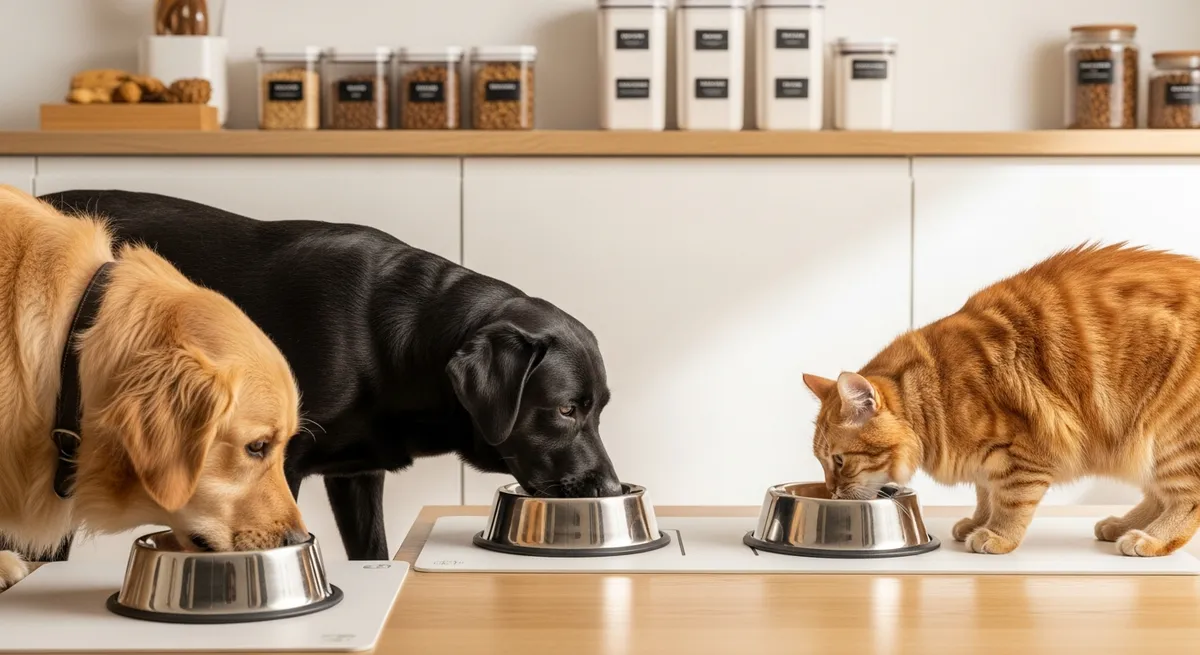
Mealtime in a multi-pet household can either be the calmest part of the day or the most stressful. Two dogs jostling at one bowl, a cat being chased off her food, the slow eater intimidated into giving up half her dinner, the food thief who's gained four pounds since the puppy arrived — every multi-pet home eventually deals with at least one of these.
The good news: feeding multiple pets calmly is not about having more space or more bowls. It's about a few simple structural choices that take chaos off the table before it starts.
Here is exactly how to feed multiple dogs, multiple cats, or a mixed household without the daily wrestling match.
Why Multi-Pet Feeding Goes Sideways
Feeding chaos almost always traces to one or more of these patterns:
- Free-feeding — leaving food out all day for everyone
- Shared bowls — multiple animals eating from the same dish
- Same-room, no separation — bowls placed close together with no defined zones
- Unequal pace — fast eaters finishing first and pressuring slow eaters
- Resource guarding — one animal protecting food from others
- Different diets in the same space — prescription food, weight-management food, or species-specific food becoming a free-for-all
- No routine — meals at unpredictable times, leading to begging, anxiety, and competition
Each of these has a specific fix. Stack the fixes together and your household is calm.
The Foundation: Feed in Zones
The single most important rule of multi-pet feeding is one bowl per animal, in their own zone, every meal.
A "zone" doesn't have to be a separate room. It can be:
- Different corners of the kitchen
- A dog crate (used positively, with the door open or closed)
- A bathroom or laundry room with the door closed
- The other side of a baby gate
- A countertop or shelf (cats only)
- A separate floor of the house
The goal is each animal eating without visual or physical access to anyone else's bowl. This single change resolves the majority of multi-pet feeding stress within a week.
How to Feed Multiple Dogs
1. Switch From Free-Feeding to Scheduled Meals
Free-feeding makes it impossible to track who ate what, manage portions, or detect early illness. Move to two scheduled meals per day at the same times daily. Most adult dogs do well with breakfast and dinner.
Pets who follow a predictable feeding schedule beg less, gain weight more predictably, and show signs of illness earlier (because changes in appetite are visible).
2. Assign Bowls and Locations
Each dog has their own bowl, in their own assigned spot. Don't move it around. Dogs are creatures of routine — knowing exactly where dinner appears reduces the pre-meal anxiety that causes most pushy behavior.
3. Manage the Fast Eater
If one dog wolfs food in 30 seconds and then targets the slow eater's bowl, you have two options:
- Slow-feeder bowl for the fast eater (a maze-style bowl that forces slower eating)
- Closed-door feeding — the fast eater eats in a separate room with the door closed and is only released when the slow eater is finished
The closed-door approach also helps with weight management and prevents resource guarding.
4. Use a Cue, Not a Free-for-All
Teach a "wait" or "sit" before bowls go down. All dogs sit, then food is placed, then a release word (like "okay") tells them to start. This turns mealtime into a calm, structured event instead of a starting gun.
5. Don't Tolerate Bowl-Stalking
When the first dog finishes and walks toward the second dog's bowl, calmly redirect. Many people assume this is harmless. It's the behavior that causes most resource-guarding fights.
How to Feed Multiple Cats
1. Multiple Bowls, Multiple Locations
Cats are not pack animals and do not naturally eat together. Provide one bowl per cat, in different locations, ideally not lined up next to each other.
2. Give Cats Vertical Options
A timid cat may prefer eating on a counter, a shelf, or a cat tree where she can't be approached from below. Use vertical space to your advantage.
3. Switch From Free-Feeding to Meals (Mostly)
Most adult cats do well with two scheduled meals a day, with measured portions. Free-feeding kibble all day is one of the leading contributors to feline obesity, and it makes it impossible to detect appetite changes — one of the earliest signs of illness in cats.
If you have a cat with medical needs that require small frequent meals, work with your vet to design a plan that still allows monitoring.
4. Watch for the Bullied Cat
In multi-cat households, one cat is often quietly being pushed off her food. Signs include:
- Eating only at unusual times (3 a.m., when other cats are asleep)
- Losing weight while other cats gain
- Eating very fast or very small amounts
- Appearing thin even though "everyone has access to food"
Solution: feed the bullied cat in a separate room with the door closed. This is non-negotiable in households where it's happening.
5. Don't Mix Species at the Same Bowl
Dogs eat cat food enthusiastically. Cat food is too high in protein and fat for dogs, can cause GI upset, and means the cat goes hungry. Cats sometimes eat dog food too, which lacks the taurine cats need. Always feed cats and dogs in separate, inaccessible zones.
How to Feed Mixed Households (Cats and Dogs Together)
This is where most chaos happens, because dogs are very motivated to eat cat food.
1. Feed Cats Up High
A countertop, a cat tree with a bowl, a shelf the dog cannot reach. This is the simplest, most reliable solution.
2. Use a Microchip-Activated Feeder for the Cat
Microchip feeders open only when the registered cat approaches. They are an investment ($150–$250) but eliminate cat-food theft entirely and allow free-feeding for the cat without dog access.
3. Pick Up Cat Food Between Meals
If your cat eats scheduled meals, pick up the bowl after 20 minutes whether she finished or not. The dog never gets a chance to access leftovers.
4. Feed Behind a Pet Gate With a Cat-Sized Opening
Gates with a small cutout at the bottom let the cat pass through but block the dog. Place the cat's bowls on the cat-only side of the gate. (For more on cat-dog cohabitation, see The Right Way to Introduce Cats and Dogs.)
5. Be Strict About Litter Box Access Too
Many dogs eat cat litter "leftovers." This is a separate problem with the same solution: put the litter box behind a cat-only gate, in a closet with a cat door, or up on a surface only the cat can reach.
Special Situations
One Pet on a Prescription Diet
If only one pet is on a special diet (urinary, kidney, weight management, allergy), separate feeding is the only safe approach. The other pets eating the prescription food may not be harmful, but the prescribed pet not getting enough of it absolutely is.
Closed-door feeding for at least one of the animals at every meal is the simplest solution.
A Senior Pet With a Younger Pet
Seniors often eat slower and need quiet to digest. Feed them first, in a quiet space, and let them finish without interruption.
A New Adopted Pet With Resident Pets
For the first 2 to 4 weeks, feed the new pet in their sanctuary room (the same room they're decompressing in). This pairs the new environment with positive feeding experiences and avoids early conflict. (For the broader introduction protocol, see How to Introduce a New Pet to Your Existing Pets.)
Resource Guarding That Won't Go Away
Some resource guarding is normal and managed by feeding in zones. Severe resource guarding — growling, snapping, lunging at the approach of a person or another pet near food — needs a certified positive-reinforcement trainer. Don't try to "train it out" by hand or correction; it almost always escalates.
What "Calm Mealtime" Actually Looks Like
When the structure is right, this is what dinner looks like:
- All animals know the schedule and gather calmly 5 minutes before mealtime
- Each animal goes to their assigned spot on cue
- Bowls go down at roughly the same time
- Each animal eats without checking on the others
- Bowls are picked up when finished
- Within 10 minutes, the kitchen is back to normal
If your household is not that yet, it can be in 1 to 2 weeks of consistent structure.
A Quick Multi-Pet Feeding Checklist
- [ ] One bowl per pet
- [ ] One assigned eating zone per pet
- [ ] No visual access between bowls (or as much separation as possible)
- [ ] Scheduled meals, same times every day
- [ ] Slow-feeder bowls for fast eaters in mixed pace households
- [ ] Cat food up high or behind a cat-only gate
- [ ] Bowls picked up after meals (no leftovers grazing)
- [ ] Special diets fed in fully separated rooms
- [ ] Calm cue (sit, wait, release) before bowls go down
- [ ] Adults monitor mealtime for the first two weeks of any change
(For broader new-pet-owner pitfalls beyond feeding, see Common Mistakes New Pet Owners Make (and How to Avoid Them).)
How PawMates Pro Helps
PawMates Pro powers shelters that prepare adopters for real life — including the everyday questions like multi-pet feeding. Our platform supports honest behavioral disclosures (resource guarding, food motivation, eating speed) at the time of adoption, so you bring home a pet with realistic expectations. Post-adoption follow-up workflows are designed to surface exactly these "small" daily questions before they grow into household conflict. Good shelter operations don't end at the front door — they support adopters into the months that follow.
The Bottom Line
Multi-pet feeding chaos is almost never about the pets. It's about the structure. Assign zones, schedule meals, separate species, accommodate special needs, and reward calm. Within two weeks, mealtime stops being something you brace for and becomes the most predictable, peaceful 15 minutes of the day.
Build the system. Stick to it. Let your pets enjoy their meals.
Frequently Asked Questions
Should I free-feed multiple dogs or cats?
For most multi-pet households, no. Free-feeding makes it impossible to monitor portions, detect appetite changes (an early sign of illness), or prevent food theft. Move to two scheduled meals per day at consistent times. The exception is some households with feline-only members where a vet has specifically recommended grazing, ideally paired with portion measurement.
How do I keep my dog from eating the cat's food?
The most reliable solutions are feeding the cat up high (counter, shelf, or cat tree the dog cannot reach), using a microchip-activated feeder, or placing the cat's bowl behind a cat-only gate. Picking up the bowl 20 minutes after meals is also essential — leftover cat food invites theft.
Can I feed two dogs from the same bowl?
No. Shared bowls cause resource guarding, allow one dog to monopolize the food, prevent portion control for each individual, and hide signs of appetite change. Always provide one bowl per dog in separate locations.
Why is my cat losing weight when there's plenty of food?
The most common cause in a multi-cat household is bullying — one cat is being pushed off the food without you noticing. Feed the underweight cat in a separate, closed room and watch for weight changes. If she's eating well and still losing weight, schedule a vet visit; weight loss in cats can also signal medical issues that need attention.
How can I prevent food aggression between my pets?
Feed every pet in their own assigned zone with no visual access to other bowls, pick up bowls when meals are finished, and maintain a calm pre-meal routine (sit, wait, release). Mild resource guarding usually resolves with these structural changes. Severe resource guarding — growling, snapping, lunging — requires a certified positive-reinforcement trainer.
Should I feed dogs before cats or cats before dogs?
Order matters less than separation. Most households find it easier to feed dogs first (because dogs are louder about hunger) and cats second in their own zones. The most important rule is that animals do not see, smell, or compete for each other's food during meals.
How long should I leave food out for my pet?
For scheduled meals, 15 to 20 minutes is plenty for most healthy pets. After that, pick up the bowl until the next meal. This prevents food theft, keeps food fresh, and helps you track each animal's appetite — one of the earliest signals of a health problem.
Related Articles