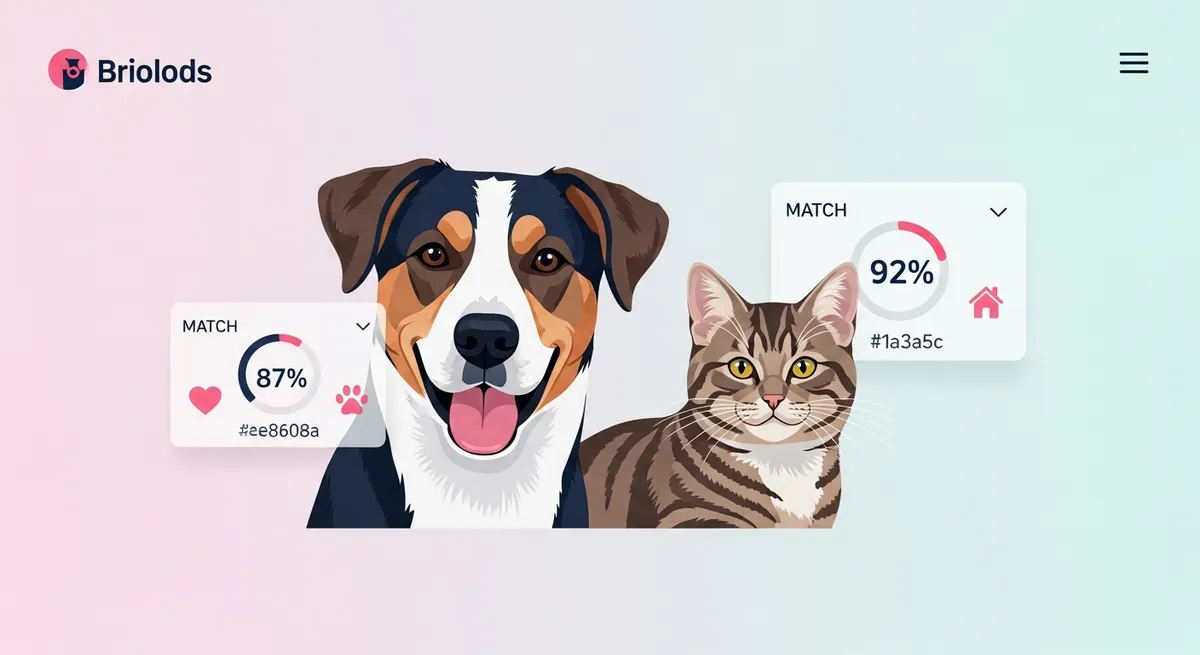
Browsing photos is a poor way to choose a family member. A puppy-eyed picture tells you nothing about whether that dog will tolerate your toddler, ignore your cat, or pace your one-bedroom apartment at 3 a.m. PawMates Pro was built to fix that.
Our matching engine looks past the photo and pairs adopters with pets whose behavior, energy, and history actually fit their life. Here's how it works — and why it leads to adoptions that stick.
The problem with traditional pet adoption
Most adoption sites are essentially online retail. People scroll a grid of cute faces, click "I want this one," and hope for the best. The result is predictable: a meaningful share of dogs are returned to shelters within six months, usually for reasons the adopter could not have known about from a photo — separation anxiety, prey drive toward cats, fear of children, leash reactivity, undisclosed medical needs.
Returns are devastating. They're traumatic for the pet, demoralizing for the adopter, and expensive for the shelter. Most of them are preventable with better information up front, which is why we cover related topics like what to do when a pet has undisclosed medical issues and why you should always ask to see medical records.
What PawMates Pro actually matches on
When an adopter creates a profile, we ask about:
- Their home — apartment vs. house, stairs, yard, fencing, neighbors, climate
- Their household — kids and their ages, other pets, who's home during the day, allergies
- Their lifestyle — hours of exercise they can realistically offer, travel frequency, work-from-home patterns
- Their experience — first-time adopter or seasoned, comfort level with training, willingness to manage medical needs
- What they're hoping for — a hiking buddy, a lap warmer, a kid's best friend, a quiet companion for a senior
We pair that with the structured behavior data shelters enter on every pet using PawMates Pro: temperament assessments, kid/cat/dog tolerance, energy level, training status, medical history, and kennel notes from staff who've spent weeks with the animal. If you're new to shelter tech in general, the adopter's guide to shelter software is a good primer on why this data matters.
The match score on the pet's card — that 87% or 92% — is a transparent calculation across those dimensions. It's not a black box, and it's not telling anyone "this is the only pet for you." It's saying *based on what you've shared and what we know, here are the pets most likely to be a great fit*.
What AI actually does (and doesn't do)
Be skeptical of any company that says "AI" without explaining what it means. Here's the honest breakdown.
What AI does at PawMates Pro:
- Reads shelter notes and extracts structured signals — turning a kennel-card sentence like *"shy first day, warmed up by day three, loves women, nervous around hats"* into tags the matching engine can use.
- Personalizes recommendations over time. If an adopter keeps favoriting calm senior dogs and skipping high-energy puppies, their feed adjusts.
- Helps shelters draft adoption-ready bios so a small team can put 80 pets online with the same care they'd give to 8.
- Flags compatibility risks. The engine warns when an adopter with a toddler is looking at a dog whose intake notes mention resource guarding. (For more on reading dog body language, see our piece on confident dogs vs. anxious ones.)
- Powers post-adoption check-ins at 3 days, 3 weeks, and 3 months, routing any concerns to the shelter so help arrives fast.
What AI does *not* do:
- Decide whether someone is approved. Shelter staff make every adoption decision.
- Replace the meet-and-greet. We strongly encourage in-person time before a commitment.
- Hide pets. Adopters can always browse the full list — match scores are a guide, not a gate.
The post-match part is where it gets really good
Matching is just the start. Once a pet goes home, PawMates Pro stays with the family:
- Day 3: a short check-in asking how the first nights went. If the dog isn't eating or seems terrified, we send a tailored guide and notify the shelter's follow-up team.
- Week 3: a deeper check-in covering training, household integration, and any behavior surprises.
- Month 3: a final check covering long-term adjustment and bond-building.
If anything looks serious — a bite, a return risk, a vet emergency the family can't afford — the system flags it as critical and alerts shelter staff in real time. Early intervention is the single biggest factor in keeping adoptions intact, which is also why low return rates are a top metric in our critical KPIs for animal shelters breakdown.
What this means for everyone
Adopters can stop second-guessing. PawMates Pro is doing the homework most adopters never get to do — surfacing pets that suit them, warning about ones that probably don't, and standing behind the placement for the critical first 90 days.
Shelters get the same thing in reverse: more right-fit applicants, fewer returns, and the data needed to keep improving. To see what that looks like in practice, read a day in the life of a shelter using PawMates Pro.
Either way, the goal is the same: adoptions that last a lifetime. Photos can't promise that. We can.